Description
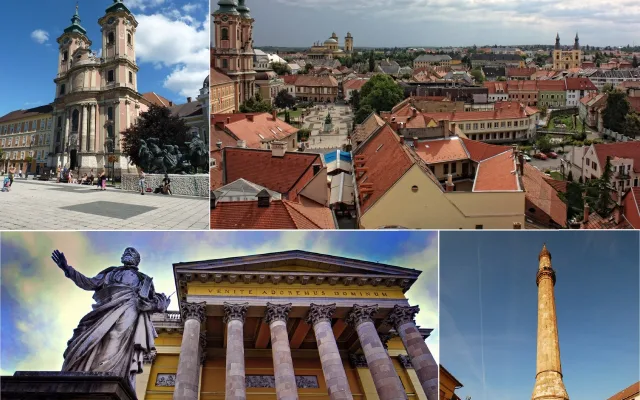
Eger is a city in northern Hungary, set at the foot of the mountains. It is known for its castle that withstood a Turkish siege, the red wine Egri Bikavér ("Bull's Blood"), and its thermal baths.
Wiki
The main historic city of northern Hungary — around 53,000 inhabitants in Heves County, 140 km northeast of Budapest. One of the most atmospheric small cities in Eastern Europe: a Baroque centre, a 13th-century castle, the northernmost Ottoman minaret in Europe (Eger was under Turkish rule 1596–1687), and the Valley of the Beautiful Woman wine district — one of Hungary's principal wine-growing zones and the home of the legendary Egri Bikavér ("Bull's Blood"). The main sights can be covered on foot in a day, but the wineries justify a second night.
Main sights
- Eger Castle (Egri Vár) — the city's main fortress (13th century), famous for the Heroic Defence of 1552, when 2,000 defenders held off an Ottoman army of 80,000. One of the central symbols of Hungarian national identity (Géza Gárdonyi's novel Eclipse of the Crescent Moon is required school reading).
- Eger Minaret (Egri Minaret) — the northernmost surviving Ottoman minaret in Europe (1596–1687), 40 m tall with 97 steps.
- Eger Cathedral (Egri Bazilika) — Hungary's third-largest cathedral, built in the Neoclassical style, 1831–1837.
- Dobó Square (Dobó tér) — the main square, with a statue of István Dobó (commander of the 1552 defence) and the ornate Minorite church.
- Valley of the Beautiful Woman (Szépasszonyvölgy) — the main wine district, 1.5 km from the centre, with around 200 wine cellars carved into tufa rock. The main evening destination in Eger. A glass of Egri Bikavér costs 2–3 EUR (about $2–3).
- Eger Thermal Baths (Bajor Egri Termálfürdő) — Eger's main thermal complex, with 9 pools.
- Eger Lyceum (Egri Főegyházmegyei Könyvtár) — one of the finest Baroque university buildings in Europe (1763), featuring a celebrated ceiling fresco in the library.
- Bükk Hills — Bükk National Park in the Bükk mountains, 30 km away.
- Tokaj — the Tokaji aszú wine region, producing one of the world's great sweet wines, lies 90 km to the northeast.
- Hollókő — a UNESCO World Heritage village 80 km away, a traditional Palóc settlement dating from the 17th–18th centuries.
- Hortobágy National Park — Hungary's largest national park, 100 km away, a UNESCO World Heritage site encompassing the Puszta grasslands.
Food and prices
The local cuisine is Hungarian: gulyás (the national stew), pörkölt (meat braised with paprika), halászlé (fisherman's soup), galuska (dumplings), strudel, lángos. The main local wines are Egri Bikavér (Bull's Blood — a red blend) and Egri Csillag (Star of Eger — a white blend). Lunch at a café costs 8–15 EUR ($9–18), dinner at a restaurant 18–35 EUR ($22–43). A glass of Bikavér is 2–4 EUR ($2–5). A litre of petrol is around 1.50 EUR ($2), a city taxi 4–10 EUR ($5–12), and a local bus ticket 1 EUR ($1). Prices are as of 2026.
Getting there and around
Eger has no airport; the nearest is Budapest (BUD), 140 km away. From Budapest: train, 2 hours, 10–15 EUR ($12–18); Volánbusz coach, 2 hours, 10–12 EUR ($12–15). Around town, the centre is compact enough to explore on foot; taxis are available for longer trips.
When to go
April to October: 12–26 °C. September and October bring the grape harvest and festivals in the Valley of the Beautiful Woman (Szüreti Fesztivál). December has a Christmas market. Winter (December–March) is cold (−5 to +5 °C), though the thermal baths offer good compensation. Summer (July–August) is hot at 28–32 °C.