Description
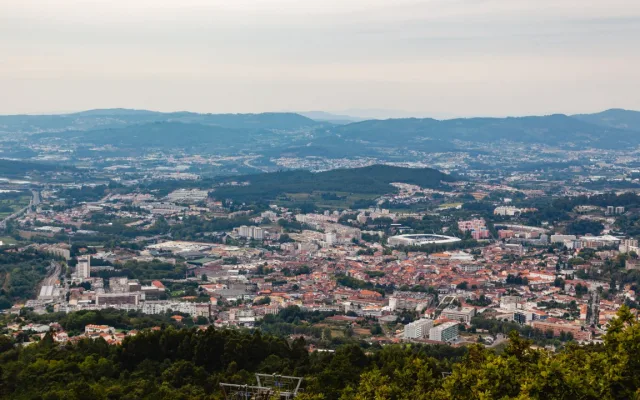
The cradle of Portugal — the city where the nation was born, home to Guimarães Castle, the Palace of the Dukes of Braganza, and atmospheric medieval streets.
Wiki
Guimarães is one of those cities people visit for a single line on a fortress wall: Aqui nasceu Portugal — "Here Portugal was born." The country's first king, Afonso Henriques, was born here in 1110, and it was from here that Portugal began its existence as an independent nation in 1139. The compact historic centre, a UNESCO World Heritage Site, still feels like an authentic medieval stage set — no fakery required.
Is it worth visiting, and for how long?
Guimarães fits perfectly as a day trip from Porto or Braga. The essential highlights — castle, palace, chapel, historic core — are all walkable in 3–4 hours. Add the ascent to Penha and a leisurely lunch and you have a full, satisfying day. Staying overnight makes sense if you want to experience the city in the evening: once the tourist coaches leave, the old squares belong to the locals, and that is the best version of Guimarães.
A realistic one-day itinerary: castle and palace hill in the morning (they are next to each other and work well as a pair), a walk through the historic centre and lunch in the afternoon, then the cable car up to Penha for the panorama before heading back.
What is actually worth seeing
- The Castle and the Chapel of São Miguel — the symbolic birthplace of the nation, though there is not a great deal inside the fortress itself: it is walls and a tower, valued for its symbolism and views. Go for the context and the photo with the famous inscription.
- Palace of the Dukes of Braganza — this is where the entrance fee earns its keep: furnished interiors, tapestries, carved wooden ceilings. The most museum-like sight in the city.
- The historic core — Largo da Oliveira, the Gothic monument Padrão do Salado, stone arcades and a tangle of lanes. This is not a single attraction but the fabric of the city itself — simply wander without a fixed route.
- Penha (617 m) — the cable car takes about 7 minutes, and at the top there is a sanctuary and a sweeping view over the Minho region. On a clear day it is unmissable; in fog there is little point.
- Citânia de Briteiros — an Iron Age hill settlement away from the centre. Of interest to archaeology enthusiasts and those with a car; without your own transport it is more trouble than it is worth.
Getting there and getting around
The nearest airport is Porto (OPO), about 60 km away, served by Ryanair, easyJet, and TAP. The easiest connection is the CP train from Porto: roughly 1 hour 15 minutes and around 4 € each way. Buses run from Braga (about 30 minutes), which is handy if you are combining the two cities in one trip.
Everything in Guimarães is within a kilometre of everything else, and a car in the old town is more hindrance than help — narrow streets, pedestrian zones, and expensive inconvenient parking. If you are visiting for the day, leave the car at a park-and-ride on the edge of the centre and walk in. The only transport you actually need is the cable car to Penha (around 6 € return).
Where to stay
If you are spending the night, base yourself in or right next to the historic core: in the morning you will wake up among the sights, and in the evening you will be in a living city. The area around Largo do Toural and the old squares strikes the best balance of atmosphere and convenience. There is no reason to stay further out — the city is small.
Food and money
The cooking is northern Portuguese, from the Minho tradition: bacalhau (salt cod in dozens of preparations), arroz de pato (duck rice), the ubiquitous francesinha that originated in Porto, and young Vinho Verde — the light, slightly effervescent wine that is very much at home here. Lunch at a tavern runs €10-15 (about $12-17), dinner at a restaurant €20-30 ($23-35), and a glass of vinho verde €2-3 ($2-3). Guimarães feels markedly more affordable than Porto or bigger tourist cities — you get more for the same money, with no premium for being on the tourist trail.
How to save money: order the prato do dia (dish of the day) at local taverns away from the main squares, drink Vinho Verde on tap rather than by the bottle, and view the castle from the outside — only buy a ticket for the palace if time is short.
Prices are as of 2026.
When to go and common mistakes
The best time to visit is from late spring to early autumn, when the cable car runs reliably and cloud cover is less likely to swallow the views from Penha. Summer brings day-trippers from Porto, but the city is large enough not to feel overwhelmed.
Common mistakes independent travellers make:
- Blocking out a full day for the centre alone — half a day is enough; leave time for Penha or nearby Braga.
- Driving into the old town — you will lose time hunting for parking; the train from Porto is simpler and cheaper.
- Skipping the evening — if you are staying the night, Guimarães only truly becomes itself after the tour groups have gone.
- Expecting a grand castle — it is a symbol, not a palace; come for the atmosphere and the history, not the scale.