Description
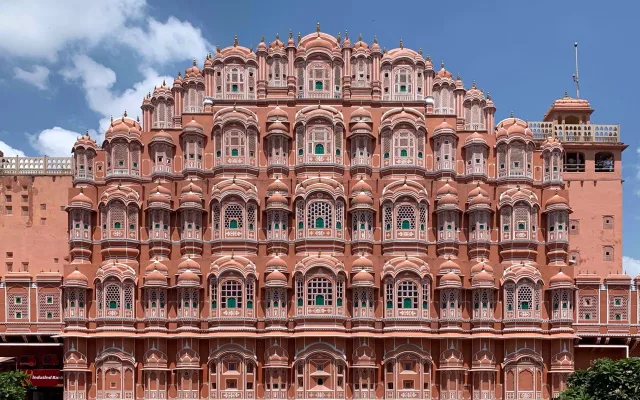
Jaipur is a city in Rajasthan known as the Pink City. Its landmarks include the Hawa Mahal, the Jal Mahal water palace and Amer Fort.
Wiki
Jaipur is the capital of the Indian state of Rajasthan and one of the high points of the Golden Triangle, famous for the terracotta-pink buildings of its old centre. Founded in 1727 by Maharaja Sawai Jai Singh II, it was one of the first cities in India laid out on a strict geometric grid, which still sets it apart from the tangled fabric of most Indian cities.
History and the shape of the city
Jai Singh II, an astronomer and mathematician, laid out Jaipur on the principles of the ancient Shilpa Shastra: nine rectangular blocks, wide straight streets and walls with seven gates. The centre became pink in 1876, when Maharaja Ram Singh ordered the facades painted for the visit of the Prince of Wales, the future Edward VII; in Hindu tradition pink is the colour of hospitality. Residents of the old city have been required to maintain the shade ever since, and the historic centre was inscribed on the UNESCO World Heritage list in 2019. Around four million people live in the metropolitan area today, and the city remains the commercial and craft heart of Rajasthan — cutting gemstones, weaving carpets and hand-block printing textiles.
Palaces and monuments
Beyond the calling card, the Hawa Mahal with its five-storey latticed facade, and the ceremonial City Palace, where the present royal family lives, several places stand out.
- Jal Mahal — the Water Palace in the middle of Man Sagar lake: four of its five storeys are under water, and the building seems to float, at its finest in the morning haze.
- Amer (Amber) Fort — the former capital of the principality, 11 km from the city: terraced courtyards, the Shila Devi temple, and the mirrored Sheesh Mahal where the reflection of a single candle multiplies into thousands.
- Jaigarh — the defensive citadel above Amer, with the giant Jaivana cannon on wheels.
- Nahargarh — the fort on the Aravalli ridge, with a panorama of the whole city at sunset.
- Jantar Mantar — the open-air observatory of colossal stone instruments, including the largest sundial in the world; another UNESCO site.
- The Albert Hall Museum in Ram Niwas garden — a specimen of Indo-Saracenic architecture, with a collection of miniatures, arms and household objects.
Districts and atmosphere
Life boils in the old bazaars within the walls: Johari Bazaar is known for jewellers and gemstones, Bapu Bazaar for textiles, jutti slippers and spices, and Tripolia Bazaar for brass and copperware. Beyond the walls lie the modern quarters — the business district of C-Scheme and the green area around Statue Circle. The white marble Birla Mandir temple complex and Galtaji, the "monkey temple" in a gorge with a cascade of sacred pools, each deserve a visit of their own.
Food
The Rajasthani table took shape in an arid land, so it is heavy on pulses, ghee and spice and light on fresh vegetables. Try dal baati churma (baked bread rolls with lentils and a sweet crumble), gatte ki sabzi, the fiery meat dish laal maas, and crisp snacks. To drink there is thick lassi in clay cups, famously at Lassiwala by the Ajmeri gate. Lunch at a simple dhaba is inexpensive, while a formal thali in a palace restaurant costs considerably more — that is a culinary experience rather than simply a meal.
Three days in Jaipur
- Day 1. The old city on foot: Hawa Mahal, the City Palace, Jantar Mantar and the bazaars within the walls.
- Day 2. The forts outside town — Amer, Jaigarh and Nahargarh, with a stop at Jal Mahal on the way.
- Day 3. Museums and temples: the Albert Hall Museum, Birla Mandir, Galtaji, and shopping for crafts and gemstones.
Practical information
Jaipur International Airport (JAI), 13 km from the centre, is served by IndiGo, Air India and Vistara, with direct links to Dubai and Bangkok. From Delhi the train or the expressway takes about five to six hours. Around the city there are auto-rickshaws, cycle rickshaws, Uber and Ola; for the forts outside town it is easier to hire a car with a driver for the day. The best time to visit is October to March, when the heat drops; in summer the temperature climbs above 40°C, and the rains fall from July to September. Dress modestly for temples and palaces, and treat haggling at the bazaars as the normal, expected part of a purchase.