Description
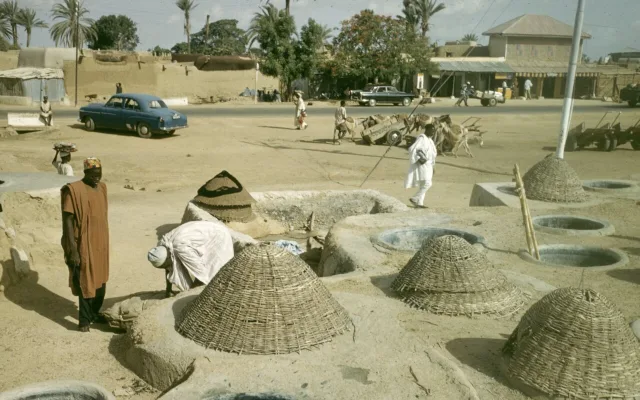
The ancient Hausa capital in the north of the country, living to its own rhythms: mud city walls, the bustling Kurmi Market and the old Kofar Mata dye pits, where cloth has been dyed with indigo for centuries.
Wiki
Kano is the largest city in northern Nigeria and one of the oldest continuously inhabited centres in West Africa. For centuries it was a crucial hub of trans-Saharan trade, and it remains the heart of Hausa culture.
Overview
Kano lies in the savannah zone of the Sahel, in northern Nigeria, and serves as the administrative centre of the state of the same name. By population it is one of the most crowded cities in the country: the metropolitan area numbers several million people. The main population groups are the Hausa and the Fulani, the predominant religion is Islam, and the spoken language of the streets is Hausa, though English is also used in official business. The climate is hot and semi-arid, with a clear division between the rainy season (roughly June to September) and a long dry period, when the dusty harmattan wind blows in from the Sahara.
History
The origins of Kano are placed in the early medieval period: the settlement took shape around Dala Hill, where by tradition iron was mined and worked. In time the city became one of the so-called Hausa city-states and acquired powerful defensive works. Caravan routes passed through Kano linking tropical Africa with the Maghreb and the Mediterranean: leather, cloth, kola nuts and slaves went north, and salt, horses and luxury goods came back.
At the beginning of the 19th century the region became part of the Sokoto Caliphate, and by the start of the 20th century it had been subdued by the British and incorporated into the Protectorate of Northern Nigeria. The colonial era and the arrival of the railway consolidated the city's role as a trading and craft centre, especially in the production and processing of groundnuts, whose famous "pyramids" of sacks were long a symbol of the local economy.
What to see
- The city walls of Kano. Ancient mud fortifications that once encircled the old city in a ring tens of kilometres long with several gates (kofar). Substantial stretches of the ramparts survive today, giving a sense of the scale of the medieval fortifications.
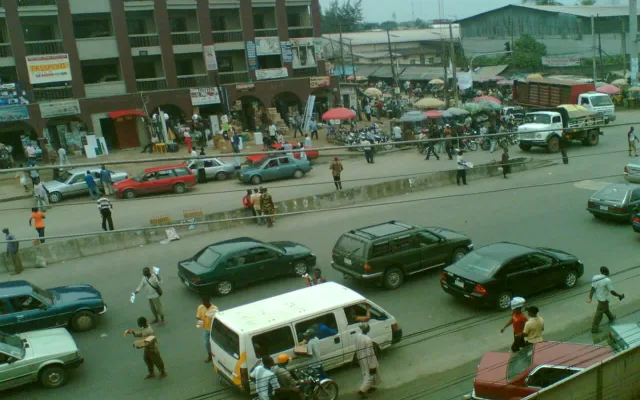
- Kurmi Market. One of the oldest markets in West Africa, founded in the heyday of the caravan trade. It is a labyrinth of trading rows selling cloth, leatherwork, brass and beadwork, spices and traditional crafts.
- The Kofar Mata dye pits. A complex of ancient indigo pits where cloth is dyed a deep blue by a centuries-old technique. It is considered one of the oldest working dyeing operations of its kind in Africa.
- The Emir's Palace (Gidan Rumfa). The residence of the traditional ruler of Kano, an extensive palace complex in the mud-built Sudano-Sahelian style.
- Kano Central Mosque. A large place of worship in the heart of the city and one of its main landmarks.
- Dala Hill and the Gidan Makama Museum. The historic site of the city's founding, and an ethnographic museum housed in an old building, with displays on Hausa culture.
Culture and food
Kano is a stronghold of traditional Hausa culture: crafts, music, oral poetry and court ceremonial. Particularly spectacular is the Durbar festival, timed to the Muslim celebrations: a mounted procession of horsemen in bright dress paying homage to the Emir. Local craftsmen are renowned for leatherworking (historic "Morocco leather" often originated here), weaving, embroidery and metal chasing.
The cooking of the north is filling and spiced. Worth trying are suya — spicy meat skewers with a peanut seasoning — tuwo and fura made from grain, porridges and thick soups based on millet and sorghum, and soups with leafy greens. Kola nuts are widespread, and among drinks, tea and Fulani dairy products. A meal at a local eating house costs 1,500-3,000 naira (about $1-2), a portion of suya 1,500-2,500 naira, a taxi across town 2,000-4,000 naira ($1.50-3), and a night in a decent hotel 40,000-80,000 naira ($30-60). Prices are as of 2026.
Practical information
It is sensible to allow about two days for a visit to Kano: enough to see the old city with its walls and gates, linger at Kurmi Market, and see the dye pits, the Emir's Palace and the Gidan Makama Museum.
- Getting there. The city is served by Malam Aminu Kano International Airport, with flights within the country and to a number of destinations abroad. Kano is linked by road and by a railway line to other regions of Nigeria.
- When to go. The dry season is the most comfortable; at the height of the harmattan there may be a dusty haze, but there is none of the exhausting humidity.
- Things to bear in mind. Kano is a conservative Muslim city, so modest dress is appropriate, especially for women; local customs and prayer times should be respected. Northern Nigeria is a difficult region and many governments advise against travel to certain states, so check your own foreign ministry's current advice before you plan anything. Yellow fever vaccination is compulsory for entry to Nigeria, and the certificate is worth arranging well in advance. Cash (naira) will be needed at the markets, where haggling is customary.