Description
A small town at the foot of Arenal Volcano — hot springs, a waterfall, and suspension bridges in the cloud forest.
Wiki
La Fortuna is a small town in northern Costa Rica, on the eastern slopes of Arenal Volcano, and has become one of the country's top nature destinations. Visitors come for thermal springs, waterfalls, white-water rafting, and walks through tropical forest; the town itself makes a convenient base for day trips in every direction.
Geography and Arenal Volcano
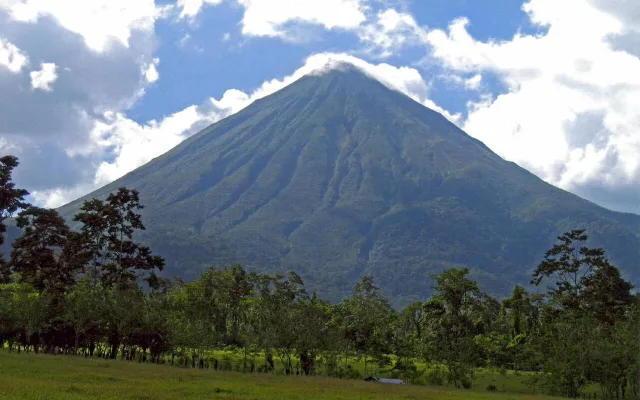
The town lies in Alajuela Province, within the canton of San Carlos, at an elevation of around 350 metres above sea level. The landscape is dominated by Arenal Volcano — a nearly perfect cone rising roughly 1,670 metres. For decades it was considered one of the most active volcanoes in the world: after a powerful eruption in 1968 it continued to throw out lava and ash for years, and at night glowing flows were visible from hotel terraces. Since 2010 Arenal has been in a resting phase, but it remains a protected area within the national park of the same name.
At its foot spreads Lake Arenal — the country's largest body of water, created when a hydroelectric dam was built. It supplies a significant share of Costa Rica's electricity and is popular with windsurfers thanks to its reliable winds.
Arenal National Park
The park, part of the Arenal-Tilarán conservation zone, covers the volcano's slopes and its solidified lava fields. Trails of varying difficulty cross the park: some routes lead through secondary forest to viewpoints looking up at the crater, while others wind across the rocky flows of past eruptions. The vegetation shelters sloths, coatis, howler monkeys, toucans, and dozens of hummingbird species. The flora is typical of wet tropics: giant ferns, lianas, orchids, and bromeliads.
Hot Springs
The volcano's geothermal activity feeds numerous thermal complexes along the road towards the nearby village of El Castillo. Mineral water heated by volcanic processes fills cascading natural and developed pools ranging from warm to very hot. Options run from large resort complexes with swimming pools, artificial waterfalls, and poolside bars, to free wild streams where locals come to relax in the evenings. Soaking in the thermal waters is practically a non-negotiable part of any visit.
La Fortuna Waterfall
A few kilometres from the centre, a gorge cut through dense forest holds the Catarata La Fortuna, a waterfall dropping around 70 metres. A steep staircase of several hundred steps leads to the base, where a cool pool forms and swimming is permitted. The spot is surrounded by lush vegetation and ranks among the most photographed sights in the area.
Suspension Bridges and Cloud Forest
To the west of town, closer to the mountain passes, the landscape gives way to cloud forest — evergreen growth perpetually wrapped in mist. Trails here are strung with suspension bridges thrown across the forest canopy, letting visitors look down into the upper jungle layer from above. Zip-lining, naturalist walks, and birdwatching are also popular. From this area it is a relatively short journey to the famous Monteverde Reserve.
Outdoor Activities
La Fortuna is the adventure-tourism hub of northern Costa Rica. Operators in the area offer:
- white-water rafting on the Río Balsa and Río Sarapiquí;
- canyoning with rappels alongside waterfalls;
- hiking and horseback riding to lava fields;
- ATV and cycling tours;
- guided trips to the Venado Caves, with underground galleries and stalactites.
Getting There and Getting Around
The easiest connection is from the capital San José: by car or scheduled bus the journey takes around three to four hours. La Fortuna Airport, close to town, handles small regional flights. The climate is humid tropical: the dry season runs roughly from December to April, while the remaining months bring heavy rain — though the forest is at its most vivid and green.
Three days is enough to cover the highlights: the first for the volcano and waterfall, the second for the hot springs and cloud-forest bridges, the third for an active pursuit such as rafting or a trip to the lake. Infrastructure is well developed — accommodation exists at every price point, cafés serve Costa Rican home cooking, and tour agencies are plentiful.
Food
Local food is simple and filling. The staples are rice and black beans (gallo pinto at breakfast, casado at lunch), fresh tropical fruit, corn tortillas, fried plantains, and coffee — something Costa Rica is justifiably proud of. Cafés serve river fish, chicken, and beef with vegetables, and desserts lean on coconut and raw cane sugar.