Description
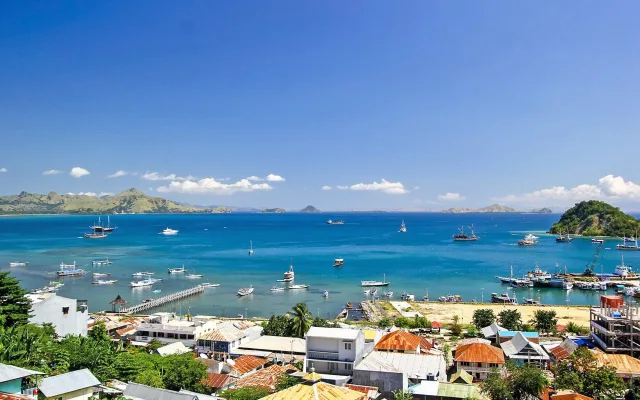
The gateway to Komodo National Park — dragons on Rinca, the Padar viewpoint, Pink Beach and world-class diving.
Wiki
Labuan Bajo is a small port town on the western tip of Flores, in the province of East Nusa Tenggara. Once a quiet fishing harbour of around 12,000 people, it is now the main staging post for travellers heading into Komodo National Park, the only place on earth where the giant monitor lizards live.
History and character
The name translates from the local languages as "the Bugis anchorage", after the seafaring people who long came here to fish. For years the bay was a backwater reached only by backpackers on slow ferries. That changed after Komodo Airport opened its international terminal in 2015: direct flights from Bali, Jakarta and Surabaya set off rapid growth. Yacht berths, hillside hotels and a waterfront looking out at the sunset over the archipelago followed.
Even so, there is not much resort polish yet. The town is strung along one main street running down to the port, and it keeps the feel of a last outpost before the open sea. Most one-day and multi-day boat trips leave from here on traditional wooden phinisi.
Komodo National Park
The heart of the region is the park, a UNESCO World Heritage Site and one of the "new seven natural wonders". It takes in three main volcanic islands — Komodo, Rinca and Padar — and around 26 smaller ones.
- The Komodo dragon is the largest living lizard: up to 3 m long and 90 kg in weight. It has venom glands in the lower jaw and can bring down prey the size of a buffalo. A few thousand survive in the wild, almost all of them inside the park.
- Rinca — many guides reckon the reptiles are easier to see here than on Komodo itself: the population is denser and the trails are shorter. Walks are strictly in the company of rangers carrying forked staffs.
- Padar — an uninhabited scrap of land where half an hour up the ridge brings you to what may be the most reproduced view in Indonesia: three bays with sand of different shades meeting in a single frame.
Beaches, reefs and the underwater world
The water around the archipelago is famously clear and rich in life, which makes the region one of the world capitals of diving and snorkelling.
- Pink Beach — a rare natural effect: the sand takes a soft pink tint from crushed red coral mixed into it.
- Manta Point — a stretch of strong current where manta rays with a wingspan of four to five metres come to feed; swimming alongside them is, for many, the high point of the trip.
- Pulau Kanawa — an uninhabited island with a white beach and a coral garden right off the shore.
- Pulau Kelor and Sebayur — compact stops for a short climb to a viewpoint and for dives over the reefs.
Diving works all year, though visibility and manta activity follow the season; April to June and September to November are traditionally reckoned good for going out on the water.
Inland Flores
Trips beyond the coast open up the other side of the region — mountainous, green and home to the Manggarai people.
- Wae Rebo village — an ethnographic landmark high in the mountains, several hours away by winding road and then on foot. It is famous for its conical mbaru niang houses under palm-leaf roofs.
- Waterfalls and rice terraces in the jungle of the interior make a popular addition to a sea-based programme.
Food
The table combines pan-Indonesian dishes with Flores recipes. Try nasi goreng and mie goreng (fried rice and noodles), sate skewers, and fresh fish and seafood over charcoal (ikan bakar). Coastal places serve the day's catch, and simple cafés with a view of the bay work the waterfront in the evening.
Practicalities
- Getting there. The main route is by air into Komodo Airport, usually connecting through Bali (Denpasar). Sea connections exist, but flying saves a great deal of time.
- How long to allow. Around four days is about right: one or two for boat trips to the dragons and the reefs, another day or two for Padar, snorkelling and a run inland on Flores.
- What to know. Park entry is charged, and movement between the islands is only by boat and with rangers. Bring sun protection, water and your own swimming gear. Cash is useful — there are few ATMs and card acceptance is limited.
Labuan Bajo remains a place where the modern world sits right up against untouched nature: morning coffee at the port and an encounter with a prehistoric predator fit into the same day.