Description
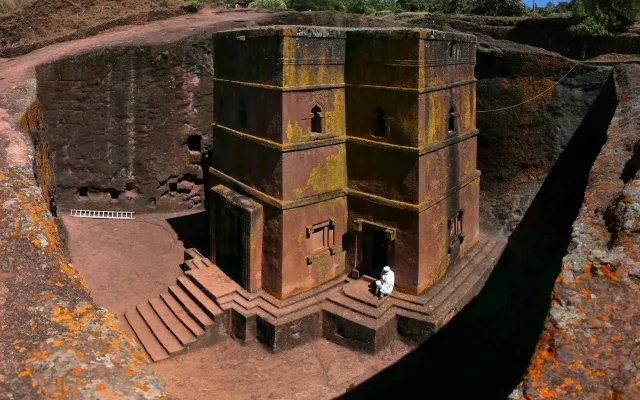
The eighth wonder of the world — eleven monolithic churches cut into rock in the 12th and 13th centuries, and a living place of pilgrimage.
Wiki
An ancient mountain town in northern Ethiopia, in the Amhara region, Lalibela is celebrated as one of the great centres of the Christian world and as a place where faith is literally carved into stone. A small town of around 20,000 people at roughly 2,500 metres above sea level, it receives thousands of pilgrims and travellers each year, come to see eleven monolithic churches cut from volcanic rock eight centuries ago.
History and origins
The complex of rock churches is associated with King Gebre Meskel Lalibela of the Zagwe dynasty, who ruled at the turn of the 12th and 13th centuries; the settlement, formerly called Roha, is named after him. Tradition holds that after the crusaders lost Jerusalem and pilgrimage to the Holy Land became dangerous, the king conceived a "New Jerusalem" in his own country. Many of the place names around echo biblical geography: the river that flows here is called the Jordan, and there is a Golgotha and a tomb of Adam.
The churches were not built from blocks but cut downwards from solid rock: first deep trenches were hewn around the perimeter, separating the future church from the massif, and then the halls, columns, vaults and windows were carved from within. That method makes each structure a single monolith. In 1978 the ensemble was among the first entries on the UNESCO World Heritage list.
The churches
The churches are traditionally divided into two large groups, separated by the bed of the "Jordan", plus the church of St George, which stands apart.
- Bete Giyorgis (St George) — the best known and the most perfect. Shaped as an equal-armed Greek cross, it is sunk some 12 metres into the rock and visible only from above, from the lip of its deep pit. It has become the visual symbol of the whole country.
- The northern group — including Bete Medhane Alem, considered the largest monolithic church in the world with its rows of massive columns, along with Bete Maryam (the church of the Virgin, richly carved and frescoed), Bete Golgotha, Bete Mikael and the Chapel of the Cross.
- The south-eastern group — Bete Amanuel with its finely worked facade, Bete Merkorios, Bete Abba Libanos and Bete Gabriel-Rufael.
The churches are joined by a system of narrow tunnels, covered passages and stairways along which processions of the faithful still move. Inside are ancient crosses, icons and liturgical books; services are conducted in Ge'ez, the liturgical language of the Ethiopian church. Visitors remove their shoes, and shoulders and knees should be covered.
Pilgrimage and festivals
Lalibela remains a living, working spiritual centre rather than an open-air museum. Two occasions draw the greatest numbers of pilgrims:
- Genna (Ethiopian Christmas, 7 January) — night vigils and solemn liturgies, for which thousands converge on the town.
- Timkat (Epiphany, 19 January) — the most spectacular festival, when pilgrims in white shamma robes join processions carrying the tabots, replicas of the Ark of the Covenant.
Dawn at Bete Giyorgis leaves a particular impression, when the first light fills the cross at the bottom of its rock well and worshippers wrapped in white pray along the stone walls.
Around Lalibela
Beyond the town centre stand churches no less interesting. In the mountains, an hour and a half to three hours away, is Yemrehanna Kristos, a cave church built of wood and stone and sheltered beneath the vault of a natural grotto, older than the Lalibela ensemble itself. Nearby stands the monastery of Asheten Maryam, reached by a steep path; the climb is rewarded with a panorama of the town and the highlands around it.
Food
The local food follows the general Ethiopian tradition. The foundation of the table is injera, the slightly sour flatbread of teff, served with a range of wat sauces, spicy meat ones and fasting vegetable ones. Try tibs (fried meat), shiro (spiced chickpea purée) and kitfo (minced beef with spices). An important part of daily life is the coffee ceremony, with the beans roasted and the coffee poured unhurriedly into small cups. On fasting days, of which the Ethiopian calendar has many, vegetarian dishes are made everywhere.
Practical information
Allow about three days: the first for the northern group, the second for the south-eastern group and Bete Giyorgis, the third for the churches out in the mountains. A single entry ticket is valid for several days and covers the whole town complex; a local guide helps with the symbolism and the history. Because of the altitude it is worth avoiding sharp exertion in the first hours, and bringing comfortable shoes for the stony paths and stairways and a hat against the sun. Most people reach Lalibela on a domestic flight to the airport near the town, and the dry season from October to March is considered the most convenient time to come.