Description
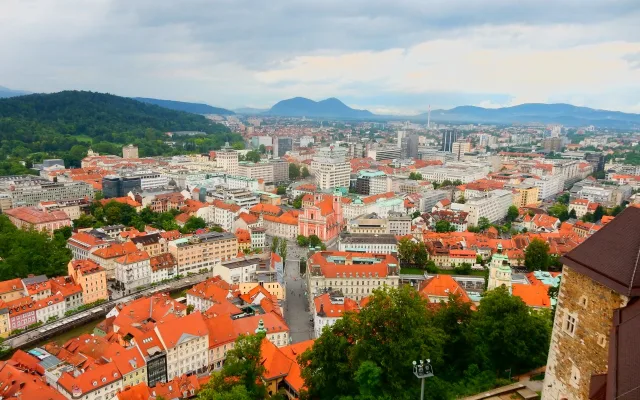
A charming Slovenian capital with a hilltop castle, a pedestrian riverside centre along the Ljubljanica, and a thriving café culture.
Wiki
Ljubljana is a rare example of a capital where everything a visitor needs fits within a half-hour walk along the river. Nobody rushes from sight to sight here — you sit with a coffee by the water, stroll up to the castle, and let the day unfold. Two days is plenty.
Getting there and getting around
Ljubljana's airport (Jože Pučnik / Brnik) is roughly 25 km from the city. A scheduled bus runs to the centre — cheap but slow and timetable-dependent; shuttle minibuses are faster and more practical with luggage, while taxis cost more. Many travellers fly into a nearby major hub — Venice, Zagreb, or Trieste — and continue overland, which often means cheaper tickets.
The bus and train stations sit side by side, a 10-minute walk from the centre. On short hops within Slovenia (Bled, Postojna), buses are generally quicker and more convenient than trains. International routes — Zagreb, Trieste, Venice, Vienna — are covered by FlixBus and local operators.
Within the city, public transport is barely needed. The pedestrian core is closed to cars, and the distances are tiny. City buses (Ljubljanski potniški promet) use the Urbana card, sold and topped up at kiosks; you cannot pay cash on board. In practice, most visitors spend two days and never bother with it.
Cycling is one of the city's signatures. The BicikeLJ rental network has stations across the centre, charges very little, and the first hour is usually free for short trips. With 200+ km of cycle paths and flat terrain, it's a genuine alternative to walking — especially if you're heading to Tivoli Park or Metelkova.
What to see and how long it takes
The real draw in Ljubljana is not individual sights but the fabric of the centre itself: the Ljubljanica embankments, Plečnik's bridges, the arcaded market. A single unhurried day covers it comfortably.
Day 1. Start at Prešeren Square and the Triple Bridge, walk both embankments, visit the Central Market (best in the morning when it's lively), and cross the Dragon Bridge. In the afternoon, head up to Ljubljana Castle — a 15-minute uphill walk or a quick funicular ride. Entry to the grounds is usually free or very cheap; the observation tower and exhibitions are worth the extra ticket. From the hilltop you get the best view over the terracotta rooftops and, on a clear day, the Alps on the horizon.
Day 2. Morning in Tivoli Park and, if contemporary art interests you, the Museum of Modern Art (MSU) or the nearby museums. The afternoon is either a day trip (Bled is an hour away, Postojna Cave and Predjama Castle are close too) or a slower day moving between coffee shops, finishing the evening at Metelkova. By day it looks like a peeling graffiti compound; after dark it turns into bars and clubs — the most unconventional spot in the city.
If museums aren't a priority, honestly the second day is better spent on a day trip: Ljubljana itself is absorbed quickly, and some of Slovenia's most beautiful spots are on its doorstep.
Where to stay
The best base is the centre or within a 10–15-minute walk of it. Anything inside the old town gives maximum atmosphere, though prices are higher and the riverside gets noisy from bars at night. Quieter options lie just beyond: behind the station, towards Tivoli, or around Metelkova (though that area has its own nightlife). Don't bring a car into the centre — parking is expensive and scarce, and the city is not built for driving.
When to go
May–June and September are ideal: warm, green, terraces open, crowds manageable. July and August are hotter and busier, and many locals leave town. December is lovely for the Christmas markets and lit-up embankments. Winter is generally mild but damp and grey — a time to lean into the coffee shops and museums.
Food, coffee and money
Slovenia uses the euro, and prices are noticeably lower than in Western Europe, though the tourist strip along the embankment carries a visible markup. Walk one block back and the same things cost less.
Things to try:
- Štruklji (also žlikrofi for the pasta variety) — local boiled dumplings or rolls filled with curd cheese, simple and filling.
- Kranjska klobasa — the Carniolan sausage, the national classic.
- Jota and ribs — hearty cooking at the meeting point of Alpine and Balkan traditions.
- The market and Open Kitchen — on Friday mornings in warm weather the market hosts street-food stalls from across the country; a great way to eat well and cheaply and sample a lot at once.
Coffee culture here is practically a civic institution. Sitting with a cup on the embankment for an hour or two is perfectly normal — nobody will hurry you along. It may be the city's defining activity.
Ways to save: drink the tap water (excellent quality, free drinking fountains throughout the centre), eat the set lunch (malica) at local restaurants on weekdays, use the bike-share instead of buses, and take the bus rather than a taxi for day trips.
Safety and common mistakes
Ljubljana is one of the safest capitals in Europe — walking around at night is relaxed and comfortable. The main risk is ordinary inattention in tourist-heavy spots.
Things to avoid:
- Overscheduling the city itself. Two full days without leaving town is too much; either trim it to a day and a half, or add Bled or Postojna.
- Expecting to pay cash on the bus — you need an Urbana card.
- Bringing a car into the centre — it's more hindrance than help.
- Arriving on a Monday to visit museums — most are closed, as is common across Europe.