Description
Ancient Thebes on the Nile — Karnak, Luxor Temple and the royal necropolises of the west bank.
Wiki
Luxor is ancient Thebes, a city on both banks of the Nile with arguably the highest concentration of antiquities anywhere in the world. People come for the temples of the pharaohs, the royal tombs, and the particular atmosphere in which the past feels almost physically present.
Background and history
Some 650 km south of Cairo, Luxor grew up on the site of the capital of the New Kingdom (1550–1077 BC). The Greeks called the city Thebes; the Egyptians themselves called it Waset. This was the cult centre of Amun, who became the supreme god of the pantheon. At its height Thebes was the political and religious centre of a powerful state, and its pharaohs poured resources into sanctuaries and into preparing their own tombs.
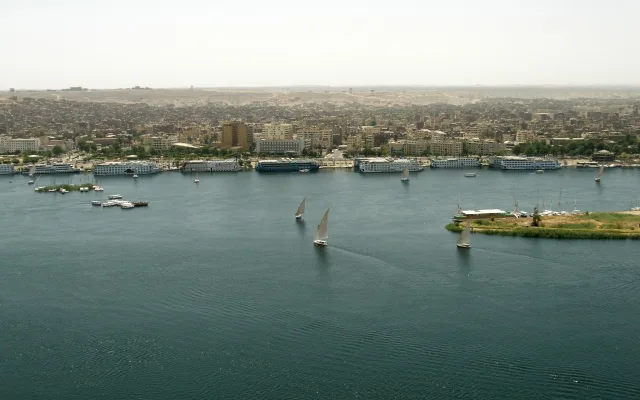
About half a million people live here today. The Nile divides the city into two halves with distinct meanings: the east bank, where the sun rises, belongs to the temples of the living and to everyday urban life, while the west bank, associated with sunset and the world of the dead, is given over to necropolises. The division reflects ancient Egyptian ideas about life and the afterlife.
The east bank: the temples
- Karnak — an immense complex built up over almost two thousand years. Its core is the hypostyle hall of the temple of Amun-Ra with 134 massive columns, some of them 21 m tall. Obelisks, the sacred lake, avenues of ram-headed sphinxes and a succession of pylons survive on the site.
- Luxor Temple stands right in the middle of the modern city. It is dedicated to the Theban triad and is at its most striking after dark, when the lighting comes on. The two sanctuaries are joined by the three-kilometre Avenue of Sphinxes, restored and reopened in 2021.
The west bank: the necropolises
- The Valley of the Kings — a rock-cut necropolis holding more than sixty tombs of New Kingdom rulers. A standard ticket usually opens several of them; the tombs of Tutankhamun, Seti I and Ramesses VI, famous for their painting and relief, are charged separately.
- The Valley of the Queens holds the burials of pharaohs' wives and royal children. The jewel of the complex is the tomb of Nefertari, with exquisite painting; entry is a separate ticket.
- The Temple of Hatshepsut at Deir el-Bahari — a three-tiered structure set into a natural rock amphitheatre, and a rare monument dedicated to a female pharaoh.
- The Colossi of Memnon — two eighteen-metre statues of Amenhotep III, all that remains of his mortuary temple.
- Deir el-Medina — the village of the craftsmen and painters who cut and decorated the royal tombs; their houses and their own small, finely decorated burials survive.
Rounding out the picture are the Luxor Museum, with a beautifully chosen sculpture collection, the Ramesseum, and the temple at Medinet Habu.
Experiences and routes
One of the strongest experiences on offer is a balloon flight over the west bank at dawn, when the first light catches the temples and the fields in the bend of the Nile. River cruises of several nights between Luxor and Aswan are also popular; the boats stop at the temples of Edfu and Kom Ombo along the way.
Food
The cooking is typical of Egypt: cheap koshari of rice, pasta and lentils, ful made from beans, tagen stews and aish flatbread. Fish is served along the Nile, and meals end with strong tea or karkade brewed from hibiscus. Street stalls sit alongside hotel restaurants.
Practicalities
October to April is the best window; summer daytime heat is hard going. See the monuments early in the morning, before the coach groups and the worst of the heat. For three days a sensible split is: day one for Karnak and Luxor Temple on the east bank, day two for the Valley of the Kings, the Temple of Hatshepsut and the Colossi of Memnon, day three for the Valley of the Queens, Deir el-Medina, the museum, or the balloon at dawn. Ferries and taxis run between the banks, and hiring a car with a driver for the day is convenient. Bring a hat, water and cash for entrance tickets and tips.