Description
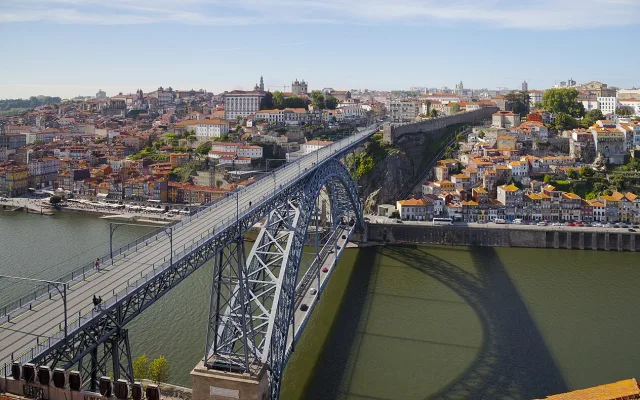
The city of port wine — the Ribeira waterfront, the Gaia cellars and the Livraria Lello bookshop.
Wiki
Porto is the second-largest city in Portugal and the capital of the region of the same name in the north of the country, spread across steep hills at the mouth of the Douro. It is to this city that the country owes its name, and to the world it gave port — the fortified wine that matures in cellars on the far bank of the river.
A little history and general character
A settlement existed on the site of today's Porto as far back as the Roman era, under the name Portus Cale, and from it came the name of Portugal itself. The medieval centre, on the UNESCO World Heritage list, has kept its labyrinth of narrow cobbled streets running down to the water. The city is often called the most atmospheric in the country: there is less ceremonial polish here than in Lisbon, but more of a living, working character. The facades of houses, stations and churches are decorated with azulejos, painted blue-and-white tiles that build up into whole pictures of historical scenes.
Main sights
- The Ribeira — the old waterfront, the heart of the historic quarter. Brightly coloured houses cling to one another, with fish tavernas and cafes on the ground floors, and from the quay there is a view across to Vila Nova de Gaia on the opposite bank.
- The Dom Luís I bridge — a two-level metal arch designed by Théophile Seyrig, a partner of Gustave Eiffel. Metro trains and pedestrians use the upper deck, from which the whole bend of the river is visible; cars use the lower one.
- Livraria Lello — a bookshop of 1906 with a carved wooden staircase and a stained-glass ceiling, one of the most beautiful in the world. Entry is charged (the sum counts towards a book purchase); the queues are long, so it is better to come at opening time.
- The church of São Francisco — Gothic on the outside, and inside covered throughout in gilded baroque carving.
- The Palácio da Bolsa (the stock exchange) — the 19th-century chamber of commerce building with its famous Arab Room, inspired by the Alhambra.
- The cathedral (the Sé) and São Bento station, with its grand azulejo panels in the concourse, are obligatory stops on a walk through the upper town.
- The Clérigos Tower — a baroque bell tower with a panorama of tiled roofs from the top.
Port wine and the Gaia cellars
Across the river, in the district of Vila Nova de Gaia, are the wine houses where port is aged in oak casks: Graham's, Taylor's, Sandeman, Cálem and others. A tour of the cellars usually ends with a tasting. Three main styles are distinguished: Ruby, young and fruity; Tawny, aged, with notes of nuts and caramel; and White, dry or off-dry, often served chilled as an aperitif. Vintage and Late Bottled Vintage are prized separately. A tour with a tasting of several samples is the clearest way to understand the difference between the categories.
Food
Northern cooking is filling and simple. The city's emblem is the francesinha, a many-layered sandwich of meat and sausage under melted cheese and a spicy beer sauce. The bifana, a roll with thinly sliced braised pork, is popular. It is worth trying bacalhau (salt cod) in dozens of variations, rich soups and fresh seafood — prawns, shellfish, octopus. It all goes down with the local vinho verde or, naturally, with port for dessert. Coffee here is cheap and served in almost every cafe.
What to see beyond the centre
- The Crystal Palace gardens and the Douro waterfront — walking areas with views over the river.
- Foz do Douro — the district where the river meets the Atlantic, with a lighthouse and beaches; an old tram runs out here along the water.
- The "six bridges" river cruise takes in the panorama of both banks at once.
Practicalities
From Lisbon the easiest way is the high-speed train — the journey takes about three hours. Francisco Sá Carneiro airport is connected to the centre by a metro line (roughly half an hour). Metro line D crosses the upper deck of the Luís I bridge, which makes the ride itself a small attraction. The historic centre is compact and best seen on foot, but be ready for steep climbs and descents.
A three-day route
- Day 1 — the Ribeira, São Bento station, the Sé cathedral, the church of São Francisco and the Luís I bridge.
- Day 2 — cross to Vila Nova de Gaia, tour the wine cellars with a tasting, and take the waterfront in the evening.
- Day 3 — Livraria Lello, the Clérigos Tower, the Palácio da Bolsa and a trip out to the ocean at Foz.