Description
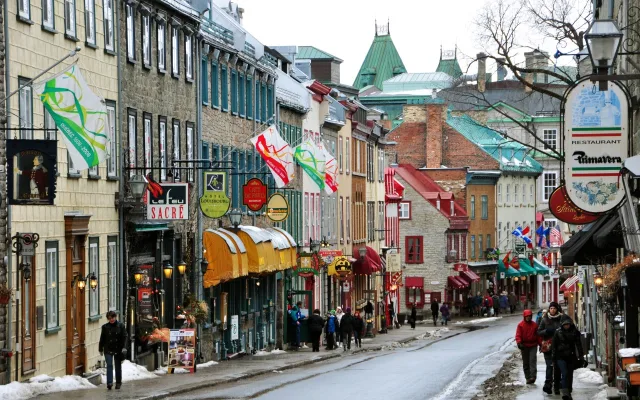
The only walled city north of Mexico with Old World charm in the New World: Château Frontenac, Petit-Champlain and the Winter Carnival.
Wiki
Quebec City is the capital of Quebec province and one of the few cities in North America where European heritage is felt at every turn. Perched on a high cape above the St. Lawrence River, it has kept its ancient fortified walls, narrow cobbled streets and the atmosphere of a French provincial town — qualities that earned its historic core a place on the UNESCO World Heritage List.
History and character
The city was founded in 1608 by French navigator Samuel de Champlain and is considered the oldest French-speaking settlement on the continent. The name comes from the Algonquin word "kebek" — "where the river narrows." Throughout the 17th and 18th centuries Quebec was the capital of New France, until it passed to British control in 1759 following the Battle of the Plains of Abraham. Today around 540,000 people live here, and French is the sole official language; English is understood, but used far less in daily life than in neighbouring Montreal.
Quebec City is the only surviving walled city north of Mexico: stone ramparts roughly 4.6 km long, with gates and bastions, encircle the historic core. The old town is divided into the Upper Town (Haute-Ville) on the cliff and the Lower Town (Basse-Ville) at the water's edge.
Main sights
- Château Frontenac — a grand hotel in the style of a French Renaissance château, opened in 1893 by a railway company. Its silhouette has become the city's trademark and one of the most recognisable buildings in Canada.
- Old Quebec (Vieux-Québec) — the heart of the UNESCO zone. The Upper and Lower Towns are linked by a funicular (funiculaire) and by the steep "Break-Neck Steps" (Escalier Casse-Cou).
- La Citadelle — a star-shaped fortress built by the British in the 1820s–1830s. It is an active military base; in summer the Changing of the Guard ceremony takes place here.
- Place-Royale and the Petit-Champlain quarter — one of the oldest commercial streets on the continent, lined with craft shops, galleries and cafés; at the centre of the square stands the church of Notre-Dame-des-Victoires.
- Dufferin Terrace (Terrasse Dufferin) — a wooden boardwalk along the cliff edge with views over the river and the port.
- Quebec National Assembly building — a Second Empire palace whose façade is decorated with statues of historic figures of the province.
- Plains of Abraham — a large park on the site of the decisive 1759 battle, a favourite spot for walks and public events.
- Musée de la civilisation and the Musée national des beaux-arts du Québec — the region's major cultural institutions, devoted to Indigenous history, fine art and Franco-Canadian heritage.
Day trips
- Montmorency Falls (Chute Montmorency) — a spectacular waterfall at 83 m, higher than Niagara; a suspension bridge spans the top, and stairs and a cable car run along the cliff.
- Île d'Orléans — a rural idyll half an hour away: farms, vineyards, maple sugar shacks (cabanes à sucre) and old parish churches.
- Basilica of Sainte-Anne-de-Beaupré — an important Catholic pilgrimage site to the northeast of the city.
Food
Quebec province is considered the birthplace of poutine — fries topped with cheese curds and gravy. Other things to try: tourtière, a spiced meat pie; pâté chinois, a local layered casserole; split-pea soup; and dishes made with maple syrup. In the winter season, sugar shacks serve traditional farmhouse feasts. Fish and mussel bistros in the Lower Town round out the culinary picture.
Winter Carnival and events
The Quebec Winter Carnival (Carnaval de Québec) is one of the world's largest winter festivals, held each year in late January to early February. The festival's mascot is the snowman Bonhomme, and the programme includes ice sculptures, night parades, canoe races across ice floes and toboggan runs. In summer the city hosts the major music festival Festival d'été de Québec.
Planning your visit
Allow around three days: the first for the Upper Town and the ramparts, the second for the Lower Town and the waterfront, the third for a trip to Montmorency Falls and Île d'Orléans. The compact centre is easy to cover on foot, but be prepared for significant changes in elevation and steep climbs. Winters are genuinely cold and snowy, so warm clothing is essential; summers are mild and ideal for walking. A few words of French will go a long way and add to the atmosphere of the trip.