Description
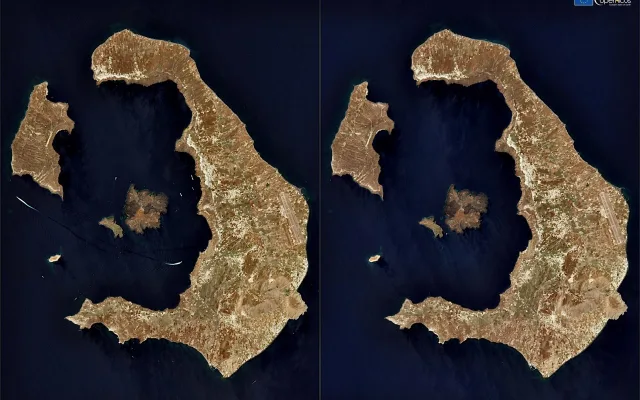
Santorini is known for its white villages perched above the blue caldera, for its volcano and for its spectacular sunsets.
Wiki
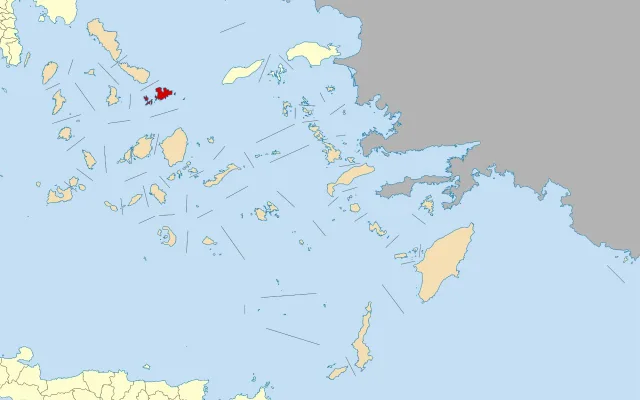
Santorini (Thira) is a volcanic island in the southern Aegean, the southernmost of the Cyclades and one of the great symbols of Greece. Its look — gleaming white villages seemingly glued to the edge of a dark precipice, blue church domes and the endless sheet of sea below — is familiar from millions of postcards and photographs.
Geography and the origin of the island
Santorini has the shape of a crescent curved around a sea-flooded crater, a caldera about 12 km across. This is no accidental bay but the drowned vent of an ancient volcano. Around 1600 BC the Minoan eruption took place here, one of the most violent catastrophes in Mediterranean history. The explosion destroyed the central part of the island, triggered tsunamis and, by a widely held theory, hastened the decline of Minoan civilisation on Crete. The legend of Atlantis is sometimes linked to the same cataclysm.
The sheer western shore faces the caldera and rises 150–300 metres; it is along this rim that the most striking settlements are built. The eastern side, by contrast, slopes gently, with broad beaches and vineyards.
Villages and towns
- Oia — the northern village, considered the most picturesque spot on the island. Narrow lanes, cube-shaped houses, windmills and the famous sunsets, for which people gather at the viewpoints by the ruins of the Venetian fortress long before the sun goes down. The galleries, jewellers and souvenir shops are concentrated here too.
- Fira — the administrative centre, strung out along the rim of the caldera. A cable car runs down from it to the old harbour, as does an ancient path served by donkeys. The town has the Museum of Prehistoric Thera and the Archaeological Museum.
- Imerovigli and Firostefani — quieter settlements between Fira and Oia, with some of the highest viewpoints on the island. Beside Imerovigli rises the Skaros rock, the remains of a medieval fortress.
- Pyrgos and Megalochori — traditional inland villages away from the caldera, which have kept their authentic Cycladic character without the tourist bustle.
What to see
- Akrotiri — the excavation of a Minoan settlement buried under ash and superbly preserved. For its multi-storey houses, frescoes and Bronze Age drainage systems it is called the "Pompeii of the Aegean".
- Ancient Thera — a classical city on the Mesa Vouno mountain, founded by Dorians, with the ruins of temples, an agora and residential quarters.
- Nea Kameni — a young volcanic islet in the middle of the caldera. Boat excursions put travellers ashore for the climb up to the smoking craters; nearby, by the islet of Palea Kameni, warm sulphurous springs well up.
- The beaches — because of the island's volcanic nature the sand here is dark. Kamari and Perissa are covered in black sand and well equipped, while Red Beach near Akrotiri is famous for its red cliffs of hardened lava. There is also White Beach with its pale rocks.
Wine and food
Santorini is a historic wine region. Its flagship is the dry white assyrtiko, made from the grape of the same name: mineral, with pronounced acidity, and a perfect match for seafood. The vines are trained into a basket shape (kouloura), coiled close to the ground to shield the fruit from the desiccating wind and to gather moisture from the mist. Sun-dried grapes go into the sweet dessert wine vinsanto. The local cooking is built on what the volcanic soil gives: sweet cherry tomatoes (hence the famous tomato fritters, domatokeftedes), white aubergines, capers, fava (a puree of split peas), fresh fish and octopus.
Practicalities
You can arrive by sea or by air. Ferries from the Athenian port of Piraeus take from 4 to 8 hours depending on the type of vessel; the flight from Athens takes about 45 minutes, and in summer services from a number of European cities are added. Scheduled KTEL buses and taxis run from the airport and the port into Fira.
The best time is late spring and early autumn (May–June, September–October): warm, but without the exhausting heat and the peak prices. July and August are the most expensive and most crowded season. Three days are enough to catch a sunset in Oia, look around Fira, take the trip to the volcano and the beaches, visit the excavations at Akrotiri and taste the wines. The island is compact, but the roads are narrow and winding — buses, taxis or a hired car are the practical options. Bear in mind that many hotels by the caldera stand on steep slopes with a great many steps.
Photos