Description
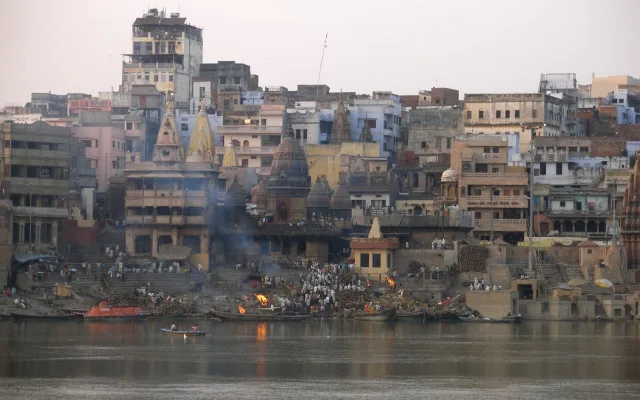
Varanasi is a city on the Ganges, known for its cremation ghats, dawn rituals and the Kashi Vishwanath temple.
Wiki
Varanasi (Benares, Kashi) is the oldest city on the banks of the sacred Ganges and the spiritual heart of Hinduism, where pilgrims come to bathe, to pray and to make their last journey. Religious life is not separated from everyday life here: dawn rituals, funeral pyres and street bustle are woven into a single fabric that astonishes every visitor.
History and significance
Varanasi is counted among the oldest continuously inhabited cities on earth: life on this spot has run unbroken for more than three thousand years, and mythology ties the city's founding to Shiva himself. The name Kashi, "city of light", appears in ancient texts; the Buddha came here, as did medieval saints and the bhakti poets, among them Kabir and Tulsidas, author of the Ramcharitmanas. For Hindus this is one of the seven sacred places that grant liberation (moksha): death and cremation on these banks are believed to break the wheel of rebirth. The city survived destruction under Muslim rulers and subsequent rebuilding, which explains the relatively late architecture of many temples despite the great antiquity of the worship itself.
The ghats and the river
Along the river run 88 ghats, stone stairways descending to the water. Each has its own purpose and character.
- Dashashwamedh — the central and busiest ghat, and the site of the evening Ganga Aarti, the fire service of the priests with oil lamps, conch shells and incense to the chanting of mantras.
- Manikarnika — the principal cremation ghat, where the pyres burn without pause day and night; photographing the processions here is neither done nor permitted, out of respect for the dead.
- Harishchandra — the second cremation ghat, named after the legendary righteous king.
- Assi — the southern end of the waterfront at the confluence with the Assi stream; boats leave from here at dawn, and the place is popular with students and pilgrims.
- Panchganga and Man Mandir — ghats with historic buildings, the observatory of Maharaja Jai Singh and a view along the bend of the river.
A rowing boat at sunrise is an essential part of any visit: out of the morning haze the ochre facades emerge one by one, bells sound, and garlands and floating diya lamps are set on the water.
Temples and shrines
The heart of the city is the Kashi Vishwanath temple, dedicated to Shiva as lord of the universe; its present form with gilded spires took shape in the 18th and 19th centuries, and in 2021 the broad Vishwanath Dham corridor opened, linking the sanctuary to the riverfront. The goddess Annapurna is venerated nearby. Among other sites are the Sankat Mochan temple to the monkey god Hanuman, the modern marble Bharat Mata temple with a relief map of India in place of a statue, and the campus of Banaras Hindu University (BHU) with its New Vishwanath temple. Thirteen kilometres away lies Sarnath, where the Buddha gave his first sermon; the Dhamek stupa survives here, along with monastery ruins, a museum holding the Ashoka lion capital, and a deer park.
The old city and its atmosphere
The maze of narrow lanes behind the ghats is a world of its own: passages a shoulder wide, shops of silk, brassware, garlands and spices, cows in the middle of the street and the smell of incense. Varanasi is famous for weaving Banarasi silk and brocade with gold thread, and for the tradition of dhrupad singing and classical music. Sadhus in saffron, temple bells and the constant movement of pilgrims complete the picture.
Food
The city is strictly vegetarian, and meat and alcohol are rare. Try the local breakfasts — kachori sabzi and chole — along with the various chaats, sweet and salted lassi (Blue Lassi in the old city is known for its many flavours), a thali of several dishes, and milk sweets such as rabri and malaiyo, the winter dessert of sweetened foam. Meals end with a betel leaf, the Banarasi paan of which the city is particularly proud.
Practical information
- Getting there. Lal Bahadur Shastri International Airport (VNS) is about 25 km from the centre, served by IndiGo, Air India and others. Varanasi is a major rail junction: the train from Delhi takes about 10-13 hours, and there are regular services to Agra, Lucknow and Kolkata.
- Getting around. Auto-rickshaws and taxi apps (Uber, Ola) are the easiest options; vehicles do not enter the narrow lanes of the old city, where you walk.
- When to go. The cool months from October to March are best; summer is exhausting, and the monsoon raises the river.
- How long to allow. Three days covers the essentials: a dawn boat and the morning ghats, the evening aarti, the Kashi Vishwanath temple and the lanes of the old city, and a separate trip to Sarnath.
- What to bear in mind. Dress modestly, remove your shoes before entering temples, respect the ban on photography at the cremation ghats, and be ready for dense crowds and persistent boatmen — agree the price in advance.