Description
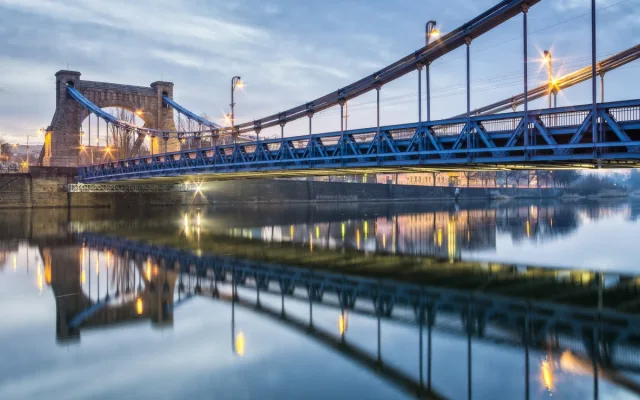
A city of gnomes and Gothic cathedrals spread across the islands of the Oder — the capital of Lower Silesia and one of the most charming places in south-western Poland.
Wiki
Wrocław is one of those places where the "second city" outshines the famous capital: two days are enough to take in Gothic old town, hunt for gnomes, and sit down for a ridiculously cheap lunch at a milk bar. Here is how to get the most out of those days without rushing or overspending.
Why go and what is genuinely worth seeing
Wrocław's greatest asset is its compactness. The entire tourist core is walkable, and the islands on the Oder give the city a pleasant rhythm: a bridge, a riverside promenade, another cathedral.
- Market Square (Rynek) — the natural starting point. A vast square with a Gothic Town Hall at its centre; coffee at the surrounding cafés is a little pricey, but the square itself is free and atmospheric at any hour.
- Cathedral Island (Ostrów Tumski) — the most evocative part of the city. Gas lamps are still lit by hand at dusk — time your visit for twilight and you may catch the lamplighter at work. At the Cathedral of St John the Baptist, a modest entrance fee gets you up the viewing tower for sweeping views of the river's bends.
- Gnomes (Krasnale) — less a sight than an excuse to explore the city with fresh eyes. There are hundreds of them, tucked beside doorways, drainpipes and ATMs. You will spot the first one near the Market Square; after that it is wherever the walk takes you. A great "route" for anyone who has had enough of museums.
- Racławice Panorama — a rare format: a 360-degree painting that merges seamlessly into a three-dimensional foreground. Tickets sell out quickly; book online and arrive for your allocated session.
- Centennial Hall (Hala Stulecia) — a UNESCO-listed feat of engineering on the eastern edge of the centre, close to the Japanese Garden and Szczytnicki Park. Combining all three in a single afternoon on your second day makes obvious sense.
How to structure 2 days
Day 1 — historic centre. Market Square → Salt Square and Flower Market → Old Town churches → Racławice Panorama → Cathedral Island in the evening for the lamp-lighting.
Day 2 — rivers and the east. A morning on the riverbanks and islands, then a tram ride to Centennial Hall, the Japanese Garden and the park. If time allows, swing through the university quarter with its Baroque Leopoldina Aula.
Two days covers the highlights comfortably. If you prefer a slower pace or want a day trip into Lower Silesia (castles, Świdnica), budget a third day.
Getting there and around
From Copernicus Airport, a city bus runs directly to the centre — cheaper than any taxi and with no fare surprises; a night service also operates. Within the city, trams and buses are the backbone; tickets are available at stop machines and on board (coins or a contactless card both work). For one or two journeys buy a single ticket; for an active day a 24-hour pass is better value.
The Nextbike cycle-share scheme works well for the riverside paths and the park near Centennial Hall — the first few minutes are often free if you return the bike on time. The historic centre itself is entirely walkable, and a bicycle there is more hindrance than help.
Trains are one of Poland's strong suits: frequent, reliable services connect Wrocław with Kraków, Warsaw and Poznań. Tickets are significantly cheaper when bought in advance online.
Where to stay
- Old Town / near the Market Square — maximum convenience, everything on foot, but expect bar noise in the evenings.
- Cathedral Island and surroundings — quieter and more picturesque, a little further from the nightlife.
- Nadodrze — a former working-class district to the north, now firmly on trend: street art, independent coffee shops, lower accommodation prices. A good balance of character and budget.
Avoid hotels near the main railway station on the grounds of "easy transport" — the centre is only a 15-minute walk away anyway, and the neighbourhood is far less interesting.
Food and money
Wrocław is noticeably cheaper than Kraków, and you feel it most at mealtimes. The essential backpacker institution is the bar mleczny (milk bar): subsidised canteens serving żurek, dumplings and pork cutlets at bargain prices, sometimes with a charmingly retro interior. Lunch there barely registers as a cost.
Among local specialities, look for Silesian dumplings (kluski śląskie) with gravy, bigos and żurek served in a bread bowl. Prices on the Market Square and at the main tourist spots carry a premium; walk a couple of blocks away and the same dishes are cheaper and often better. Craft beer is a serious culture here — seek out taprooms away from the main square.
When to go and what to watch out for
- Season. May to September is warm and green but busy; late spring and early autumn are ideal. Winter is damp, but the Christmas market on the Market Square is one of the best in Poland.
- Safety. The city is relaxed; the centre is comfortable to walk at night. Standard awareness in crowds and at the station is all that is needed.
- Common mistakes. Do not try to "complete" the gnomes in a single evening — they are background texture to a walk, not a race. Agree on a fare before taking a taxi from the airport. And do not reduce your visit to the Market Square alone: the islands and Nadodrze show you what Wrocław is really like.