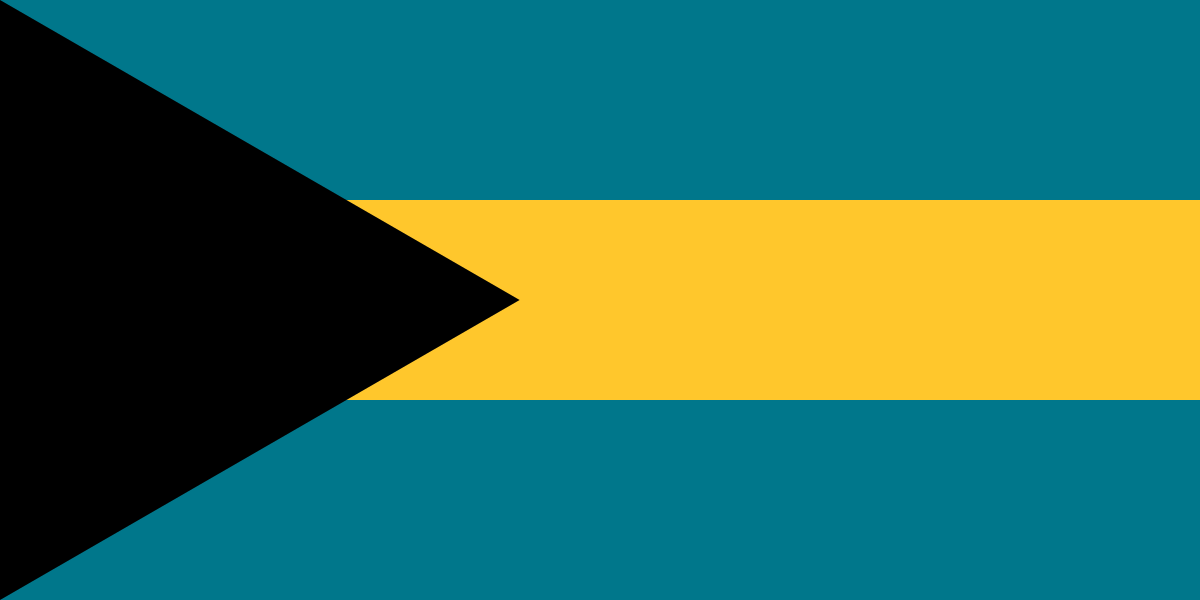
Bahamas
BSAn Atlantic archipelago of more than 700 islands and 2,000 reefs, where the turquoise water is clear enough to see the bottom 60 metres down. The Bahamas are known for the swimming pigs of Exuma, the pink beaches of Harbour Island and the vast Atlantis resort in Nassau. This is no backpacker country — it is expensive — but constant flights from the United States make it easy to reach. The Bahamian dollar is pegged 1:1 to the US dollar, which is accepted everywhere.
Where to go #
Nassau
The main hub of the archipelago, where the colonial architecture of the centre sits next to the modern resorts of Paradise Island. Almost every trip starts here, whether you stay a night or a week. It is also the cheapest place to sort out ferries, domestic flights and supplies before heading out.
Freeport
Grand Bahama draws golfers and casino visitors, and runs at a noticeably slower pace than the capital. It works well if you want beaches and facilities without the cruise-ship crush. The island also has the best cave system in the country on its doorstep.
Dunmore Town
Tiny Harbour Island is generally reckoned the most charming place in the Bahamas, with pastel cottages and golf carts instead of traffic. Nothing here happens quickly, which is the entire point. It is also where the famous pink sand is.
George Town
Exuma is the base for exploring hundreds of cays and the shallow turquoise banks between them. Boat trips leave daily and the water genuinely looks the way it does in the photographs. Come for the swimming pigs and stay for the sandbars.
Marsh Harbour
Abaco has recovered its status as the sailing capital of the region and is once again the centre for chartering. The out islands nearby are full of small settlements reachable only by boat. It suits anyone whose holiday revolves around water.
Andros
Remote communities where nature comfortably outweighs infrastructure, and the largest landmass in the country by far. A typical independent route links two or three islands, so you see the contrast between the resorts and the wild Caribbean. Andros is firmly the wild end of that scale.
What to see #
The Exuma pigs: On the uninhabited cay of Big Major, the famous swimming pigs paddle out to the boats looking for food.
It sounds like a gimmick and largely is, but it remains the single most photographed thing in the country.
Pink sand: The shore on Harbour Island really is a soft pink, from microscopic organisms mixed into the coral grit.
It is at its most intense in early morning light, before the day trippers arrive.
Atlantis: The vast water park and aquarium on Paradise Island includes slides through shark tunnels and a substantial casino.
It is expensive for a day pass, but if you are travelling with children it will occupy an entire day.
Thunderball Grotto: An underwater cave that became famous through a Bond film and is ideal for snorkelling.
Go at low tide and around midday, when shafts of sunlight come through the roof openings.
Blue holes: Andros hides the deepest sinkholes anywhere, both inland and offshore, and divers come specifically for them.
Even from the surface the colour of the water above them is unlike anything else.
Lucayan National Park: On Grand Bahama you can explore an extensive cave system and walk through mangrove to an empty beach.
The boardwalk to Gold Rock Beach at low tide is the best short walk in the country.
Prices #
Currency: The Bahamian dollar is pegged one to one with the US dollar, which makes every calculation trivial.
Cash: US dollars are accepted everywhere alongside local notes, and your change may well come back as a mix of both. On the out islands, cash is not optional, since card acceptance thins out fast.
Cards: Visa and Mastercard work in the larger shops, restaurants and hotels in Nassau and Freeport, and Amex at the resorts. Away from those, plan around cash.
ATMs: Machines are common in Nassau and rare elsewhere, and they charge a few dollars per withdrawal. Take out what you need before island-hopping, and a Wise or Revolut card removes the conversion markup.
Tipping: Around fifteen percent in restaurants if a service charge has not already been added. Check the bill first, because many places add it automatically.
| Item | Price (USD) |
|---|---|
| Conch salad from a stall | 10 |
| Lunch at the Fish Fry | 15 |
| Dinner for two | 80 |
| Kalik beer in a bar | 7 |
| Beer from a shop | 3 |
| Bottle of water | 2 |
| Jitney bus ride | 1.25 |
| Taxi to the airport | 35 |
| Water taxi | 4 |
| Golf cart hire | 70 |
| Domestic flight | 150 |
| Ferry to Eleuthera | 60 |
| Night in a rental | 110 |
| Night in a hotel | 250 |
| Water park entry | 190 |
| Rum punch | 12 |
Getting around #
Getting in: Nassau has direct flights from London, Toronto and a long list of US cities, plus Panama City if you are coming up from South America. Routing through Miami or Fort Lauderdale is the fastest option from most places but requires US transit permission, so check that before booking.
Jitneys: The minibuses in Nassau cost a little over a dollar and get you to the main city beaches cheaply. They are also the fastest way to understand how the island actually lives.
Taxis: There are no meters and fares are set by the government by zone, so agree the price before you set off. Rates from the airport are fixed and posted.
Water taxis: Boats run every half hour between Nassau harbour and Paradise Island, which avoids the bridge traffic entirely.
Inter-island flights: Bahamasair and Western Air hop between islands in twenty to forty-five minutes. It is the fast option and priced accordingly.
Ferries: Bahamas Ferries link the capital with Eleuthera and Abaco at a fraction of the airfare. Slower, but you see the water.
Cars and carts: Driving is on the left, so hiring a car only makes sense for a longer stay outside the towns. On small islands like Harbour Island, a golf cart at around seventy dollars a day is the standard vehicle.
Where to stay #
Private rentals: Renting a room or an apartment through the usual platforms roughly halves what a hotel would cost. On the out islands it may also be the only thing available.
Resorts: The Nassau resorts offer all-inclusive packages, though the brand premium often outruns the actual quality of the service. Read recent reviews rather than the brochure.
Budget rooms: Small guesthouses set back from the Cable Beach shoreline come in around a hundred dollars a night. That is genuinely cheap by Bahamian standards.
Out islands: On Exuma or Eleuthera the choice is limited, so book several months ahead. Turning up hoping for a room is a bad plan in winter.
Luxury: The boutique hotels of Harbour Island and private villas on remote cays are aimed at people paying for seclusion. They are priced to keep them that way.
Where to base yourself: In the capital, downtown puts you near the transport, while the quieter districts west of the centre are calmer and cheaper.
What to eat #
Conch: The national delicacy, served raw in a citrus salad or battered and fried until crisp. Eating a conch salad made in front of you at a stall is close to a required experience.
The Fish Fry: On Arawak Cay in Nassau they cook snapper and grouper straight off the boat for far less than any restaurant. Go where the queue is, and eat it hot.
Lobster: The clawless Caribbean lobster is on menus from August to March and is the centrepiece of any dinner. Outside that window it is off-limits by law.
Peas and rice: Rice cooked with pigeon peas and spice comes alongside almost every meat or fish dish. It is the flavour you will associate with the country afterwards.
Rum: Cocktails such as the Goombay Smash are built on local rum with pineapple and orange juice. They are stronger than they taste, which is the recurring lesson.
Guava duff: Sweet dough rolled around guava and served under a butter sauce. It is the traditional end to a celebration meal and worth ordering once.
Safety #
Street crime: In Nassau, avoid the Over-the-Hill district, particularly after dark, where robberies do happen. The tourist areas themselves are heavily policed and calm.
Your belongings: Never leave bags or electronics unattended on a public beach, even for a short swim. This is the single most common way visitors lose things here.
Sun: The UV index is extreme, so factor 50 is not optional. Reef-safe formulations are increasingly expected at the marine parks.
The sea: The Atlantic-facing shores get strong rip currents. Be honest about your swimming ability and stick to the sheltered western beaches if in doubt.
Wildlife: Jellyfish appear seasonally, and snorkelling outside the reef line brings the occasional barracuda. Neither is a serious problem if you keep your distance.
Documents: Keep passports and the bulk of your cash in the room safe and carry only small notes. It is also worth reading your own government's travel advisory during storm season.
Etiquette and culture #
Junkanoo: The biggest event of the year runs at Christmas and New Year, when the streets of Nassau fill with costumed dancers and drums. If your dates line up, do not sleep through it.
Bahamian time: Life moves at a relaxed pace, and transport or staff running late is simply normal. Getting visibly annoyed about it marks you out immediately.
Sunday: Life stops. Many shops close and families go to church, so plan food shopping for Saturday.
Dress: Swimwear belongs on the beach only. Put on light everyday clothes before walking into town or a restaurant.
Music: Goombay and calypso rhythms play everywhere and rake-and-scrape is the traditional form. Live music at a beach bar is easy to find on any weekend.
Manners: Bahamians are friendly and expect a proper greeting before you get to the point of your question. Skipping it reads as rude in a way that will slow you down.
Connectivity #
Local SIMs: BTC and Aliv have counters in the airports where you can buy a data package with your passport. Tourist bundles start around fifteen dollars a week for a few gigabytes.
eSIM: An international eSIM has you online the moment you land and avoids the queue entirely. It is usually the simpler option for a short trip.
Coverage: 4G is reliable in all the main towns, but on remote cays the signal disappears completely. Download maps before you take a boat anywhere.
Wi-Fi: Hotel Wi-Fi often costs extra and is not always fast, so mobile data tends to be the more dependable choice. Cafes and bars in Nassau are generally free.
Language: English is the official language, spoken with a strong local rhythm and plenty of dialect. You will understand everything, though the first day takes some tuning in.
Topping up: You can add credit through the operators' apps or by buying scratch cards in any small supermarket.
Phrasebook #
| English | Bahamian dialect | Pronunciation |
|---|---|---|
| How are things? | Wha' da vibe is? | Wha da VYBE is |
| Wow, unbelievable! | Mudda sick! | MUD-da sick |
| I'm leaving | I ga | Eye gah |
| Gossip | Sip sip | Sip sip |
| Homemade lemonade | Switcha | SWITCH-a |
| Stray dog | Potcake | POT-cake |
| White Bahamian | Conchy Joe | CONK-ee Joe |
| Thing, whatsit | Tingum | TING-um |
| Cheeky, forward | Biggity | BIG-i-tee |
| Hanging out | Limin' | LIME-in |
| Traditional music | Rake-and-scrape | Rake-an-SCRAPE |
| Sure thing, friend | Yeah, mon | Yeah mon |
| What is that? | Wha' dat is? | Wha DAT is |
| Scruffy, unkempt | Jungaless | JUNG-a-less |
| Is that right? | Is dat so? | Is DAT so |
| Slowly | Longly | LONG-lee |
| Friend | Spar | Spar |
| Someone with a sweet tooth | Sweet mou' | Sweet MOW |
| My home | Me yard | Me YARD |
| Stubborn | Hard head | Hard HED |
Good to know #
Consular help: Several countries maintain a mission in Nassau, while many others cover the Bahamas from Kingston, Havana or Washington. Find out which applies to your passport before you leave.
Sun protection: The climate demands high-factor water-resistant sunscreen, and reef-safe versions are preferred at the marine parks. Buy it before you arrive, since island prices are brutal.
Ferry schedules: Inter-island sailings change with the weather, so confirm the day before you plan to travel. Do not build a tight connection around a boat.
Snorkel gear: Buying your own mask and snorkel pays for itself on day one, given what rental costs here. It also means you can stop anywhere.
Drinking water: Tap water is fine for washing but tastes strongly of minerals, so most people buy bottled. Large containers work out far cheaper than small bottles.
Planning: The official tourism ministry portal carries the festival calendar and the list of licensed guides and operators.