
Namibia
Namibia is a country of otherworldly landscapes: the red dunes of Sossusvlei, the Skeleton Coast, Fish River Canyon and the endless Namib and Kalahari deserts. One of the least densely populated countries on earth, it astonishes with the sheer scale of its emptiness and silence. German colonial heritage, remarkable wildlife and faultless roads make it the ideal place for a self-drive trip in Africa.
Where to go
#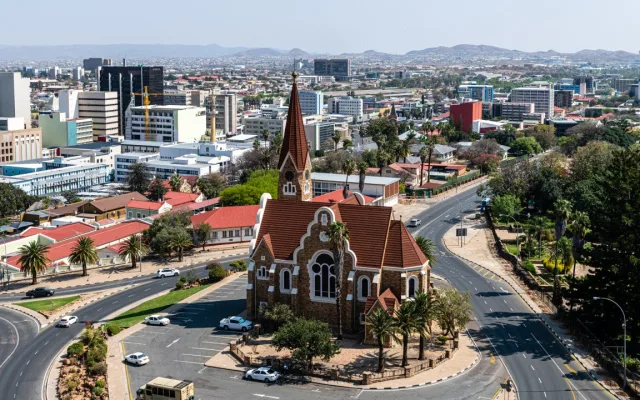
Windhoek
Namibia's tidy capital — German architecture, the Alte Feste and the starting point for the Namib desert.
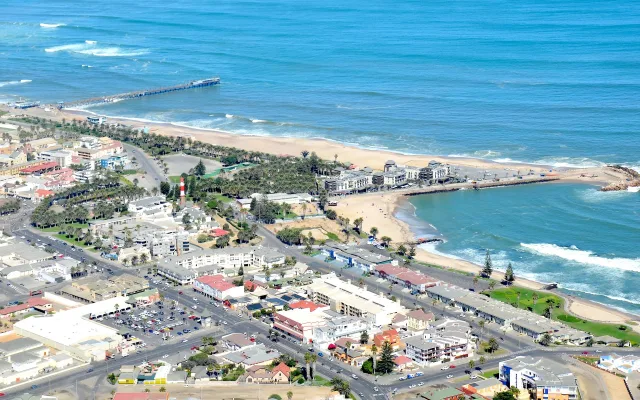
Swakopmund
A German-founded resort on the edge of the Namib — Atlantic dunes, skydiving, quad bikes and colonial architecture.
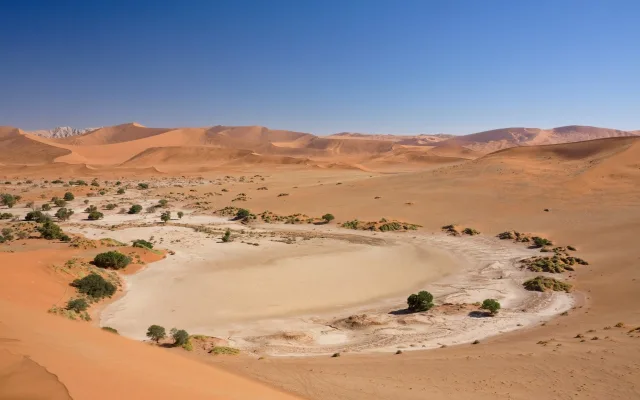
Sossusvlei
Rust-red dunes and Dune 45, the blinding white clay pan of Deadvlei, and dead trees against a burning sunrise.
What to see
#Sossusvlei: If you want the best photographs in the country, go to the burnt-orange dunes and the dead camel thorn trees of Deadvlei. Sunrise here counts as compulsory, when the shadows turn the desert into something that looks like another planet.
Etosha National Park: Worth a trip for budget self-drive safari, where the animals come to you at floodlit waterholes. You can sit in your own car for hours watching elephants, lions and rhinos go about their business.
Skeleton Coast: A sinister, magnetic shoreline littered with rusting shipwrecks and bleached whale bones. Constant fog and heavy surf create a rare feeling of being completely cut off from civilisation.
Fish River Canyon: A vast gash in the earth, impressive for sheer scale and for the absolute silence at the viewpoints. If you have the time, spend a day walking the rim trails to take in the full depth of the drop.
Spitzkoppe: Granite peaks and giant stone arches that start to glow an extraordinary fiery colour at sunset. It is paradise for anyone who likes sleeping out under a genuinely clean night sky and doing easy scrambles by day.
Twyfelfontein: An ancient open-air gallery where thousands of San rock engravings survive on rust-red slabs. Some find it overrated because of the heat, but the historical value of the petroglyphs is not in doubt.
Prices
#Currency: The Namibian dollar is in circulation and is pegged one to one with the South African rand. Rands are accepted everywhere at parity, but change often comes back in local coins, which are hard to offload once you leave.
Cards: Visa and Mastercard work fine in Windhoek, Swakopmund and at fuel stations on the main routes, and ATMs are easy to find in any town. Amex is rarely accepted, and once you turn onto the gravel you should assume cash only, so carry a reserve.
Exchange: Change US dollars or euros on arrival at the airport or at a bank branch in Windhoek. Note that notes issued before 2013 may be refused outright or exchanged at a punishing rate.
Withdrawals and apps: Local ATMs add their own fee per withdrawal, so take out larger amounts less often. A Wise or Revolut card gives you a much better rate than airport bureaux and works at most bank machines in the towns.
Tipping: Ten percent of the bill is normal in restaurants if the service pleased you. At fuel stations the pump attendants and the men watching your car in the car park get a few coins, and that is simply standard courtesy.
| Item | Price (USD) |
|---|---|
| Lunch in a local cafe | 8 |
| Game steak in a restaurant | 17 |
| Bottle of Windhoek lager | 2.5 |
| Litre of petrol | 1.5 |
| NWR campsite pitch | 15 |
| Night in a town guesthouse | 55 |
| Etosha park entry (day) | 9 |
| SIM card with data bundle | 4 |
| Short taxi ride | 5 |
| 1.5 litre bottle of water | 1 |
| Intercape coach ticket | 22 |
| Cappuccino | 3 |
| Supermarket sandwich | 4.5 |
| Set of souvenir postcards | 4 |
Getting around
#Getting here: Windhoek's Hosea Kutako airport is the gateway, reached from Europe on direct services out of Frankfurt or with one change in Doha, Addis Ababa or Johannesburg. From North America the usual routing is via a European or Gulf hub and then south, and fares climb sharply over the dry season from May to October.
Coaches: Large Intercape liners run between the big towns. They are comfortable enough and they keep to time, but the route network covers only a small fraction of the places actually worth seeing.
Shuttles: The popular way to get from Windhoek to Swakopmund is a Carlo's minibus. Seats are booked ahead through messaging apps, and passengers are usually collected from their hotel door inside the city limits.
Combis: Shared minibuses are very cheap, very cramped and completely unpredictable, since they leave only once full. This is how the country actually moves, and it demands iron patience and no fixed schedule.
City taxis: In the capital the cars have no meters, so agree the fare before you get in. There are no ride-hailing apps here, and the easiest method is flagging down a free car at the kerb with a wave.
Flying and driving: FlyNamibia's domestic hops put you in Walvis Bay an hour after leaving the capital, which costs real money but saves days on dusty gravel. Driving is on the left, everything off the tarred highways is treacherous gravel, and you must never drive after dark, because game runs onto the road and the collisions are fatal.
Where to stay
#Guesthouses: In the towns these are the best value, often with a pleasing German flavour. The owners usually serve a substantial breakfast and give genuinely useful advice on routing yourself into the emptier corners of the country.
Government camps: The NWR network runs the accommodation inside the national parks, and it is your only chance to sleep beside the animals. Rooms can be tired, but waking up to sunrise inside the park makes up for it.
Rooftop tents: The format of choice for anyone renting a 4x4. It is a mobile house that lets you sleep at equipped campsites with hot showers and your own fire pit out in wild country.
Farms: Many private landholdings have been converted for guests, and you can live in the absolute silence of the savannah. Plenty of these farms keep cheetahs that you can legally watch from an open terrace.
Booking: Pitches at popular spots like Okaukuejo or Sesriem go six months ahead of the travel date. Use the official NWR site for the parks and international booking platforms for private guesthouses in the towns.
Standards: Even in budget places cleanliness is usually excellent, which people put down to the German influence. Power and hot water exist almost everywhere except the simplest, most remote pitches deep in the Namib.
What to eat
#Meat first: Namibia is heaven for carnivores, with beef and fresh game forming the backbone of the daily diet. Oryx and kudu steaks are cooked with real skill here, and the meat comes out surprisingly tender and fragrant.
Braai: The local take on barbecue has become part of the national identity and the central social ritual. Everything goes on the coals, from spiced boerewors sausage to huge marinated slabs of ostrich or zebra.
Kapana: In the township markets you have to try this street meat, seared over enormous open fires. Chunks of beef are dusted with a salt and spice mix and handed to you hot straight off the communal iron grill.
The German trace: In Swakopmund you can easily find classic schnitzel, apple strudel and fresh pretzels. The bakeries are excellent and frequently match the best European standards for quality and taste.
Seafood: On the Atlantic coast the menus are ruled by oysters and fish landed that morning. Prices for these are far below European levels while the product itself stays world class.
Beer: Local beer is brewed strictly to the old Bavarian purity laws, with no additives and no chemistry. Windhoek and Tafel are the popular labels, and both go down perfectly after a long hot day in the savannah.
Safety
#The general picture: Namibia counts as one of the calmest countries on the continent for independent travel. People are broadly friendly and street crime in tourist areas stays low.
Town risks: In busy parts of Windhoek petty theft and bag snatching happen to distracted visitors. Never leave bags or electronics visible in a parked car even for a minute, because it invites a smashed window.
Wild animals: In the national parks getting out of your vehicle outside designated areas is absolutely forbidden. Predators hide expertly in the grass, and elephants can turn very aggressive if startled.
Health: Drink bottled water, though tap water in the major towns is considered reasonably clean. Desert sun is merciless, so factor 50+ sunscreen and a hat become your closest friends.
Roads: Most serious incidents come from carrying too much speed on gravel. Dust from oncoming vehicles kills visibility, and any sharp correction on a loose surface tends to end in a rollover.
Isolation: In desert regions the phone signal can vanish for hundreds of kilometres, leaving you entirely on your own. Always tell someone your route, carry five litres of water per person in the car, and check your own government's travel advisory before you go.
Etiquette and culture
#An ethnic mix: More than ten peoples live side by side here, each holding on to its own traditions. It is remarkable to see a Himba woman in ochre and a businessman in a sharp suit on the same street.
The colonial layer: German influence runs through daily life, from the love of order to street names and local holidays. It creates an odd blend of African temperament and European reserve that is unique in the region.
Herero: Women of this group wear vast Victorian dresses and headdresses shaped like cattle horns. It is a memorial to a tragic past and a serious symbol of pride, and it is impossible to miss in a crowd.
Himba: These people keep a semi-nomadic life and have not traded their ancient traditions for convenience. Always ask before photographing anyone here, because it is a basic matter of respect.
Punctuality: Unlike much of the region, Namibia values the clock, especially in transport. If the intercity coach says eight in the morning, it will almost certainly leave at eight and it will not wait.
Land and wildlife: For Namibians the land and its animals are the country's central asset and a point of national pride. Do not litter and follow the park rules, because environmental questions are taken extremely seriously here.
Connectivity
#Networks: MTC is the undisputed market leader, and its SIM cards are sold on every corner and at the airport. Coverage is solid in the towns, but deep in the desert you will have nothing, which needs planning around.
Buying a SIM: Registering a line requires your original passport and about ten minutes. Mobile data plans are cheap and speeds in the main centres are good enough to work on.
eSIM: If you would rather not queue on arrival, Airalo and similar providers sell Namibian data plans you can activate before you land. It costs a little more than a local SIM but gets you online the moment you clear the terminal.
Language: English is the official language and almost everyone in the towns and in the service industry speaks it. Signs, menus and park information are all in English, which removes any language barrier for an independent traveller.
Afrikaans and local tongues: A large part of the population uses Afrikaans, close to Dutch, in daily life, and a couple of words in it earns you real warmth. In rural areas and the north you will hear the click sounds of Oshiwambo or Nama, so never be shy about asking someone to repeat themselves.
Digital detox: Expect internet in Etosha or Sossusvlei to exist only at the lodges, and to be weak even there. Download offline maps in advance so you are not guessing at the endless gravel junctions.
Phrasebook
#| English | Afrikaans | Pronunciation |
|---|---|---|
| Hello | Hallo | HAH-loh |
| Good morning | Goeie more | KHOO-yuh MAW-ruh |
| Thank you | Dankie | DUNK-ee |
| Please | Asseblief | AH-suh-bleef |
| Yes / No | Ja / Nee | Yah / Neh-uh |
| How are you? | Hoe gaan dit? | Hoo khaan dit? |
| How much? | Hoeveel kos dit? | HOO-fale kos dit? |
| Water | Water | VAH-ter |
| Food | Kos | Kos |
| Beer | Bier | Beer |
| Help! | Help! | Help! |
| Nice, great (slang) | Lekker | LEK-ker |
| Barbecue (slang) | Braai | Bry |
| Mate, friend (slang) | China | CHAY-nah |
| No worries (slang) | Is oraait | Is oh-RITE |
| The bill | Die rekening | Dee RAY-kuh-ning |
| Goodbye | Totsiens | TOT-seens |
| Toilet | Toilet | TOY-let |
| Sorry | Jammer | YUM-mer |
| Petrol | Petrol | PET-rol |
| Expensive | Duur | Deer |
| Meat | Vleis | Flayss |
| I don't know | Ek weet nie | Ek vate nee |
| Good luck | Sterkte | STERK-tuh |
Good to know
#Plugs: Namibia uses type D and M sockets with three round pins, so most European and North American plugs will not fit. An adapter costs almost nothing in any supermarket, or ask at your hotel reception.
Power: Voltage is the standard 220–240V, but at campsites the sockets may be in the shared block or missing entirely. Bring a large power bank and a car charger for your devices.
Offline maps: Google Maps works well, but download the regions you need for use without a signal. For rougher routes people recommend iOverlander, which carries a database of every campsite.
Time zone: Namibia sits on UTC+2 all year and no longer changes the clocks for summer or winter. That puts it in line with most of continental Europe in winter, so jet lag from Europe is minimal.
Shopping: Proper shopping centres exist only in the capital and the coastal towns, and there the range is European. Out in the interior the choice is thin, so stock up on food and consumables while you are in the big towns.
Consular help: Most Western countries cover Namibia from an embassy in Windhoek or from Pretoria in South Africa. Note down the address and duty phone number for your own country's mission before you leave, since documents do get lost on the road.
Frequently asked questions
#Many Western passports get a free visa on arrival or visa-free entry for tourism, typically for up to 90 days, and the stamp is issued at the border. You will need an onward ticket and a passport valid for at least six more months, and you should always check your own passport's current rules before booking.
Visa and Mastercard are widely accepted in Windhoek, Swakopmund and other towns, and ATMs are common. Amex is a much weaker bet, and once you leave the tarred roads you should be carrying cash, so withdraw a reserve before heading into the parks.
The country is one of the safest in Africa, but it demands real care on the roads because of the gravel surfaces. The main threats are skids and rollovers rather than crime, along with game running out in front of you.
The dry season from May to October is ideal, when the grass burns off and animals concentrate at the few remaining water sources. In Etosha during this window you can reliably see lions, elephants and even the rare black rhino.
On average a properly equipped 4x4 runs 120–150 dollars a day depending on season and model. It is the most practical option because it combines reliable transport with a full sleeping setup.
The main highways are excellent tar, but most of the sights are reached on gravel roads of varying quality. A 4x4 is strongly advisable for comfort in deep sand and essential in the wild north.
No vaccinations are required for entry, and malaria risk exists only in the northern regions during the rainy season. For a standard route, repellent and covered clothing in the evening are enough.
In Windhoek and Swakopmund the tap water is treated and considered safe, though visitors often dislike the taste. Most travellers simply buy bottled water at the supermarket for drinking.
Yes, but with restrictions. Registration is mandatory for a drone of any weight. NCAA approval must be requested at least 60 days ahead; there is no weight exemption and the drone is declared on arrival. Rules for other countries are in the drone ranking by country.
No — your national licence is accepted for a car. Traffic drives on the left. Car rental starts at 23. Licences in English are accepted. Traffic drives on the left and intercity gravel roads are where most crashes happen. Rules for other countries are in the driving and rental table.
You can rent a bike and your national licence is enough. Crucially, your licence must include category A. Category B is not enough — this is what catches most riders out. A helmet is compulsory. Bike rental usually starts at 18. Rules for other countries are in the driving and rental table.
Updated
The data on this page goes out of date. Visa rules and permitted stays, border requirements, prices and budgets, transport and local conditions all change fast, and we do not re-check every page every day. We show the date of our last check where we have one, but before you travel, verify with official sources: the country’s consulate, its immigration service, its e-visa portal and your carrier.