
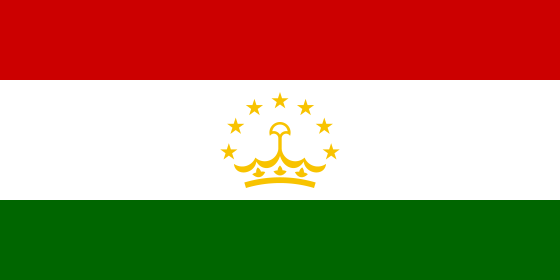
Safety in Tajikistan
A rating built from four independent indices, plus scams, laws and what to do when something happens
Rating calculated from the indices below
Indices checked on 10.08.2026
Position in global indices
Save these before you fly
The general picture
Overall: The country has low crime and a genuine warmth towards visitors. You can walk around the cities in the evening without worrying about yourself or your belongings.
Altitude sickness: On the Pamirs you will be above 4000 metres. Gain height gradually, drink far more water than feels necessary and carry altitude medication so a bad headache does not wreck the trip.
Roads: Mountain switchbacks have no barriers and rockfall is routine after rain. Leave the driving to experienced local drivers who know every dangerous bend on the Highway.
Borders: Stay away from the Afghan border zones outside established tourist routes. Photographing border posts and soldiers is strictly forbidden and will get your images deleted or worse.
Water: Do not drink from the tap in the cities. Buy bottled water and wash market fruit and vegetables thoroughly to avoid stomach infections.
Signal: Mobile coverage disappears in the mountains for long stretches. Download offline maps and warn people at home that you may be unreachable for days on the Highway. Check your own government's travel advisory before you go.
How tourists get scammed
Tajikistan has low street crime and a strong tradition of hospitality. Organised deception is limited; formalities are not.
Taxis. There are no meters and prices are agreed. Apps operate in Dushanbe. A foreigner will be quoted more and haggling is expected.
Currency exchange. Only banks and licensed offices may exchange — street exchange is illegal, and counterfeit-note schemes are built on it. Bank rates are fine.
Transport to the Pamirs. Seats in a jeep to Khorog and Murghab are sold at the stands at negotiated prices. Some drivers take more people than seats and drive the hairpins at night. Arrange in advance and do not agree to a night departure.
"Guides" and permits. The GBAO permit is issued officially and costs little. Offers to "do it faster for cash" mean either overpaying or a forgery.
Bazaars. Haggling is compulsory in Khujand and Dushanbe, and the opening price for a visitor is inflated.
What gets you fined or jailed
The GBAO permit is a compulsory document. Entering Gorno-Badakhshan — which is the whole Pamir Highway, Khorog, Murghab and the Wakhan — requires a separate permit in addition to your visa. It is obtained in advance online with the e-visa or at OVIR in Dushanbe. Without it you will be turned back at the first checkpoint. Some districts, including parts of the Wakhan corridor, require additional permits.
Registration. Stays over ten days require registration with the interior ministry. Hotels do this and issue a slip — keep it.
The Afghan border. The Pamir Highway runs along the Panj in places, and the far bank is Afghanistan. Photographing border installations, approaching the river in unauthorised places and certainly attempting to cross are categorically prohibited.
Drugs. Tajikistan is a transit country for Afghan heroin and the law reflects it: long sentences, no bail, and regular road checks. Never carry anyone else's belongings or parcels.
Drones. Effectively prohibited: importing one without permission means confiscation at customs.
Photography. Military installations, checkpoints, bridges and border areas are off limits.
Health: vaccines, medicines, care
Altitude is the main medical factor. The Pamir Highway crosses the Ak-Baital pass at 4,655 metres, Murghab sits at 3,650 and Lake Karakul at 3,900. These are altitudes at which most people develop altitude sickness, and sleeping at 4,000 after Dushanbe (800 metres) can end in pulmonary oedema. The rules: gain height gradually, sleep in Khorog and Alichur before Murghab, avoid alcohol, and descend immediately with headache plus vomiting or breathlessness at rest.
Vaccinations. None mandatory. Hepatitis A, typhoid and rabies are advised.
Water. Bottled or boiled only. In the Pamirs water comes from streams — boil it.
Healthcare barely exists outside Dushanbe. Khorog has a basic hospital and Murghab a first-aid post. Evacuation from the Pamirs takes a day or more and helicopters are scarce. Your insurance must cover altitude to 5,000 metres and evacuation, or it is useless.
Roads. The Pamir Highway is dirt, scree, fords and rockfalls. Accidents and mudflows occur regularly.
Earthquakes. The region is seismically active.
Emergency numbers: 102 police, 103 ambulance.
Police: how to handle them
Tajikistan ranks low on the Corruption Perceptions Index, and low-level extortion occurs regularly.
Checkpoints. There are many on the Pamir Highway, and they are the main scenario in which you meet authority. Passport, visa and GBAO permit are checked. It usually passes formally and quickly, though requests for "help" occur. Keep your documents in order and copies separately.
Traffic police. They stop cars often, foreign plates especially. Calmly ask for a written report.
Reporting theft. Reports are slow and a certificate is issued. Do not expect an investigation.
Languages. Russian is understood everywhere, especially in Dushanbe and among older people. Younger people in the capital and Pamir guides speak English.
Border areas. Conditions on the Kyrgyz frontier toward Batken and on the Afghan border change. Check the current situation before travelling rather than advice a year old.
Attitude to visitors. Hospitality is sincere and insistent: an invitation to plov and a bed in a village is the norm.
What else to check
The rating is built from open international indices and foreign-ministry advisories; links to the primary sources are in the cards above. Conditions change faster than annual reports come out — check current travel advice before you go.