
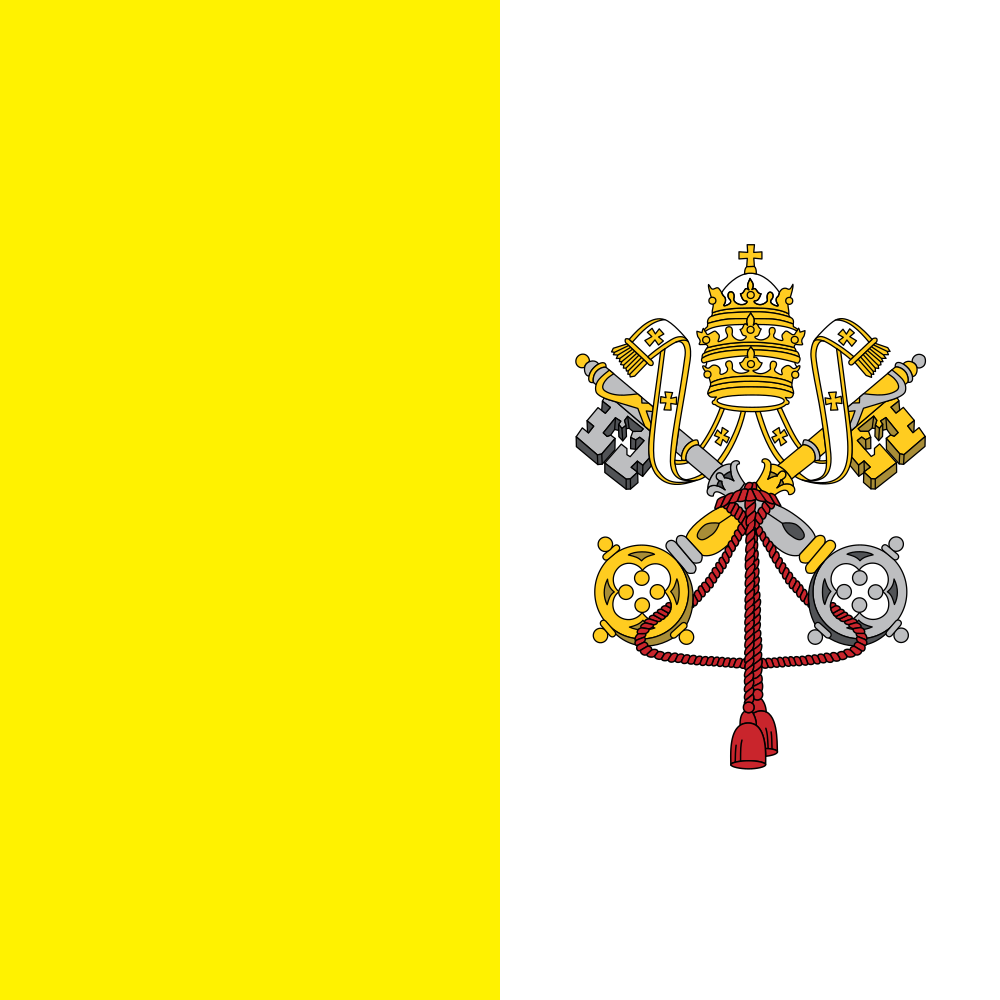
The smallest independent state in the world — 0.44 km² behind walls in the middle of Rome. It is the spiritual centre for 1.3 billion Catholics, the place where Michelangelo painted the Sistine Chapel and Bernini built the colonnade of St Peter's Square. The Vatican Museums hold one of the greatest art collections in existence. Formally a separate country, the Vatican has no border control — you simply cross the square and you are in another state.
Where to go
#Vatican City
The reason you came: the Sistine Chapel and the greatest of all the basilicas. This is the smallest state on earth, packed into half a square kilometre behind its fortress walls.
Rome
The vast city wrapped around the papal enclave, where you will actually sleep and eat. It is also the easiest place from which to plan your walks and side trips to the shrines.
Castel Gandolfo
Worth a trip to see the pope's summer residence and to sit by the scenic Lake Albano. Touring the Apostolic Palace and the gardens makes a fine addition to the main programme.
Prati
The smart district immediately outside the northern walls, and the best place for an independent traveller to book a room. It has the trattorias locals actually eat in and the entrance to the museums.
Borgo
The atmospheric old quarter squeezed between Castel Sant'Angelo and St Peter's Square. Its narrow lanes are where you get the closest feel of the medieval papal city.
Trastevere
A picturesque district on the far bank of the Tiber, twenty minutes on foot. People go there for the noisy nightlife and the most genuine cooking in the city once the ticket offices have shut.
What to see
#The Sistine Chapel: the legendary room where you finally see Michelangelo's ceiling with your own eyes. Photography and video are strictly forbidden, and the guards enforce the silence with real conviction.
St Peter's Basilica: the largest church in Christendom and something you can absolutely see in a day. Entry is completely free, but be ready to stand in a long security queue on the square.
The Vatican Museums: an enormous complex holding everything from Egyptian mummies to Raphael's finest work. Download the official audio guide to your phone beforehand so you do not get lost in kilometres of galleries.
Climbing the dome: the highest viewpoint in Rome and the best panorama over the square. You can save money by taking the stairs or pay a little more for the lift most of the way.
The Vatican Gardens: a closed area you can only enter with a booked group. It is a rare chance to see the green lungs of the state, with its elegant fountains and grottoes.
The necropolis: the excavations under the basilica containing what is believed to be the tomb of St Peter. Tickets have to be requested months ahead by email through a dedicated office.
Prices
#Currency: Ordinary euros, though the state mints its own rare coins bearing the pontiff's portrait. You will almost never get one in change, because collectors take them instantly.
Cards: Plastic is accepted nearly everywhere, from souvenir stalls to the museum ticket desks, and phone payment works fine. Visa and Mastercard are universal, Amex less reliably so.
Cash: Carry notes for the dome climb and small souvenirs. The kiosks at the foot of the basilica have terminals that regularly stop working or take cash only.
Tipping: In the cafes and restaurants around the walls, around ten percent is the convention. Often a service charge is already on the bill, listed as coperto or servizio, so check before adding more.
Value: Booking museum entry online costs more than the door price but buys you a timed slot, and that trade is almost always worth making in high season.
| Item | Price (USD) |
|---|---|
| Museum ticket at the desk | 22 |
| Online skip-the-queue ticket | 33 |
| Dome climb with lift | 17 |
| Dome climb on foot | 11 |
| Student concession ticket | 11 |
| Vatican postage stamp | 1.5 |
| Museum audio guide | 8 |
| Fridge magnet | 6 |
| Espresso at the bar | 2 |
| Cafeteria sandwich | 8 |
| Pizza in Prati | 16 |
| Lunch in a Borgo trattoria | 38 |
| Bottled water, 0.5 l | 2.5 |
| Souvenir rosary | 12 |
| Postcard home | 1 |
Getting around
#Getting there: You reach the Vatican through Rome, and Fiumicino takes nonstop flights from every major European city as well as New York and other US gateways. From the airport the Leonardo Express reaches Termini in half an hour, from where it is one metro line to the walls.
Metro: The quickest approach is the red Line A. Get off at Ottaviano for the museums, or Cipro if you want to walk through Prati first.
City buses: Routes 40 and 64 run from the central station straight to St Peter's Square. They are convenient expresses, but pickpockets work them hard, so watch your bag.
On foot: From the historic centre, walk across the Ponte Sant'Angelo and down Via della Conciliazione. It is the loveliest approach and gives you the full view of the dome and the facade.
Taxis: From central Rome expect around 15 euros depending on the hour. Ask for Musei Vaticani if you already hold a timed entry ticket.
Tram: Line 19 drops you at Piazza Risorgimento, five minutes from the entrance. A good option if you would rather watch the city go past on the way.
Rail: The state has its own station, but it is used only for occasional special services. Independent travellers use Roma San Pietro, just south of the colonnade.
Where to stay
#Prati: The ideal base if you plan an early museum slot without a long journey first. It has plenty of good guesthouses in handsome late nineteenth-century buildings.
Borgo: You will be sleeping literally under the pope's windows, surrounded by old stone. It is the most expensive area on the border, but St Peter's Square is a two-minute walk.
Trastevere: Choose this if you want to combine the shrines with an evening in the bars. It is slightly further out, but the walk to the Vatican along the Tiber is a pleasure in itself.
Around Termini: The budget choice, with excellent transport links and not much atmosphere. The metro runs directly to the basilica in about fifteen minutes.
Inside the walls: There is no tourist accommodation within the state itself, which houses only clergy. Look instead for apartments advertised with a Vatican view for a direct look at the dome.
Booking: Reserve a couple of months out. That is what it takes to find a well-rated place at a sane price within walking distance of the entrance.
What to eat
#The museum cafeteria: The only way to eat without leaving the enclave. The pizza, pasta and salads are perfectly decent and priced like an average Roman canteen.
Roman pizza: For the best pizza by weight, walk five minutes to Pizzarium. This is Gabriele Bonci's cult address and there is always a queue of locals and food obsessives.
Prati trattorias: This residential district has a far higher density of restaurants for regulars than the centre does. Look for menus with carbonara made without cream and a proper peppery cacio e pepe.
Street food: Try supplì, fried rice balls with molten mozzarella at the centre. Cheap, extremely filling and easy to carry while you walk.
Drinking water: The nasoni fountains on St Peter's Square and across Rome run free, ice cold and clean. There is no reason to keep buying plastic bottles.
Arlu: A comfortable place in Borgo serving traditional cooking with a modern hand. Prices sit above average, but the ingredients and the service justify it.
Safety
#Dress code: You will not be admitted to the basilica or the museums in short shorts or with bare shoulders. Bring a light scarf you can throw over yourself before the checkpoint.
Pickpockets: Professionals work the crowds on the square and the packed buses. Wear your backpack on the front, keep nothing in back pockets and stay alert in the crush.
Sun: In summer the open squares offer no shade at all and the marble radiates heat. Wear a hat, use sunscreen and refill at the fountains regularly.
Touts and scams: Ignore anyone offering a free tour or fast-track help. Buy only through the official portal or an established international ticketing site.
Security screening: Everyone goes through metal detectors at the basilica and the museums. Knives, tripods, glass bottles and oversized backpacks are all refused.
ID for concessions: Students and young visitors must carry an original passport to claim a reduced ticket. Without it you pay the full adult price, no discussion.
Etiquette and culture
#The Swiss Guard: Instantly recognisable in striped uniforms that have barely changed in centuries. They are the entire army of the smallest state on earth and the pontiff's personal security.
The papal audience: On Wednesdays you can see the pope up close on the square and receive his blessing. It requires free tickets, requested in advance through the prefecture.
The Vatican post: The yellow post boxes are notably faster and more reliable than the red Italian ones. Send a card with a local stamp; it is the best cheap souvenir there is.
Latin: The dead language remains official here alongside Italian. You can even set the cash machines to a Latin interface if you want to try withdrawing money in it.
Sunday prayers: At midday on Sunday the pope addresses the faithful from the window of the Apostolic Palace. It is open to all, with no ticket or booking needed.
Quiet and respect: Remember this is a functioning religious centre, not simply a popular museum. Loud conversation or misplaced laughter inside the churches gets a sharp word from the guards.
Connectivity
#Mobile: There is no separate operator, so an Italian SIM or a European eSIM works perfectly. Coverage is solid across the whole territory, including the courtyards, the undercrofts and the gardens.
Free wifi: The square and the museums carry the official Vatican network. It is useful for pulling up a map or the audio guide if you have run out of data.
eSIM: An Airalo or similar profile bought before you fly saves you looking for a phone shop in Rome and covers the rest of Italy on the same plan.
Sockets: Guesthouses here often still have the old Italian sockets with three holes in a row. Most modern Type C and F plugs go straight in, but travellers from the UK, US or Australia need an adaptor.
Official apps: Download the augmented-reality guide before you visit the galleries. It makes the dense context of the Raphael rooms and the Sistine ceiling far easier to follow than a paper plan.
Language: Museum staff and the guards speak good English, so you will not struggle. A couple of words of Italian still buys you a warmer response from waiters.
Phrasebook
#| English | Italian | Pronunciation |
|---|---|---|
| Good morning | Buongiorno | bwon-JOR-no |
| Thank you | Grazie | GRAHT-tsyeh |
| Please | Per favore | per fa-VO-reh |
| Yes / No | Sì / No | see / no |
| Excuse me | Mi scusi | mee SKOO-zee |
| Where's the entrance? | Dov'è l'ingresso? | do-VEH lin-GRES-so |
| Ticket | Biglietto | bee-LYET-to |
| Queue | Coda | KO-da |
| How much is it? | Quanto costa? | KWAN-to KOS-ta |
| Water | Acqua | AH-kwa |
| Coffee | Caffè | kaf-FEH |
| The bill, please | Il conto, per favore | eel KON-to per fa-VO-reh |
| Toilet | Bagno | BAN-yo |
| Help! | Aiuto! | a-YOO-to |
| Beautiful! | Bellissimo! | bel-LEE-see-mo |
| Very good | Molto buono | MOL-to BWO-no |
| One moment | Un attimo | oon AT-tee-mo |
| Goodbye | Arrivederci | ar-ree-veh-DER-chee |
| Slang: what the hell? | Che cavolo? | keh KA-vo-lo |
| Slang: cool | Figo | FEE-go |
| Slang: let's go! | Daje! | DA-yeh |
Good to know
#Official site: For 2026, buy tickets only at tickets.museivaticani.va. It is the one way to avoid a mark-up and to be certain of your entry time.
Opening hours: The museums open Monday to Saturday from 8am to 8pm, with last entry at 6pm. They are closed on Sundays, except the last Sunday of each month.
Free Sunday: On the last Sunday of the month entry costs nothing, which is a dubious saving. You will queue for hours and then move through an unbearable crush of people.
Audio guide: Bring your own headphones so you can use the digital guide on your phone. It is more comfortable and more hygienic than renting an old handset at the desk.
The post office: It sits to the right of St Peter's Basilica and sells the rare stamps. Sending a note home from the centre of the Catholic world is a good use of ten minutes.
Closing dates: The Vatican is shut on 1 and 6 January, 19 March, at Easter and at Christmas. Check the liturgical calendar before you travel so you do not arrive at a locked gate.
Frequently asked questions
#No. There is no passport control at the boundary; you simply walk across an invisible line on the square, so whatever rules govern your entry to Italy are the only ones that apply. Carry your original passport anyway, because the gendarmerie can ask for it.
Go to the official museums site, pick your date and the time slot for the Sistine Chapel, and pay by card. A voucher with a barcode arrives by email and is what you show at the entrance.
Nothing at all, at any time it is open. You pay separately only for extras such as the dome viewing platform or an audio guide.
Shoulders and knees must be covered, for men and women alike, and nothing revealing gets through. Short shorts, vest tops and mini skirts are turned away by the guards before the metal detectors.
Right at the 8am opening or in the afternoon after 3pm, once the main wave has passed. Avoid Saturdays, Mondays and Wednesday papal audience days, when the crowds peak.
No. All photography and filming inside the chapel are banned under the terms of the old fresco restoration contract. Guards watch closely and will ask you to delete images or leave.
Metro Line A to Ottaviano is the simplest, or the number 64 express bus from Termini station. You can also walk it in half an hour from the Pantheon across the very photogenic Ponte Sant'Angelo.
Head into Prati, immediately behind the northern wall, and look for small pizzerias and family trattorias. That is where you find real Roman food at local prices, well clear of the tourist traps on the square.
Effectively no — flying is banned or out of reach for tourists. Vatican airspace is closed — it is a permanent no-fly zone inside Rome. Rules for other countries are in the drone ranking by country.
Updated
The data on this page goes out of date. Visa rules and permitted stays, border requirements, prices and budgets, transport and local conditions all change fast, and we do not re-check every page every day. We show the date of our last check where we have one, but before you travel, verify with official sources: the country’s consulate, its immigration service, its e-visa portal and your carrier.