
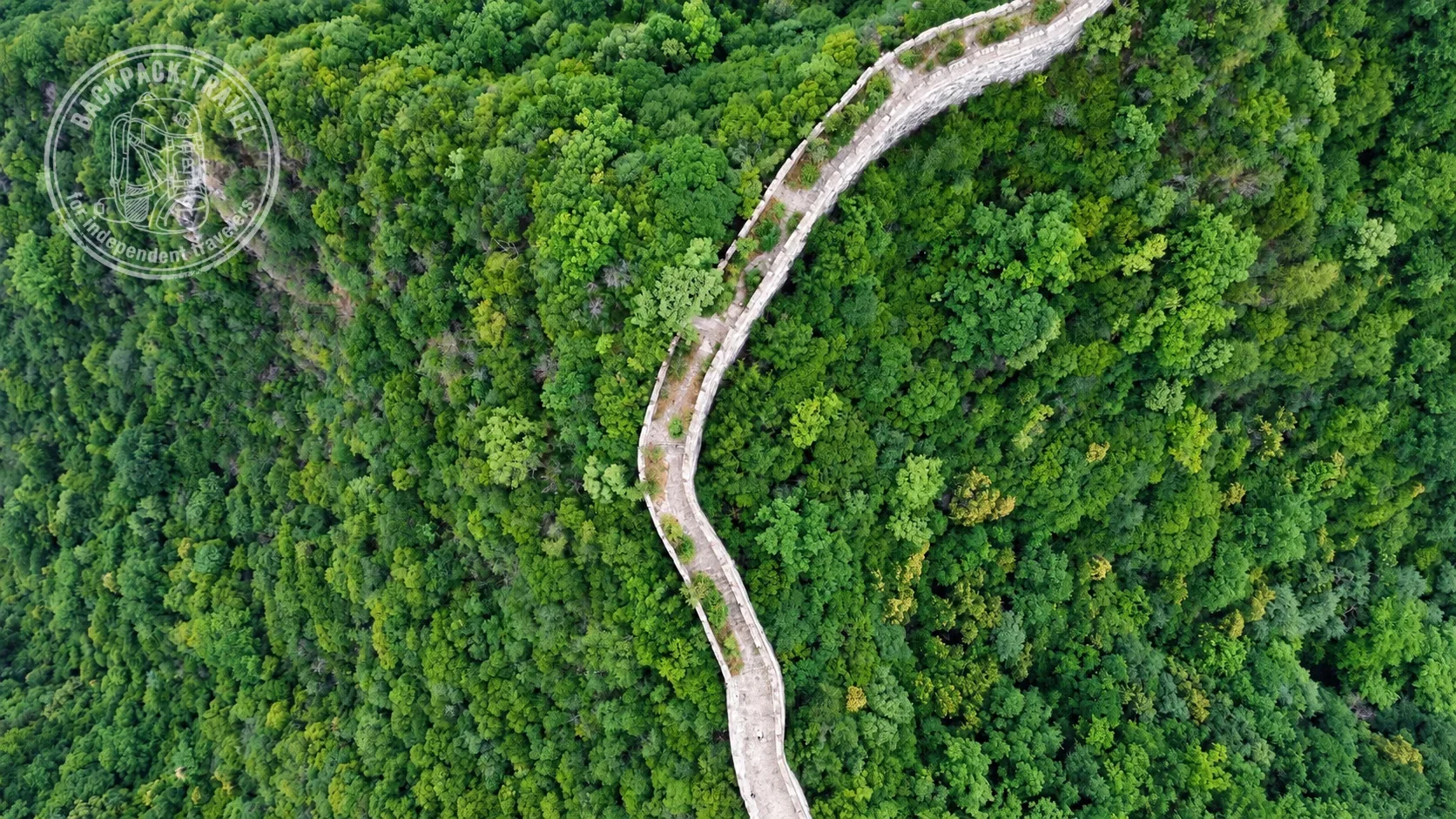
How old is the Great Wall of China? It depends on where you go and what you are looking at. An ancient section may resemble an earthen mound, while a neat-looking tower may have been rebuilt. On my trips, I often had to work out where the old masonry survived and where modern builders had intervened.
Cover photo:  Города и дороги

So many myths surround the Great Wall of China that it can be hard to tell what you have come to see. An ancient fortification? Restored ruins? A modern structure on the site of a wall that vanished long ago?
The claim that the entire wall was built recently is fiction. Ancient fortifications survive and archaeologists study them. Extensive restoration also took place in the 20th century, under Mao Zedong and later Deng Xiaoping. Some sections now look so neat and new that they can feel like a plastic attraction. On the ground, you have to distinguish old masonry from restoration work and rebuilt towers. The age of a fortification and the age of what a visitor sees today can be very different.
Another view holds that everything ancient has crumbled away, leaving only earthen ramparts. That is what you find in some places. But an earthen rampart was not necessarily a brick wall reduced to a shapeless mound: many fortifications were built from rammed earth in the first place. Elsewhere, stone masonry, brick towers and entire stretches of defensive lines survive. Looking for a single “real wall” while dismissing everything else gets you nowhere.
The wall is often imagined as one continuous line: climb up by the sea and walk across China. No such route exists. The common name covers numerous defensive lines built in different periods from different materials. They branch, run parallel and break off; some sections have disappeared entirely. Travelling along the Great Wall means journeys between individual walls, fortresses and passes.
After visiting ten or so sites, I finally felt I had enough material for an article. Before that, the wall had seemed too different on every trip to write about it. By the sea, above a river, on the North Korean border or in a forest where I met nobody, each visit introduced me to something new.
Alongside the places I have visited, I will include a few sections with different histories and designs. I will start with the early Qi fortifications, then move to the eastern sections, Beijing and the western frontiers.
The wall predates a unified China
One section lies near Qingdao: the wall of the state of Qi, 齐长城. The name is easily confused with Qin, but the distinction matters. Qi was a separate state, and its fortifications predate China's unification. Its eastern sections reached what is now Qingdao.
At Xiaozhushan in Zhushan Forest Park, a modern stone wall for visitors was built beside the ancient remains. The age of the ancient fortifications cannot be applied to all the masonry along the visitor trail.
 Города и дороги
Before China's unification, individual states built walls to fortify mountain passages and borders with their neighbours.
Their enemies were not always nomads from the north. The Qi wall primarily defended the southern approaches, where other Chinese states lay. It helped protect territory and control the border. The familiar explanation that “the Chinese built the wall against northern raids” accounts for only part of this history.
Later came Qin Shihuangdi, the first emperor of unified China, usually named when people ask who built the Great Wall. Yet fortifications existed before him. Around 220 BCE, parts of the earlier northern defences began to be linked into a common system under his rule. That did not mean every former state's wall, including the Qi wall, was joined into one line.
Later rulers adapted the defences to their own needs. Borders moved; some fortifications lost their purpose, while others had to be rebuilt. Ancient earthen structures survive in the west. Many of the brick walls and towers familiar from photographs belong to the Ming period, from the 14th to the 17th century. Centuries separate these structures.
So the question “How old is the Great Wall of China?” always needs a qualification: which section? Earthen fortifications in the desert, the Qi wall near Qingdao, or a mountain tower that was restored repeatedly afterwards?
Qi, Qin, Han and Ming: which periods are these?
Ming, Tang and Han are names of imperial dynasties: ruling houses and the periods when they governed. Qi and the other early states existed before China's unification. The dates below refer to states and dynasties; an individual tower may have been built or reconstructed much later.
 Qi and the other early states Before unification in 221 BCE
- Qi, Chu, Yan, Zhao, Wei and Qin were separate states. They built their own fortifications, including defences against one another. The Qi wall in Shandong belongs to this early history.
 Qin 221–206 BCE
- The first imperial dynasty of unified China. Under Qin Shihuangdi, parts of earlier northern fortifications were linked around 220 BCE. Qin and Qing are different dynasties.
 Han 206 BCE — 220 CE
- The dynasty under which frontier fortifications extended westwards. Han earthen walls survive in Gansu. The period includes an interruption: the Xin dynasty ruled in 9–23 CE.
 Tang 618–907
- An imperial dynasty of the 7th–10th centuries. In this directory it is associated with individual beacon towers and fortifications on the western frontiers.
 Jin — the Jurchen dynasty 1115–1234
- A Jurchen state in northern China. Its frontier lines included ramparts and ditches. This is the Jin dynasty named in the directory's northern frontier-ditch entries.
 Ming 1368–1644
- An imperial dynasty of the 14th–17th centuries. Its defensive system included many familiar brick walls and towers near Beijing, as well as the fortifications at Shanhaiguan and Jiayuguan. Rammed earth was also used in the west.
 Qing 1644–1912 — rule in China
- The Manchu dynasty that succeeded the Ming. It adopted the name Qing in 1636; 1644 was the year it took Beijing. A “Ming / Qing” label means that a site's history spans both periods.
Hushan: a wall overlooking North Korea
 Города и дороги
We begin in Dandong, in northeastern China. Hushan, 虎山长城, stands beside the Yalu River about 15 kilometres from the city. The international border runs nearby: across the water is North Korea.
Hushan is usually presented as the eastern starting point of the Great Wall. More precisely, it is the eastern end of the Ming wall. Chinese specialists confirmed this role following research and excavations in 1990. The hilltop fortification allowed guards to watch the approaches to the river across the surrounding plain.
The complete towers and neat walls, however, have not stood in their present form for more than five centuries. A historic fortification existed here, but modern builders restored much of what visitors see on the site of the ancient remains.
From the wall you can see the river and the land beyond the border. At the foot of the hill is a point called 一步跨, roughly “cross in one step”. The name plays on the proximity of the two countries; it does not imply permission to cross the border.
Shanhaiguan: town, sea, river and mountains
 Города и дороги
Around Shanhaiguan, four very different sites can be visited: fortified town gates, a stone wall by the sea, a river crossing and a mountain section. They guarded the passage between the Yanshan Mountains and the Bohai Sea, an important route linking the North China Plain with the country's northeast.
The First Pass Under Heaven is the gateway in the town. The famous inscription 天下第一关 is on Zhendong Tower above Shanhaiguan's eastern gate. “First” is an honorary title, rather than the place where construction of the entire wall began. Gates, towers and additional fortifications in front of the entrance guarded the road. Merchants and armies travelled through the pass, and its garrison could block their movement.
Laolongtou is the wall by the sea. Its name means “Old Dragon's Head”: the massive stone end of the wall projects into the Bohai Sea. It secured the coastal end of the defensive line. The fortification was badly damaged in 1900; most of the present complex was reconstructed in the 1980s and 1990s. Original blocks recovered from the water were also used. Laolongtou is both a historic site and an example of extensive reconstruction. From the beach, you can clearly see the masonry continuing among the waves.
 Города и дороги
Jiumenkou is a fortified bridge carrying the wall. It resembles an aqueduct, but the water flows beneath it. Eight stone piers divide the river into nine openings, or water gates, below the fortress wall. This allowed the builders to cross the river while maintaining its flow and defensive positions above the channel. Fortifications stand at either end, and the wall then climbs the hillsides.
 Города и дороги
Jiaoshan is the wall in the mountains. The plain gives way to a climb along the ridge. After the town gates and the seaside, it is particularly clear how terrain shaped the builders' work: the fortifications follow the slope, using height as part of the defence. The stairs are steep; the climb takes more energy than a walk around the urban fortress.
 Города и дороги
Jiankou: a forest contrast to Badaling
 Города и дороги
Many wall sections survive around Beijing. Badaling is among the best known. Its restored towers and neat crenellations have largely shaped the familiar visitor image of the wall.
The Jiankou section near the Beijing Knot left a very different impression. Even the road there ran through remote countryside. For several kilometres I met nobody: just forest, mountain ridges and ruined wall. After the restored visitor complexes, the absence of people was what felt most unfamiliar.
The Beijing Knot itself, Beijing Jie, 北京结, is notable for the defensive lines that converge there. They branch and follow the ridges in different directions. The name literally describes the meeting of several branches.
This unrestored route is not open to visitors; entering closed sections without permission is prohibited. The ruined masonry is unstable, with a risk of falling on steep stretches. An account of an earlier trip does not mean it can be repeated today. In September 2026, the authorities were still discussing a Jiankou visitor area: such plans do not in themselves mean that the route is open.
Xifengkou — Panjiakou: the wall underwater
At Laolongtou the wall was deliberately extended into the sea, while Jiumenkou's water gates allowed a river to flow beneath it. Around Xifengkou and Panjiakou, the water arrived long after the fortifications. A reservoir built here in the 1970s submerged old passes and parts of the wall.
The masonry now descends from a mountainside to the water, disappears beneath the surface and reappears on the opposite shore. Remains of the defensive line lie between the visible stretches. As the reservoir level changes, fragments are exposed and then submerged again.
There is no intact fortress underwater that could simply be drained and opened for walks one day. Waves and freezing water damage the masonry. Conservation work aims to stabilise the remains without extensively recreating the lost walls.
Baiyangyu: a wall of marble

Baiyangyu, near Qian'an in Hebei, has an unusual building material. The section is known as the “marble wall”: reddish marble was used in the foundations of walls and towers. Grey-white limestone is also found nearby, and the difference between the stones is particularly visible where sections meet.
The name may suggest a brilliant white wall of palace marble. In fact, it is a mountain fortification built using stone available nearby. This is easy to miss in a wide photograph of the ridge. The stone's colour and texture are clearer up close, at the base of the walls and towers.
Westwards: from marble to earthen walls
The journey continues through Shanxi to the Hexi Corridor in Gansu. Wooded mountains give way to open uplands, then dry plains and stony deserts known as gobi. Against earth of the same colour, sometimes only a straight line or the silhouette of a solitary tower reveals the wall.
Many fortifications here were built from rammed earth, packed between formwork panels and compressed layer by layer into a solid wall. Mud brick is a different construction method: individual blocks are shaped and dried, then laid as masonry. Stone was also used in different sections; ancient desert walls sometimes contain layers of reeds or branches.
Zhenqiangbao and Deshengbao: earthen fortresses near Datong
 Города и дороги
At Zhenqiangbao (镇羌堡), near Datong, tall masses of rammed earth survive. Grass covers the top, and a broad opening remains where the gates once stood.
At neighbouring Deshengbao (得胜堡), the southern brick gate survives with a carved surround and the inscription “保障”, meaning “protection”. A village still stands behind it, with earthen remains of the fortress walls visible around it.
Zhenqiangbao, Deshengbao, Shichangbao market fort and Deshengkou Pass belong to the same frontier complex, but they are separate locations. I visited Zhenqiangbao and Deshengbao, but never found Deshengkou Pass itself.
Shandan: two lines more than a thousand years apart

Further west, near Shandan in Gansu, Han and Ming defensive lines run alongside one another. In places, only tens of metres separate them, although they were built more than a thousand years apart.
Earthen structures from both periods survive here. The two lines cross the same dry plain, showing how a new frontier defence was added beside an older one.
Shandan has a museum of the Han and Ming walls that helps visitors understand the structural remains in the surrounding landscape.
Jiayuguan: fortress, museum and ramparts
 Города и дороги
Still further west lies Jiayuguan. Its tall towers and several defensive enclosures resemble a palace complex, but their purpose was military: to control passage along the Hexi Corridor. Walls extended from the fortress towards the surrounding natural barriers.
Beyond the gates, earthen walls stretch far across the plain. The northern defensive line from the fortress to the Heishan hillside extended for 7.5 kilometres.
The Great Wall Museum stands nearby. Its displays include inscribed bricks and copies of painted Wei and Jin bricks showing animals and everyday scenes. Such paintings have been found in ancient tombs near Jiayuguan.
Wei and Jin: which periods are these?
- Wei and Jin — the periods of the museum paintings Cao Wei: 220–265; Jin: 265–420
- These names appear in the description of painted tomb bricks in the Jiayuguan museum. Cao Wei, one of the Three Kingdoms, existed much later than the earlier state of Wei. The Jin dynasty of 265–420 and the Jurchen Jin dynasty of 1115–1234 were different states. Their Chinese names use different characters: 晋 and 金.
 Города и дороги
Xuanbi: the Overhanging Great Wall
 Города и дороги
Nearby is a separate site, Xuanbi. The wall climbs steeply up the slope, as if suspended from the mountain. It guarded the approaches near Shiguan Gorge and formed part of Jiayuguan's defensive system.
The section acquired its present appearance after restoration in 1987. Layers of stone slabs, sand and earth were used; a small fragment of the old wall was retained as a historic example. Xuanbi's neat silhouette should not be mistaken for an untouched ancient structure either.
Dunhuang: a wall of sand and reeds

The wall's history continues beyond Jiayuguan. Near Dunhuang, around the ancient Yumen Pass, Han fortifications survive. Their construction layers of sand, gravel and reeds can still be distinguished. One section stands near Danggu beacon tower. There are no neat crenellations or stairs: weathered wall remains rise above the desert plain, retaining their layered structure in places.
Yumen Pass itself was a frontier crossing on the Silk Road. Permits were checked and crossings recorded here: merchants and envoys needed documents issued by the authorities.
The Yumen Pass complex also preserves beacon towers and storehouses. Construction layers remain visible in some wall fragments.
Looking for the next wall
The Great Wall is thousands of kilometres of fortifications, with no single route you can walk from end to end. Towns, roads and places where almost nothing survives lie between the remaining sections. Exploring every site is hardly a task for one traveller either: a single name on the map may cover several defensive lines from different periods, a fortress and dozens of separate towers.
By the sea it is heavy stone masonry; in the forest, a broken stairway; in the west, an earthen rampart that could pass for a fold in the landscape. Familiar crenellations and tall towers may be absent, while some earthen remains predate the famous mountain walls by roughly fifteen centuries. Beyond the main tourist complexes, the wall’s variety becomes especially clear. You start noticing materials, traces of restoration and the terrain: why this ridge, how the wall crossed a river, what a lone tower once guarded. I still want to seek out places like these.
Thought that was it? How about a Great Wall in Russia?
In August 2022, archaeologists excavated a pit with animal bones on the steppe in eastern Mongolia. Nearby were earthen enclosures built along a ditch. The layout surprised the researchers. Rammed-earth walls surrounded individual enclosures, with a ditch running across the steppe between them. Where the team examined it, the ditch was roughly four metres wide and two metres deep.
By then, the team had already traced the line using satellite images and field surveys. It runs for about 737 km across northeastern China, eastern Mongolia and part of Russia in southern Siberia. In Mongolia it has long been known as the Wall of Chinggis Khan.
The bones and a seed from the pit gave the archaeologists a clue to the age of the site. Radiocarbon dating put the finds in the 11th century, when the Khitan Liao dynasty ruled the area. Chinggis Khan was born after it fell. What was a ditch hundreds of kilometres long for? One theory is that it helped track nomads as they moved their herds.

And that really is it.
Where to go: a brief overview
| Destination | What to look for |
|---|---|
| Beijing and surroundings | Open mountain sections at Mutianyu, Simatai and Jinshanling; the Jiankou route in the article is a closed, unrestored section. |
| Shanhaiguan and surroundings | Shanhaiguan Pass, Laolongtou by the sea, Jiaoshan in the mountains and Jiumenkou's nine water gates. |
| Liaoning, Dandong | Hushan, the wall beside the North Korean border. |
| Shandong | The ancient wall of the state of Qi, built before China's unification. |
| Shanxi, near Datong | Zhenqiangbao: earthen walls and gate remains, with other frontier forts nearby. |
| Gansu | Jiayuguan Fortress, Xuanbi Overhanging Great Wall, the two lines at Shandan and Han remains near Dunhuang. |
These are a few places to begin. Locations, features and access information for individual sections are collected in the full directory.
Which Great Wall section should you visit? Comparison and map

Comments
Log in to leave a comment
Nothing here yet. Be the first!