Description
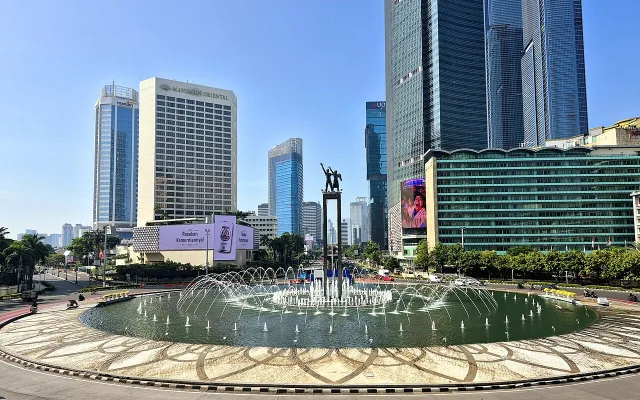
Jakarta is the capital of Indonesia, a huge metropolis with museums and traditional street eateries known as warungs.
Wiki
Jakarta is not a picture-postcard city, and most people pass through it in transit, wrongly skipping what is worth a day of their time. This is an enormous, noisy, in places chaotic metropolis where colonial Kota runs up against glass skyscrapers, and where the best food in the country is cooked not in restaurants but in street warungs. Two days are enough to see the main things and move on — to Java, Bali or the islands.
What is genuinely worth seeing
- The National Monument (Monas) — a 132-metre tower with a gilded flame, the symbol of independence. Entry is about 20,000 rupiah (roughly $1), with the climb to the top charged separately. The viewing platform gives a sense of the scale of the city, but in haze and at a traffic-choked midday the view is poor — go at opening or towards evening. At the foot is a large park where locals gather in the evenings.
- The old town, Kota Tua — the core of historic Jakarta. A Dutch quarter of the 17th century, Fatahillah Square, the city history museum in the former town hall, cafes in colonial mansions. This is the most walkable piece of Jakarta: everything is compact, so you can abandon transport and go on foot. At weekends it is busy and lively, and old bicycles are hired out.
- The National Museum — the largest in the country, with a collection of Javanese antiquities, masks, textiles and stone sculpture. The ticket is nominal, from 5,000 rupiah. A good way to get to grips with the culture of the archipelago before travelling on through the islands.
- Sunda Kelapa harbour — the old port, where wooden pinisi schooners still moor and are unloaded by hand. An atmospheric, unpolished place — come for the texture, not the comfort.
- Taman Mini (Taman Mini Indonesia Indah) — a miniature park with traditional houses from every province. It is far from the centre and takes half a day; take it on only if you want "all of Indonesia at once" and have time to spare.
Most of the shopping malls can be skipped without regret — there are dozens of them, but there is no reason to travel here specially to shop.
Getting there and getting around
Soekarno-Hatta airport is about 30 km west of the centre. The most predictable way in is the Railink airport train (about 70,000 rupiah, or $4), which bypasses the traffic. Taxis and Grab/Gojek will also take you, but at rush hour the journey can stretch to a couple of hours — leave a margin before a flight.
Within the city:
- TransJakarta (BRT) — a network of express buses on dedicated lanes, with a ticket at 3,500 rupiah (about $0.20). The most honest way to move about while avoiding the jams. Payment is by a transport card bought at the stations.
- The MRT — a modern metro, so far a single line, but fast and clean; handy for routes along the main axis of the city.
- Gojek and Grab — taxi and motorbike apps. The motorbike taxi (ojek) is a lifesaver in traffic and costs next to nothing, with a base fare from 10,000 rupiah ($0.60). For one person without luggage it is the fastest option.
- On foot Jakarta is not built for it: the pavements are broken, the distances long, the heat and humidity heavy. Walk selectively — around Kota, through the parks — and use transport between districts.
Where to stay and how long to allow
The best areas are around the business axis (Sudirman–Thamrin), or closer to Kota if you want the atmosphere of the old town. A budget hotel starts from 180,000 rupiah a night ($10), a decent mid-range one around 900,000 rupiah ($50). For two nights it makes sense to take a place next to a BRT or MRT station so as not to be at the mercy of the traffic.
Two days divide up simply: the first for Monas, the National Museum and the business centre; the second for Kota, Sunda Kelapa and the street food. Add Taman Mini only if you are staying for a third day.
Food
This is what makes Jakarta worth a stop. Here you can try all the Indonesian classics: nasi goreng (fried rice), mie goreng (noodles), soto ayam (chicken soup), sate (little skewers with peanut sauce). The warungs — street eating houses — are almost always tastier and two or three times cheaper than restaurants: a cheap filling lunch costs from 35,000 rupiah ($2), coffee around 35,000 rupiah ($2), dinner in a restaurant about 270,000 rupiah ($15). Prices are as of 2026. The rule is simple: where there is a queue of locals, the food is good.
Practical advice
- When to go — the dry season, roughly April to October. From November to March tropical downpours flood the streets, and the city with its traffic seizes up completely.
- Traffic is the main enemy of any plan. Do not try to squeeze points at opposite ends of the city into the same part of the day; group them by district.
- Keep cash to hand: warungs and small shops do not take cards.
- Safety is broadly normal for a big city — watch your pockets in crowds and at markets, and take care on the roads (the traffic is chaotic and crossings are few).
- Haggling is in order at markets and with ordinary taxi drivers; in the apps the price is fixed and fair — use Grab/Gojek so as not to overpay.
Jakarta is not the goal of a trip but its working start: in two days it gives a cross-section of the whole country — history, museums and the best street food — and then releases you to the islands.
Photos