Singapore
SGA city-state of barely 730 km² with the ambitions of a whole planet. Singapore is the futuristic Gardens by the Bay, the best street food in Asia in its hawker centres, immaculate cleanliness, Swiss-level safety and the multicultural mix of Chinatown, Little India and Arab Street. Expensive to live in, but astonishingly cheap to eat in — this is the country where Michelin stars go to street vendors.
Where to go #
What to see #
Gardens by the Bay: still the number one thing to see, and the free Garden Rhapsody light show runs at 19:45 and 20:45. Inside the Flower Dome and Cloud Forest conservatories it is properly cool, which is a relief in equatorial heat.
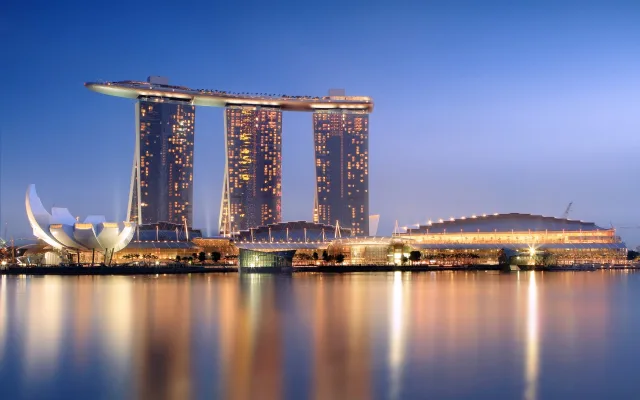
Marina Bay Sands SkyPark: the observation deck gives you a wider view than the observation wheel does, for roughly the same money. If you are choosing one high thing to pay for, choose this one.
Jewel at Changi Airport: worth a trip even if you are not flying that day, for the tallest indoor waterfall in the world and the gardens wrapped around it. Easy to reach on the MRT.
S.E.A. Aquarium on Sentosa: sharks and rays drift past a single enormous pane of glass. Good for a hot afternoon and genuinely impressive rather than merely large.
Botanic Gardens: the one garden in the region with a UNESCO listing, and the best possible way to start a morning before the heat builds. Free to enter, except the orchid section.
Spectra at Marina Bay: the fountain and light show on the waterfront runs at 20:00 and 21:00. Get there ten minutes early for a spot at the railing.
Can you do it in a day? Just about: Botanic Gardens in the morning, the ethnic quarters after lunch, the bay in the evening. Two days is far more comfortable.
Prices #
Currency: you need Singapore dollars in cash for hawker centres and small shops, even though the city is otherwise close to cashless. Exchange rates at the airport and in the malls are much the same, so don't hunt.
Cards: contactless Visa and Mastercard work almost everywhere, including transit gates, and Apple Pay and Google Pay are standard. Amex is accepted at hotels and larger restaurants but not reliably at small vendors.
ATMs and apps: withdrawals are straightforward and machines are everywhere. A Wise or Revolut card saves you the usual foreign-exchange markup, which adds up quickly over a week here.
Taxes: restaurants add 10% service and 9% GST on top of the menu price. Look for the "++" symbol beside a price so the final bill doesn't surprise you.
Tax refund: on purchases from 100 SGD you can claim GST back through the eTRS system at the airport before departure, but only if you showed your passport at the time of buying.
| Item | Price (USD) |
|---|---|
| MRT ride | 1.50 |
| Hawker centre lunch | 5.00 |
| Cafe dinner with a drink | 15.00 |
| Hainanese chicken rice | 4.00 |
| Beer in a bar, 0.5 l | 10.00 |
| Cappuccino | 4.50 |
| Cloud Forest entry | 35.00 |
| Universal Studios ticket | 65.00 |
| Capsule hotel, per night | 30.00 |
| Three-star hotel, per night | 110.00 |
| SIM card, 100 GB | 12.00 |
| Grab ride across town | 12.00 |
| Bottled water, 1.5 l | 1.20 |
| Souvenir T-shirt | 8.00 |
| SkyPark observation deck | 22.00 |
Getting around #
The MRT: the metro is the sensible way to move. Trains run every two to five minutes, the carriages are spotless and the air conditioning is fierce. Stations sit next to almost everything you came to see.
SimplyGo: you tap any contactless foreign card straight on the gate. No pass, no token, no queue. Tap in and tap out, and the fare is calculated for you.
Taxis: use Grab or Gojek rather than flagging one down or joining the rank outside a mall. It is cheaper, and you avoid haggling over the surcharges.
Buses: the network covers the whole island including the outer suburbs. Board through the front door and tap the reader. Tap again when you get off, or you will be charged the maximum fare for the route.
Tourist Pass: the unlimited pass only pays for itself if you make five or six journeys a day. Otherwise just use your bank card and forget about it.
On foot: the city is compact, but humidity and heat wear you down fast. Plan routes that duck through cool malls or underground walkways for part of the way.
Where to stay #
Where to base yourself: for a first visit, Chinatown or Bugis. Both have cheap beds, excellent food and an MRT station within a few minutes' walk. Lavender is another good balance of price and location.
Capsules: a Singapore speciality and better than they sound. You get a private pod with ventilation, sockets and a blind, so you keep your privacy while paying dormitory money.
Geylang: the cheapest rooms in the city, with the caveat that this is the red-light district. It is safe enough, but the atmosphere won't suit everyone.
Marina Bay: staying at the famous ship-topped hotel is only worth it for the rooftop pool, which guests alone can use. On a tighter budget, pay for the observation deck instead and sleep elsewhere.
Deposits: nearly every hotel blocks a deposit on your card at check-in, and it can be a substantial sum. Check the amount in advance and keep headroom on the card.
Booking: international booking sites work fine, and Trip.com often has the sharpest prices in this part of Asia and handles foreign payment cards without fuss.
What to eat #
Hawker centres: covered markets with dozens of stalls where millionaires and construction workers eat side by side. Maxwell and Old Airport Road are the classics, with honest food at low prices. Hawker culture is on UNESCO's intangible heritage list.
Michelin for five dollars: this is the city where a starred dish costs less than a coffee. Hill Street Tai Hwa Pork Noodle and Hawker Chan in Chinatown are the famous two, and yes, you will queue.
What to order: Hainanese chicken rice and laksa with coconut milk are the non-negotiables. Chilli crab is an expensive pleasure, best ordered by a group in a proper seafood restaurant.
Drinks: try kopi, local coffee with condensed milk, or teh tarik. Tap water is entirely safe to drink, which quietly saves you a fortune in bottles over a week.
Durian: the world's most pungent fruit is loved here and strictly banned from hotels and public transport. Break that rule and the fine is real.
Hygiene: every stall carries a health grade of A, B or C. Even a B-grade stall meets strict standards, which is why food poisoning here is genuinely rare.
Safety #
The fines: Singapore is called a fine city for a reason. Spitting, feeding pigeons and crossing the road away from a crossing all carry penalties. Follow the rules and you will never notice them.
On the MRT: eating is banned, and so is drinking, even plain water. A mouthful from your bottle can cost 500 SGD. Wait until you are back on the street.
Smoking: only in designated zones, marked by yellow squares painted on the pavement. Along Orchard Road and in the parks, it is effectively banned everywhere.
Vapes: e-cigarettes, heated tobacco devices and the liquids for them are illegal. Don't try to bring them in your luggage; the Changi scanners are looking for exactly this, and possession fines reach 2000 SGD.
Drugs: trafficking carries the death penalty, and possession is treated with the same severity. The law applies to foreign visitors without exception or discretion.
Chewing gum: importing gum for sale is prohibited, though customs will let a personal pack through. Bin it properly — littering is its own fine.
Otherwise: violent crime is close to nonexistent and walking alone at night is normal. Check your own government's travel advisory if you want the formal position.
Etiquette and culture #
Singlish: the local dialect of English sounds odd at first, salted with Malay and Chinese. Little particles like "lah" or "can" tacked onto the end of a sentence carry the emotion. Standard English is understood by everyone.
Kiasu: a local word for the fear of missing out or coming second. It explains the enormous queues for a new gadget or for a stall that someone said was good.
Shoes off: always remove them before entering a home, a mosque or a Hindu temple. In some small shops and cafes in the ethnic quarters, people leave shoes at the door too.
Chope: a packet of tissues or an umbrella left on a hawker centre table means the seat is taken. Everyone respects it. Claim your table first, then go and order.
Table manners: in Indian and Malay places, eat with your right hand; the left is considered unclean. In Chinese restaurants, never stand chopsticks upright in rice, which echoes a funeral rite.
Dress for the aircon: despite the heat outside, the MRT and the malls are freezing. Carry a light layer or a scarf so you are not shivering through lunch.
Connectivity #
Local SIM: tourist cards from Singtel or StarHub are sold in the arrivals area at Changi. They usually cost 12-15 SGD, include 100 GB and last 7-12 days. Bring your passport to register.
eSIM: if your phone supports it, install Airalo or a similar app before you fly and you will have data the moment you land. The local physical SIM is often better value once you are in the city.
Wi-Fi: the free Wireless@SG network covers most public places, though registration frequently wants a local mobile number. Large malls and the airport run their own open networks.
Apps worth having: Grab for cars, Google Maps for transit routing. It reads the MRT and bus network accurately, including the walking connections between lines.
Coverage: 4G and 5G work perfectly, including deep inside the metro tunnels. Dropouts within the city simply don't happen.
Calling home: use messaging apps. Voice calls over WhatsApp and Telegram run without restriction and spare you international rates entirely.
Phrasebook #
| English | Singlish | Pronunciation |
|---|---|---|
| Yes / No | Can / Cannot | kahn / KAHN-not |
| Thank you | Thank you lah | thank-yoo LAH |
| Sorry | Sorry lah | SOR-ree LAH |
| How much is it? | How much ah? | how-much AH |
| That's delicious! | Shiok! | shee-OK |
| Takeaway, please | Tabao | tah-BAO |
| To eat / a meal | Makan | MAH-kahn |
| Coffee with milk | Kopi | KOH-pee |
| Black coffee | Kopi-O | koh-pee-OH |
| Tea | Teh | teh |
| Pulled milk tea | Teh tarik | teh TAH-rik |
| Oh no! | Alamak! | ah-lah-MAHK |
| Sir (older man) | Uncle | UNG-kul |
| Ma'am (older woman) | Auntie | AHN-tee |
| Where is it? | Where got? | where-got |
| Understood | Understand | un-der-STAND |
| The bill, please | Bill please | bill-pleez |
| To reserve a table | Chope | chope |
| Afraid to miss out | Kiasu | KYAH-soo |
| Spicy | Spicy | SPY-see |
| Water | Water | WAH-ter |
Good to know #
Getting there: Singapore is one of the best-connected airports on earth. There are nonstop flights from London, Frankfurt, Paris and Amsterdam, and long-haul services from New York, Los Angeles and San Francisco. Connecting through Doha, Dubai or Istanbul with Qatar Airways or Emirates is usually the cheapest way in from Europe.
Arrival card: everyone must file the free SG Arrival Card online within three days of landing, on the official ICA site or in the MyICA app. Ignore any site that asks you to pay for it, since the real service costs nothing.
Weather: it is summer all year at around 30°C, and it rains most days. The rain is heavy and short. Carry an umbrella or a light rain shell and you will barely notice.
Plugs: the British three-pin type. Adapters cost a couple of dollars in any 7-Eleven, or the hotel front desk will usually lend you one.
Tipping: the 10% service charge is already on the bill in most places, and tipping on top is not expected. Leaving small change in a taxi or a cafe is taken kindly, nothing more.
Emergencies: dial 999 for police, 995 for ambulance and fire. Response is fast and the operators speak English.