Description
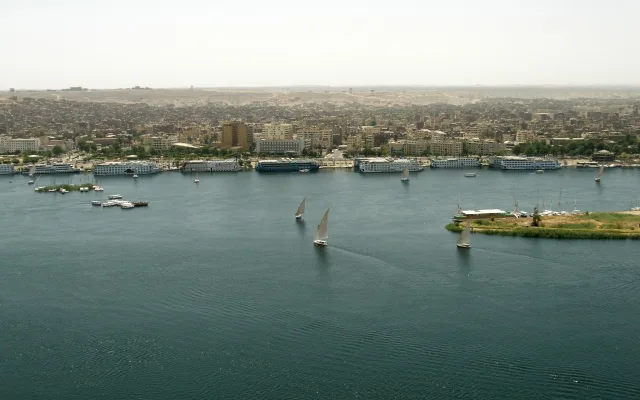
Egypt's southernmost city on the Nile — the temple of Philae, Abu Simbel, the High Dam and feluccas under sail.
Wiki
Aswan is Egypt's southernmost large city, the point where the Nile narrows and the heat turns drier than in Cairo. People come for the day trip to Abu Simbel, for the temple on its island, and for the particular rhythm of a place where a felucca under sail does the work of public transport.
Is it worth it, and how long to allow
Two days is enough, but they need dividing sensibly. Day one is Aswan itself: the island temple of Philae, the unfinished obelisk, a felucca on the Nile at sunset. Day two is effectively eaten by Abu Simbel: an early start, traditionally before dawn, and around three hours each way across the desert. If you plan to continue by cruise boat to Luxor, Aswan is the logical starting point — most boats leave from here.
Do not try to squeeze Abu Simbel and a proper look at the city into one day; it turns into a race. Better to arrive in the evening, sleep, and set off for the temples fresh.
Getting there and around
To the city. Flying from Cairo is quickest, about an hour; the train takes a night but is cheaper and skips the airport, and sleeper berths should be booked ahead. From Luxor the daytime train, roughly 3 hours, is a fine way to watch the Nile valley go past.
Around town. The centre is compact and the Corniche is walkable end to end. The key thing about Aswan is that the city sits on two banks and several islands, so the real transport is water. Public motor-launch ferries cross to the west bank and the islands for next to nothing; a felucca is for the ride and the atmosphere. Taxis exist, but always agree the fare before getting in.
To Abu Simbel. Buses and minivans leave in an organised early-morning run. For those who value time there is a short domestic flight instead: it saves most of a day but costs considerably more.
Where to stay
- The Corniche (east bank) — all the infrastructure, the station, cafés, boat departures. Convenient, but noisy and without the view.
- Elephantine Island — Nubian guesthouses in among the village, quiet, reachable only by boat. The best choice for atmosphere, as long as you accept depending on the ferry.
- The west bank — sunset views and the Aga Khan mausoleum, greener and calmer.
Hotels with a terrace over the Nile earn their price: the sunsets here really are among the best in the country.
Practicalities: money, haggling, safety
Aswan is noticeably cheaper than Cairo or the Red Sea resorts. Cash matters — cards are not taken everywhere, least of all by boatmen and in the Nubian villages. Haggling is expected for everything: feluccas, taxis, souvenirs. The opening price for a foreigner is usually two to three times what it should be, so bargain without embarrassment.
The city is safe and easy-going, but expect persistent touts along the Corniche and on the approaches to the sights. The classic scam is the boatman who promises an "included" tour and then asks for a surcharge at every island; fix the route and the total out loud beforehand. Women travel comfortably here, though covered clothing removes unnecessary attention.
What is actually worth seeing
- The Temple of Philae on Agilkia Island — reachable only by launch, which is part of the pleasure. Go near opening time or late in the day, when the heat and the crowds ease.
- Abu Simbel — essentially the reason people come to Aswan. The colossi of Ramesses II are overwhelming in scale, and the rescue of the temples from the rising water is visible in the block seams inside the artificial hill.
- The Aswan High Dam — the structure that created Lake Nasser, flooded Nubia and forced the temple rescues in the first place. A short stop, usually tacked onto the Abu Simbel run or the boat to Philae.
- The unfinished obelisk — quick to see but a clear lesson in ancient engineering: you can make out how the granite was cut from the bedrock and why the work was abandoned when it cracked.
- The Nubian villages (Gharb Soheil, Gharb Aswan) — painted houses, spices, tame crocodiles. Be honest with yourself about the ethics of the crocodile photo; the animals are kept in cramped boxes.
- The botanical garden on Kitchener's Island — shade and a break from the glare, easily combined with a felucca trip.
Food
Look for grilled bolti, the Nile tilapia that is the local speciality. The basic backpacker staples, koshari and ful, cost very little in the street places set back from the Corniche, away from tourist pricing. Dinner with a river view costs more, but you are paying for the view rather than the kitchen.
When to go
October to April is best: warm days and comfortable evenings. Summer turns Aswan into a frying pan, over 40°C, though visitors thin out and prices fall — an option if you tolerate heat and want quiet. Twice a year, on 22 February and 22 October, the rising sun reaches deep into the temple at Abu Simbel and lights the statues in the sanctuary; it is worth timing a trip for, and worth arriving early, because the temples are packed on those days.