Description
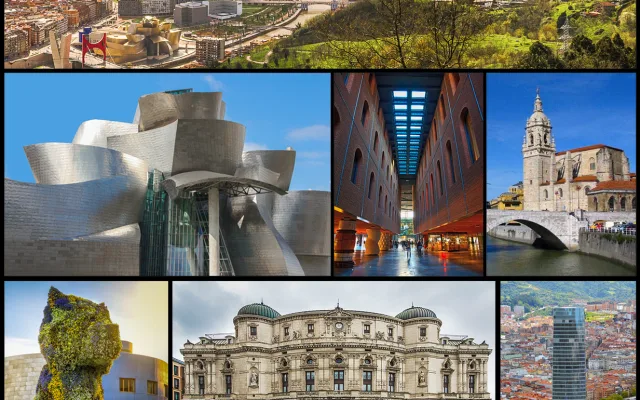
A Basque metropolis transformed by Frank Gehry's Guggenheim Museum, home to Spain's finest pintxo bars and one of Europe's most remarkable urban reinventions.
Wiki
Bilbao surprises. An industrial port city that within a couple of decades became one of Europe's cultural capitals — without losing its Basque character in the process. Two days are enough to see the highlights, work out the pintxo circuit properly and take the funicular up for a panorama — but you will find yourself reluctant to leave.
Why go and how long to allow
Bilbao is compact, and that is one of its great strengths: almost everything is within walking distance along the Nervión river. Two days is a realistic minimum. Day one: the Guggenheim and the waterfront. Day two: the Old Town (Casco Viejo), the market and the funicular. If you are here for architecture and food, two days is enough; if you want day trips to the Basque coast — San Sebastián, Getxo, Guernica — add a third.
The city's defining quality is contrast. In a single day you can move from former shipyards turned into parks and pedestrian riverwalks, past a titanium museum of world standing, and into the medieval Siete Calles with bars where people stand elbow to elbow.
Getting there and getting around
The airport (BIO) is 12 km to the north. An express bus (Bizkaibus A3247) runs into the centre — cheap, direct and frequent, with stops at Plaza Moyua and the bus station. A taxi costs noticeably more and is only worth it for a group or with heavy luggage.
Within the city, walking is the easiest option: Guggenheim to Casco Viejo takes 20–25 minutes along the river, and it is one of the best walks in town. The metro (designed by Norman Foster and recognisable by its curved glass entrance canopies, nicknamed fosteritos) is useful for travelling along the main corridor and out to the coast at Getxo. The tram (Euskotran) runs along the river past the main sights — handy when your feet need a rest. Single tickets are fine for occasional use, but the rechargeable Barik card is better value if you are moving around a lot.
Tip: use the river as your navigational spine — it is almost impossible to get lost in Bilbao.
What is genuinely worth seeing
- The Guggenheim — not just inside, but outside. Walk the full circuit: from the riverside, from the La Salve bridge, in the evening when it is lit up. Jeff Koons's Puppy (a giant floral sculpture), Louise Bourgeois's Maman spider, and the water and fire installations by the water's edge are all free. Buy tickets online in advance — queues are real.
- Casco Viejo — the heart of the evening. The Siete Calles (Seven Streets), the Cathedral of Santiago, and the arcaded Plaza Nueva (flea market and bric-a-brac swap on Sundays).
- Mercado de la Ribera — a covered riverside market, well worth a look for Basque produce and a quick bite.
- Artxanda Funicular — lifts you up the hillside in a few minutes to the best panoramic view of the city and the river bend. Go in the late afternoon, in time for sunset.
- Museum of Fine Arts — an underrated alternative to the Guggenheim: Goya, El Greco, Basque masters, and usually cheaper (free entry at certain hours — check on arrival).
- Azkuna Zentroa (formerly the Alhóndiga wine warehouse) — a civic space redesigned by Philippe Starck, with a rooftop pool and its famous colonnade of 43 different columns.
Food: how to eat pintxos properly
Pintxos — the Basque take on tapas — are a ritual, not a meal. The format: walk into a bar, pick one or two pintxos and a glass, pay, move on to the next place. Over the course of an evening you visit three or four bars — this is the local version of dinner, called txikiteo. The main zones are Casco Viejo (Plaza Nueva, Calle Somera) and the Indautxu/Gran Vía area for a slightly calmer crowd.
What to try: gilda (olive, anchovy and pickled pepper on a skewer — the classic), bacalao al pil-pil, txuleta (Basque bone-in beef steak, ordered to share), and the cheese Idiazabal. To drink: local white txakoli, poured theatrically from a height, or a Rioja.
Price-wise, Bilbao feels noticeably cheaper than San Sebastián or Barcelona: eating well on pintxos costs very little as long as you stay out of the tourist spots near the museum. Costs only climb for a full sit-down dinner at a cider house or high-end restaurant.
Budget tip: lunch is best done as menú del día (a set weekday lunch) — the best-value meal in Spain. Pintxos on the counter usually have a fixed price; made-to-order hot pintxos cost more but are worth it.
When to go and things to keep in mind
The best time to visit is May to September, mild and free of southern heat. Bear in mind that Bilbao sits in green, Atlantic-facing Spain — rain is possible in any season, and a light waterproof layer is useful even in summer. Aste Nagusia (the Big Week festival) at the end of August is the city's main celebration, with concerts and fireworks: atmospheric, but accommodation fills up and prices rise well in advance.
Where to stay: Casco Viejo puts you in the thick of bars and nightlife (it can be noisy); Abando/Indautxu is more central, quieter, and close to the metro and main station. Both are within walking distance of everything.
Bilbao is a safe city; normal urban awareness in crowds and markets is all that is needed. The classic visitor mistake is reducing the city to the Guggenheim alone and leaving; the second is ordering pintxos as a sit-down meal in one place instead of moving between bars. And remember: this is the Basque Country — signs appear in Euskara alongside Spanish, and locals notice when visitors acknowledge that.