Cape Town
South AfricaDescription
The Mother City beneath Table Mountain — Robben Island, the V&A Waterfront and the penguins of Boulders Beach.
Wiki
Cape Town is the oldest city in South Africa and its legislative capital, spread like an amphitheatre between the Atlantic and Table Mountain. Founded by the Dutch in 1652 as a staging post for the East India Company, it is today the cosmopolitan centre of the Western Cape, with a metropolitan population of nearly five million, where African, European, Malay and Indian cultures meet.
Geography and climate
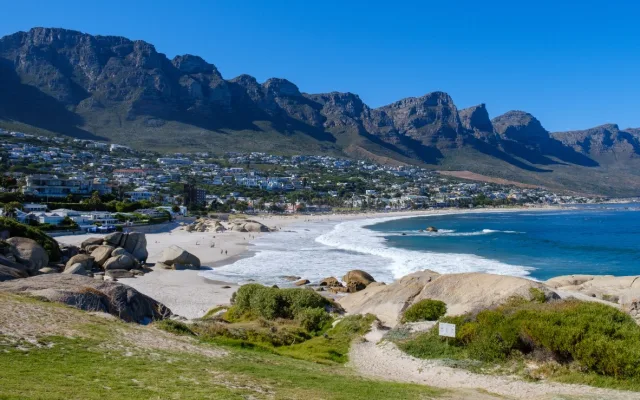
The city lies on a narrow strip between the sea and the mountain massif, crowned by the flat summit of Table Mountain (1,086 m) and its neighbours, Lion's Head and Devil's Peak. This relief creates many microclimates and the famous winds: the summer south-easter, the Cape Doctor, clears the cloud and brings cool air.
The climate is Mediterranean. Summer (December to March) is dry and sunny at 25-28°C, and this is high season. Winter (June to August) is mild and rainy at 15-18°C. One important detail: the Atlantic water at the western beaches is cold all year (12-16°C) because of the Benguela current, while False Bay is noticeably warmer.
Main sights
- Table Mountain. The rotating cable car takes a few minutes; walking routes such as Platteklip Gorge take two to three hours. The plateau gives a panorama of the city, the bay and the peninsula.
- Robben Island. The island museum on the UNESCO list, where Nelson Mandela spent more than two decades. Tours are led by former prisoners; the boat from the Waterfront takes about half an hour.
- Bo-Kaap. The historic Cape Malay quarter on the slope of Signal Hill, recognisable by its brightly painted houses, mosques and cobbled lanes.
- The V&A Waterfront. A busy harbour with a Ferris wheel, the Two Oceans Aquarium, markets and the jetties from which ferries and pleasure boats depart.
- The District Six Museum. An exhibition about the district whose "coloured" population was forcibly removed during apartheid.
- Kirstenbosch. A world-class botanical garden at the eastern foot of the mountain, with endemic fynbos, proteas and the Boomslang canopy walkway.
The Cape and the peninsula
The Cape Peninsula runs south to the Cape of Good Hope national park. On the way are the African penguin colony at Boulders Beach, reached by boardwalks, the town of Simon's Town, and the scenic Chapman's Peak Drive above the Atlantic. At the tip are the Cape Point viewpoints with their old lighthouse; ostriches, bontebok and impudent baboons live in the area, and the baboons must not be fed.
Beaches and nearby
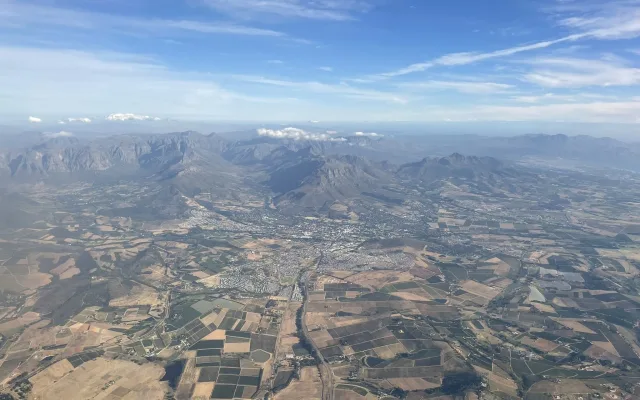
The Atlantic seaboard means glamorous Clifton and Camps Bay, with white sand and a view of the Twelve Apostles. Swimming is chilly, but the sunsets and the atmosphere are pure holiday. Only 40 to 60 minutes away lies the winelands: Stellenbosch, Franschhoek and Paarl are known for their 17th- and 18th-century estates, tastings and food. A hop-on wine tram runs through the valleys.
Food
Cape cooking reflects the history of the trade routes. Try bobotie, spiced mince baked under an egg crust; the hearty bunny chow, a hollowed loaf filled with curry; the substantial gatsby sandwich; homemade boerewors at a braai; and Malay dishes with dried apricots and spice. The local wines — chenin blanc, pinotage and Cap Classique sparkling — are among the best on the continent. Markets such as the Old Biscuit Mill offer street food from around the world.
Practicalities
Five days is enough for a good visit: one for the mountain and the centre, one for Robben Island and the Waterfront, one for the peninsula with the penguins and the Cape, one for the wineries, and one for beaches and museums with some slack for the weather — the mountain is often covered by its "tablecloth" of cloud. Hiring a car is easiest (traffic drives on the left), or you can use tours and sightseeing buses. The currency is the South African rand, and cards are accepted everywhere.
As in any large city, take care: do not display valuables, avoid empty places after dark and use transport you trust. The tourist districts are patrolled and comfortable enough for independent travellers.