Description
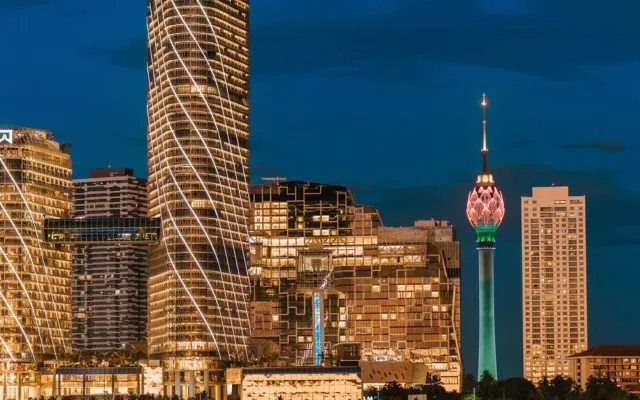
The capital of Sri Lanka — Galle Face Green, the Fort, the Pettah bazaar and the tea boutiques.
Wiki
Colombo is often skipped on the way to the beaches and the mountains, and that is a mistake: a couple of days here give a good start on understanding the country, from the colonial inheritance to the layered street life. It is not about postcard views but about markets, tea shops, sunset on the promenade and a first encounter with Sri Lankan food before the long road ahead.
Why come, and for how long
Colombo is neither a beach resort nor an open-air museum but a working capital, mixing Sinhalese, Tamils, Muslims, the descendants of the Burghers and Chinese. Since the end of the civil war in 2009 the city has been building hard: the Port City district has risen on reclaimed land, and the 350-metre Lotus Tower has become the new landmark.
Two days is enough to cover the key points without rushing. Many people use the city as a staging post: the airport is closer to Negombo than to Colombo itself, so it makes sense to plan it for arrival or departure.
Getting there and getting around
- The airport (BIA) is about 30-35 km to the north, near Negombo. Into the centre people take a taxi or use PickMe, the local equivalent of Uber, usually cheaper than street drivers. There are buses too, but with luggage a car is easier.
- Tuk-tuks are the main transport within the city. Look for ones with a meter or booked through PickMe; otherwise agree the fare before getting in.
- Trains — a scenic line runs along the coast, and Fort station is the departure point south (Galle, Mirissa) and into the mountains (Kandy, Ella). Tickets are cheap and the views from the window are part of the experience.
- On foot — the Fort and Pettah are compact and best seen walking, but between the outlying points take a tuk-tuk: the heat and the traffic wear you down.
What is genuinely worth seeing
- Galle Face Green — a 500-metre promenade by the ocean. Come in the evening: sunset over the Indian Ocean, kites, crowds of locals and rows of street food. A good place to feel the rhythm of the city.
- Pettah — a dense trading quarter where the streets are divided by trade. Here are colonial-era Dutch warehouses and the vivid red-and-white Jami Ul-Alfar mosque. Go in the morning, travelling light and without valuables on show.
- The Fort — the old administrative core with British and Dutch buildings, restored blocks and office towers alongside.
- Gangaramaya — the principal Buddhist temple, an eclectic temple-museum with Hindu and Chinese Buddhist elements. On nearby Beira Lake stands the photogenic floating temple of Seema Malaka, by the architect Geoffrey Bawa.
- Independence Memorial Hall and Independence Square — where independence from Britain was proclaimed in 1948, and a pleasant area to walk.
- The National Museum — for context on the island's history before heading inland.
- The Lotus Tower — an observation deck; people go for the view over the city from height.
- Mount Lavinia — a beach suburb about 12 km out, where people escape the city bustle for sunset and seafood.
Food and prices
Sri Lankan cooking is hot and filling: rice and curry (several kinds of vegetables, dal, coconut sambol), kottu (chopped roti with vegetables and meat, made to the ringing of blades), and hoppers, thin bowl-shaped pancakes, often with an egg. All of it is cheap in local places and on Galle Face Green. Do not skip the tea boutiques: the country is one of the world's tea capitals, and Ceylon tea is bought here both to try and to take home.
The city feels inexpensive for a traveller: street food and local transport cost very little, and only the hotels in the new districts and imported goods are noticeably dearer. People save on taxis (use the apps), on food (eat where locals eat) and on water (buy bottled, in large volumes).
Where to stay
- Fort and Pettah — in the thick of it, close to the station and the markets, convenient for a short stop.
- Galle Face and Kollupitiya — nearer the ocean and the promenade, calmer and with a view.
- Mount Lavinia — if you want the beach and quiet at the cost of distance from the centre.
Practicalities and common mistakes
- When to go. The west coast is drier from roughly December to March. In the rainy season the downpours are short but sharp.
- Dress at temples. Shoulders and knees covered, shoes off. Do not turn your back on a Buddha statue for a photograph — it is considered disrespectful.
- Money. Cash in Sri Lankan rupees is needed for markets and tuk-tuks; cards are not accepted everywhere.
- Safety. The city is generally calm; watch your belongings in the crush of Pettah and do not agree to "special tours" from touts at the temples.
- The main mistake is trying to sprint through Colombo in half a day between flights. Either give it a day or two, or honestly treat it as transit and head for the coast.