Description
A volcanic island — Hallasan, waterfalls, lava tubes and the haenyeo, the women who free-dive for a living.
Wiki
Jeju is the largest island in South Korea, lying in the strait south of the Korean Peninsula and forming a self-governing province of its own. Created by volcanic activity, this southern edge of the country combines subtropical nature, black lava shores and a distinctive island culture, which makes it the most popular holiday destination for Koreans themselves and for visitors from neighbouring countries.
Nature and the main sights
- Hallasan — an extinct volcano 1,947 m high, the highest point in the Republic of Korea, surrounded by the national park of the same name. The crater at the summit holds Baengnokdam lake, and the slopes pass through vegetation belts from subtropical forest to alpine meadow. Several trails of varying length and difficulty are marked out; access to the highest routes is usually regulated by time of day.
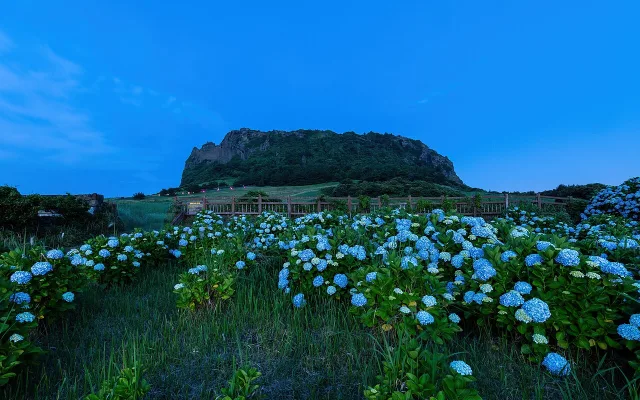
- Seongsan Ilchulbong (Sunrise Peak) — a striking tuff crater on the east coast, rising straight out of the sea. It is a UNESCO World Natural Heritage site and is considered one of the finest places to watch the sunrise.
- Waterfalls — the Cheonjeyeon and Cheonjiyeon cascades are in the south of the island, while the Jeongbang falls are notable for dropping almost directly into the sea. Parkland and trails surround them.
- The Manjanggul lava tubes — one of the longest lava caves on the planet; part of the system, with its frozen stone formations, is open to visitors.
- Coastal scenery — the columnar basalt cliffs of Jusangjeolli, headlands and black beaches alternate with pale sandy bays such as Hyeopjae.
The haenyeo and the island's heritage
Jeju's calling card is the haenyeo, the women divers who go down without air tanks for shellfish, abalone and seaweed. The tradition is on the UNESCO list of intangible cultural heritage and reflects the matriarchal order of the coastal communities. Their work and daily life can be seen along the shore and in a museum devoted to the craft.
The island's emblem is the dol hareubang, the "stone grandfather" figures carved from porous basalt and regarded as protective charms. The local dialect differs noticeably from standard Korean, and traditional villages, with their thatched and tiled roofs and walls of volcanic stone, preserve the feel of the old island life.
Food
Island cooking is built on what the sea and the volcanic soil provide.
- Raw fish and hoe — fresh seafood, some of it brought up by the divers: abalone, octopus, shellfish.
- Black pork — the meat of the local pigs, grilled at the table; one of the signature dishes.
- Mandarins — citrus from the plantations in the south of the island, including a large knobbly-skinned variety, turned into juice and sweets.
- Abalone porridge and seafood soups — hearty traditional dishes of the coastal villages.
Lunch at a local eating house runs 10,000-15,000 won (about $7-11), a plate of black pork for two 40,000-60,000 won ($28-42), and a compact hire car from 50,000 won a day ($35). Admission to Seongsan Ilchulbong is 5,000 won ($3.50) and to the Manjanggul lava tube 4,000 won ($3). Prices are as of 2026.
Getting there and getting around
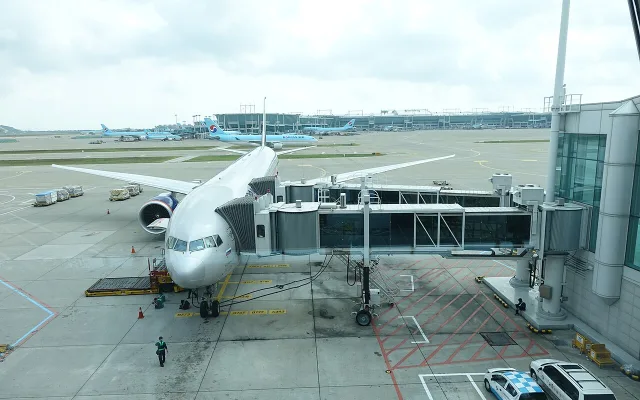
The main way to reach the island is by air. Jeju airport takes frequent flights from Seoul, Busan and other cities in the country, and the Seoul–Jeju route is reckoned one of the busiest air corridors in the world; there are international flights as well. Ferries run from the mainland coast and will carry a car.
Around the island itself a rental car is the easiest option: the roads are good and many of the natural sights are scattered along the coast and inland. There is a network of scheduled buses linking Jeju City in the north and Seogwipo in the south with the attractions. Cycle touring is well established too — a coastal loop runs right around the island.
When to go
A mild climate, the warmest in the country, makes Jeju appealing all year. Spring (April–May) brings cherry blossom and golden fields of rape. Summer is warm and humid, good for swimming and the beach, but it falls in the rainy season and typhoons are possible. Autumn gives clear dry weather and good visibility for climbing, and winter is mild: snow settles mainly on the summit of Hallasan, in contrast with the green coast.
Three days on Jeju
- Day 1. The eastern side: sunrise at Seongsan Ilchulbong, the Manjanggul lava tubes, a walk along the coast and the divers' villages.
- Day 2. A climb or a walk on the trails of Hallasan National Park, with the evening in Seogwipo.
- Day 3. The south coast: the Cheonjeyeon and Jeongbang waterfalls, the basalt cliffs, Hyeopjae beach and the local cooking.