Description
Malaysia's duty-free archipelago — Cenang beach, mangrove safaris and the cable car up Mount Mat Cincang.
Wiki
Langkawi is an archipelago of 99 islands — 104 at low tide — in the Andaman Sea off north-west Malaysia, right up against the Thai border. The main island, Pulau Langkawi, has around 95,000 residents and combines duty-free status, good beaches, old jungle and the distinction of being Southeast Asia's first UNESCO Global Geopark.
Background and history
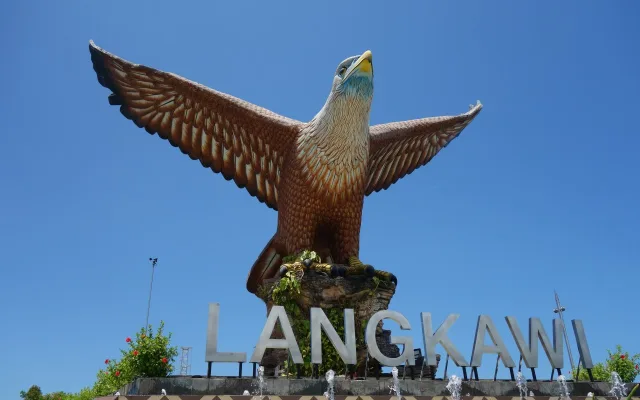
Langkawi belongs to the state of Kedah and lies some 30 km off the mainland coast. The name is usually traced to Sanskrit roots meaning "island of the reddish-brown eagle", which is why an eagle presides over the main square. Geologically the archipelago is among the oldest land in the region: its limestone and sandstone are hundreds of millions of years old, and in 2007 that earned Langkawi its UNESCO Geopark listing.
For a long time the islands were a poor fishing backwater, known mainly for the legend of Mahsuri and her curse. The turning point came in 1987, when Langkawi was declared a duty-free zone: alcohol, chocolate, perfume, tobacco and tableware are noticeably cheaper here than on the mainland. From the 1990s roads, an airport and resorts went up quickly, and today the islands are one of Malaysia's main beach destinations.
The main sights
- Langkawi Sky Bridge — a curved suspension footbridge 125 m long, hanging around 660 m above sea level over the jungle of Mount Mat Cincang. You reach it on the Panorama Langkawi cable car, one of the steepest in the world, with middle and top viewing stations.
- Eagle Square (Dataran Lang) — the 12 m eagle sculpture beside Kuah harbour, the island's emblem and the point where ferries arrive.
- Kilim Karst Geoforest Park — a mangrove boat safari between limestone cliffs, with sea eagles and kites, macaques, monitor lizards and bat colonies in the caves.
- Telaga Tujuh (Seven Wells) — a chain of seven natural pools and waterfalls in the jungle at the foot of Mat Cincang.
- Pulau Payar Marine Park — a marine reserve about an hour to the south, the best snorkelling and diving in the area.
- Underwater World Langkawi — a large aquarium in Pantai Cenang with penguins and a walk-through tunnel.
- Lagenda Park, Galeria Perdana and Mahsuri's mausoleum, for the island's legends and history.
Beaches and nature
Pantai Cenang is the main and busiest beach, the centre of tourist life with bars, restaurants, rental shops and water sports. Quieter Pantai Tengah lies next door. In the north, Tanjung Rhu is one of the most scenic and least crowded beaches, white sand with karst islets offshore. The interior is rainforest, still home to monkeys, hornbills and deafening cicadas. Sunset cruises around the archipelago are popular, usually with a swim stop and a look at Pulau Dayang Bunting, the "island of the pregnant maiden", with its freshwater lake ringed by limestone.
Food
The cooking is Malay and Chinese-Malay. Look for nasi lemak (rice in coconut milk), char kway teow, satay, laksa, the shaved-ice dessert ais kacang and, in season, durian. The island position means plenty of fresh seafood — fish, squid, crab and prawns off the grill. Cheap meals are found in hawker centres and at the pasar malam night markets, which rotate around the villages every evening; the biggest is in Pantai Cenang. Resort restaurants cost more but offer a wide international choice.
Practicalities
Flying is easiest: Langkawi International Airport takes flights from Kuala Lumpur, Penang, Singapore and elsewhere. The alternative is a ferry from Kuala Kedah, Kuala Perlis or Penang into Kuah port. On the island a rented car or scooter is the sensible way to move around — public transport is thin, and taxis are best arranged in advance.
The currency is the Malaysian ringgit, and duty-free goods are worth buying here rather than later. The best time to visit is the dry season from November to April; between May and October expect rain and rough seas, which can cancel boat trips. Five days is enough to take in the cable car and Sky Bridge, the Kilim mangroves, snorkelling at Pulau Payar, the Telaga Tujuh waterfalls and beach time at Cenang and Tanjung Rhu without rushing.