Description
Myanmar's cultural capital: the royal palace, Mandalay Hill, craft workshops and the former capitals of Inwa, Sagaing and Amarapura.
Wiki
Mandalay is Myanmar's second city and its last royal capital, founded by King Mindon in 1857 in the dry heart of the country, on the east bank of the Irrawaddy. About 1.2 million people live here, and Burmese consider this the spiritual and cultural centre of the nation: craft traditions, Buddhist shrines and the remains of Konbaung court culture have all survived here.
History
The city takes its name from Mandalay Hill, at whose foot Mindon raised his new capital, moving the court from Amarapura. Tradition holds that the site was chosen because of a prophecy that a great city of the faith would arise here on the 2,400th anniversary of Buddhism. The kingdom did not last long: in 1885, after the Third Anglo-Burmese War, the British took the city, sent the last king, Thibaw, into exile in India and annexed Upper Burma to their colonial possessions. During the Second World War the historic centre was badly damaged, the wooden palace burned down, and the buildings now standing inside the fortress walls are a reconstruction.
The main sights
- The Royal Palace — a rebuilt ensemble of dozens of pavilions inside a vast square fortress with a moat and crenellated walls. The residence of kings Mindon and Thibaw gives a sense of how a Burmese court was laid out; a watchtower survives on the grounds.
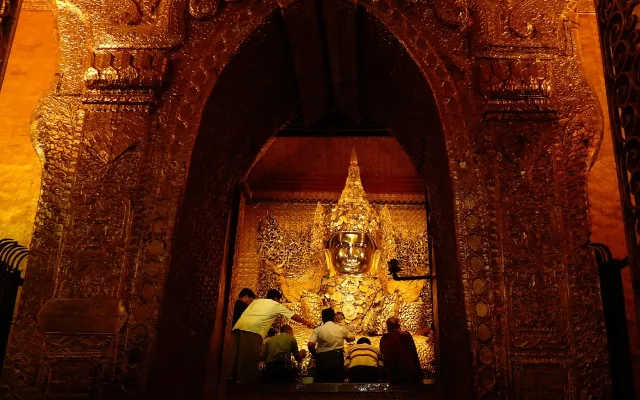
- Mahamuni — the city's most important shrine and one of the country's greatest. The cast bronze Buddha has disappeared over the centuries beneath a layer of gold leaf several centimetres thick, applied by male pilgrims as an act of devotion. Early each morning the statue's face is ritually washed.
- Kuthodaw — the complex nicknamed the world's largest book: 729 white marble slabs inscribed with the Pali canon of the Tipitaka, each sheltered under its own whitewashed stupa. Sandamuni, conceived along similar lines, stands nearby.
- Mandalay Hill, about 240 metres high, crowns the city; a long covered stairway climbs past monasteries and statues to the pagoda at the top, from where the plain and the bend of the Irrawaddy open up — especially fine at sunset.
- Shwenandaw Monastery — a surviving fragment of the earlier wooden palace and a masterpiece of teak carving, covered in the finest ornament and figures.
Around the city
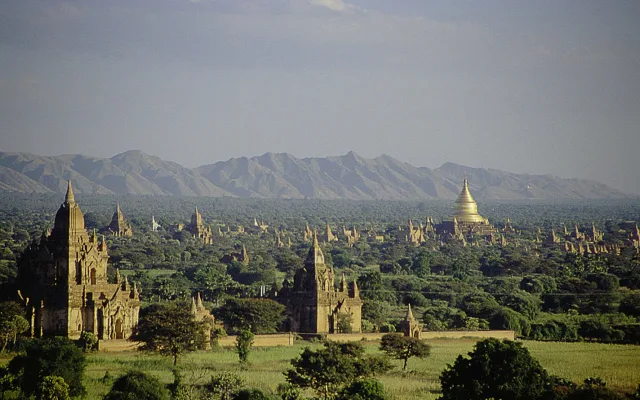
The valley around Mandalay holds the traces of earlier capitals, which the Burmese moved from place to place.
- Inwa (Ava) — an ancient capital on a river island, reached by boat across a channel. Horse carts carry visitors through fields among ruined pagodas and a leaning watchtower; here stand the teak Bagaya Monastery on its massive black posts and the brick Maha Aungmye Bonzan.
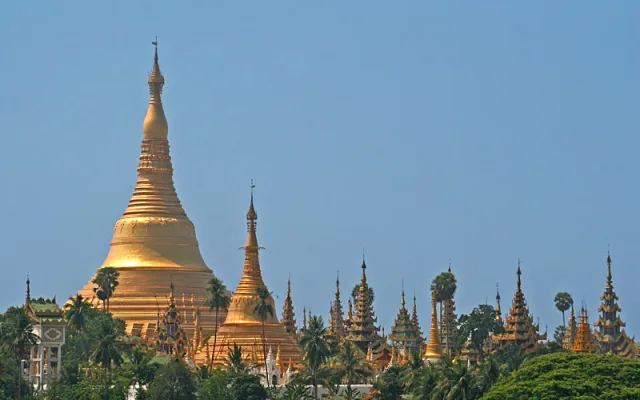
- Sagaing — the hill of a thousand pagodas on the far bank, scattered with white and gold stupas and working monasteries, and one of the country's centres of monastic learning.
- Amarapura is famous for the U Bein bridge, a wooden crossing about 1.2 km long assembled from teak piles salvaged from a dismantled palace. At dawn and dusk the silhouettes of monks on the bridge above Taungthaman Lake have become the emblem of the region.
- Mingun, upstream, holds the giant unfinished base of the Pahtodawgyi pagoda, an enormous bell that still rings, and the brilliant white, wave-like Hsinbyume.
Crafts and culture
Mandalay is known for workshops where a trade passes from one generation to the next. The Mahamuni quarter turns out marble and bronze Buddha images; elsewhere craftsmen beat gold leaf by hand with wooden mallets, weave silk and cotton, carve wood and make sequinned tapestries. In the evening there are performances at the marionette theatre, an old court art of string puppets.
Food
The local cooking blends Burmese, Shan and Chinese strands. Shan noodles are popular, along with mohinga, the fish soup with rice vermicelli, curry with rice, and lahpet thoke, the salad of fermented tea leaves. The influence of neighbouring China shows in the abundance of noodle shops and tea houses.
Practical information
The best time to travel is the cool dry season from November to February; summer in central Myanmar is very hot. Three days is enough to see the city's shrines and make trips out to Inwa, Sagaing, Amarapura and Mingun. Covered clothing and bare feet are required at pagodas and monasteries. Important: the armed conflict that began in 2021 continues, and many governments warn of the risks — check the current security situation and visa rules before planning a route.