Description
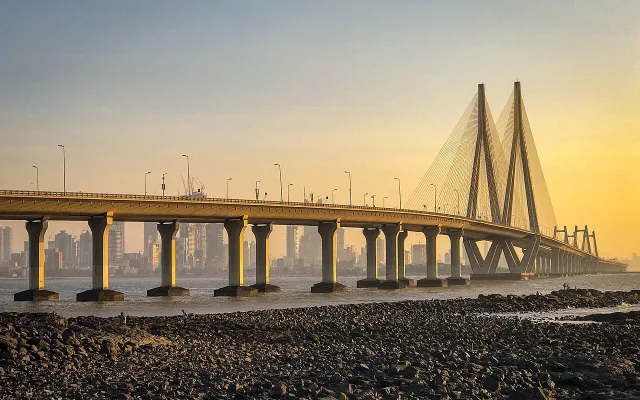
Mumbai is India's financial capital and the home of Bollywood: the Gateway of India, the Elephanta cave temples, Marine Drive, street food and the dabbawala lunch couriers.
Wiki
Mumbai is the largest city in India, on the shore of the Arabian Sea, and its financial heart, known as the "city of dreams" and the home of Bollywood. A metropolis of around 20 million people, it lives at a furious pace of contrasts: colonial architecture stands beside mirrored towers, and the luxury of Malabar Hill beside the dense fabric of working-class quarters.
History and general character
Mumbai grew out of seven marshy islets that passed to Britain in the 17th century as the dowry of the Portuguese princess Catherine of Braganza, and were later joined by causeways into a single mass of land. The Portuguese name Bombaim and the English Bombay lasted until 1995, when the city officially returned to the local form, Mumbai, connected with the patron goddess Mumbadevi. The capital of the state of Maharashtra generates a substantial share of the country's output; the Reserve Bank of India, the BSE stock exchange and the head offices of the largest corporations are all here.
The architectural inheritance of the British era is well preserved: the neo-Gothic and Indo-Saracenic buildings of the Fort district, along with Chhatrapati Shivaji Terminus (the former Victoria Terminus), are on the UNESCO World Heritage list.
Main sights
- The Gateway of India — the triumphal arch of yellow basalt in Indo-Saracenic style, laid to commemorate the 1911 visit of King George V and finished only in 1924. Ferries leave from here, and in the evening crowds of residents and traders gather at the arch.
- The Taj Mahal Palace Hotel — the legendary hotel of 1903 opposite the Gateway, a symbol of the city's luxury and of its resilience.
- Elephanta Island — a complex of Hindu cave temples cut into the rock in the 5th to 8th centuries and dedicated to Shiva; the central image is the majestic three-faced Trimurti sculpture. A UNESCO site, reached by boat from the main pier.
- Marine Drive — the curving promenade along the bay, whose night-time lamps have been nicknamed the "Queen's Necklace". It leads to Chowpatty beach, a popular place for evening walks.
- Dharavi — one of the most densely populated quarters in Asia, where an informal economy is in full swing: leather working, pottery and the recycling of waste. Organised walking tours show it as a working hive rather than as a spectacle of poverty.
- Haji Ali — the gleaming white mosque and tomb on a causeway, reached by a narrow walkway at low tide.
- The Dhobi Ghat laundry — the giant open-air site of hand washing, one of the most recognisable images of Mumbai.
Bollywood and culture
Mumbai is the centre of the largest film industry in the world by number of releases. The Film City studios in the north of the city and the studios in the Andheri and Goregaon districts produce hundreds of pictures a year; tours let you see the sets and the shooting process. The city is rich in museums: the Chhatrapati Shivaji Maharaj Vastu Sangrahalaya holds antiquities, miniatures and natural history collections. Hindus, Muslims, Christians, Parsis and Jains live side by side here, which is reflected in a varied calendar of festivals — Ganesh Chaturthi is especially vivid, when figures of the elephant-headed god are ceremonially carried into the sea.
Food
Mumbai's street food is deservedly considered among the best in the country. Its calling card is vada pav, a spicy potato patty in a bun, along with pav bhaji, a fragrant vegetable stew with bread. On Chowpatty and Juhu beaches, bhelpuri and other light chaat snacks are sold. Seafood is the coast's strong suit: fish and prawns in the Maharashtrian and Malabar styles are served everywhere, and the fresh catch comes in at Sassoon Dock. A city legend of its own is the dabbawalas, the couriers who deliver thousands of home-cooked lunches in metal tins to office workers with almost flawless accuracy.
Practicalities
The best time to travel is the cool dry season from November to February; the monsoon downpours from June to September make getting around noticeably harder. The backbone of transport is the suburban trains, the busiest in the world; they are supplemented by metro lines, black-and-yellow taxis, auto-rickshaws on the outskirts and ride-hailing services. Chhatrapati Shivaji International Airport connects the city with the world.
Over three days it makes sense to give the first to the southern part — Colaba, the Gateway of India and the Fort quarter; the second to the trip to Elephanta and Marine Drive in the evening; the third to Bollywood, Dharavi and the markets. In dense crowds it is worth watching your belongings, drinking bottled water and allowing time for traffic.
Photos