Tehran
Description
Iran's capital under the Alborz range: the Golestan and Niavaran palaces, the National Jewels, a ten-kilometre bazaar and ski slopes within reach of the metro.
Wiki
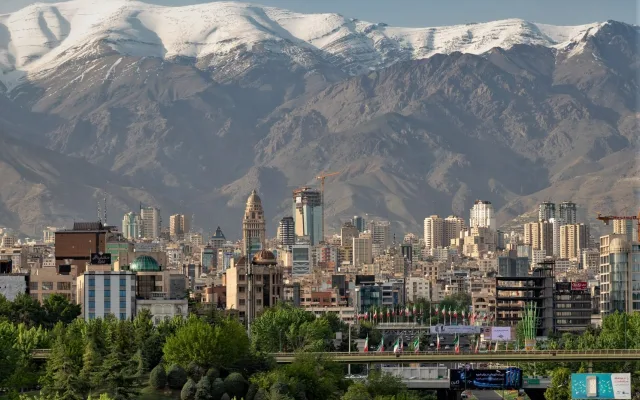
Tehran is the political, economic and cultural centre of Iran, spread across the slopes of the Alborz range in the north of the country. A huge, noisy city of contrasts, it puts Qajar palaces, an enormous bazaar and glass towers within sight of snow-covered peaks you can reach from inside the city itself.
The city and its geography
About 9 million people live in the city proper and some 16 million in the wider agglomeration, which makes Tehran the largest city in West Asia. It sits at roughly 1,200 metres, and the difference in altitude across the metropolis is significant: the cooler, greener northern districts (Tajrish, Niavaran, Darband) climb towards the mountains, while the historic, densely built southern districts run down to the plain. You feel the difference in the climate and in the way people live. Tehran became the capital under the Qajars at the end of the 18th century, and its explosive growth came in the 20th. Before travelling, check the visa rules and the practicalities that come with sanctions: international bank cards do not work in the country, and cash is changed locally.
Palaces and historic monuments
- Golestan — the jewel of the Qajar era and a UNESCO World Heritage Site. The 19th-century complex is known for its Hall of Mirrors, its tilework, the Marble Throne and the state rooms, where Persian tradition meets European influence.
- Sa'dabad — the sprawling summer residence of the Pahlavi dynasty, 105 hectares in the north of the city with several dozen pavilions in a shaded park. A number of them are open as museums.
- Niavaran — the last residence of Shah Mohammad Reza Pahlavi before the 1979 revolution; the interiors keep the furnishings and personal possessions of the family.
- The National Jewels Treasury — a collection without equal, held at the Central Bank. Among its pieces are the Daria-i-Noor, a pink diamond of around 182 carats, and a throne set with thousands of stones.
Museums and the modern city
Tehran is rich in museums. The National Museum of Iran covers antiquity from prehistory to the Islamic period. The Museum of Contemporary Art holds a rare collection of 20th-century Western painting — Picasso, Warhol, Pollock and others, assembled before the revolution. A separate chapter of history is the former US embassy, seized in 1979 during the hostage crisis and now a museum with an anti-Western display.
The symbols of the newer era are the Milad Tower, 435 metres tall, with viewing decks and a revolving restaurant, and the Tabiat Bridge ("nature"), a striking three-level pedestrian park-crossing opened in 2014 that joins two green spaces. Another instantly recognisable landmark is the Azadi Tower on the square of the same name, the ceremonial gateway to the capital.
The bazaar and city life
The Grand Bazaar is one of the city's great experiences: a labyrinth of covered lanes running more than ten kilometres in total, selling carpets, fabric, spices, gold, copperware and dried fruit. It is not only a market but a historic economic centre, with its own mosques, tea houses and caravanserais. The northern foothills — Darband and Tochal — are where people go walking: the trails start here, tea houses line the streams, and the cable car climbs to an upper station at about 3,740 metres, from where a short walk takes you to the Tochal summit at 3,964 m.
The ski resorts
Tehran is unusual in how close it is to winter sport. Shemshak is about an hour away and Dizin two to two and a half hours by mountain road — the two biggest ski centres in the country, with high-altitude runs and a long season. The Tochal slope itself is also skied. Few capitals in the world sit this close to snow.
Food
Iranian cooking is built on saffron rice, slow-cooked stews and meat over coals. Try the different kebabs — minced koobideh and chicken joojeh — and the thick stews: sour, herb-heavy ghormeh sabzi and sweet-sour fesenjan with walnuts and pomegranate sauce. For dessert, faloodeh, saffron ice cream, baklava and strong tea. Street food and family-run places are inexpensive.
Planning the trip
Three days covers the essentials: one for Golestan, the bazaar and the Treasury; a second for the Sa'dabad and Niavaran residences and the museums of the north; a third for the mountains, the Tochal cable car or a run out to a resort. The metro is the easy way to move around — modern, cheap and reaching the key points, with separate carriages for women. Allow for local norms of dress and behaviour, for heavy traffic, and for the fact that many things are paid for in cash only. Prices are written in rials but quoted in tomans, which are rials divided by ten; it takes some getting used to.
Updated