Description
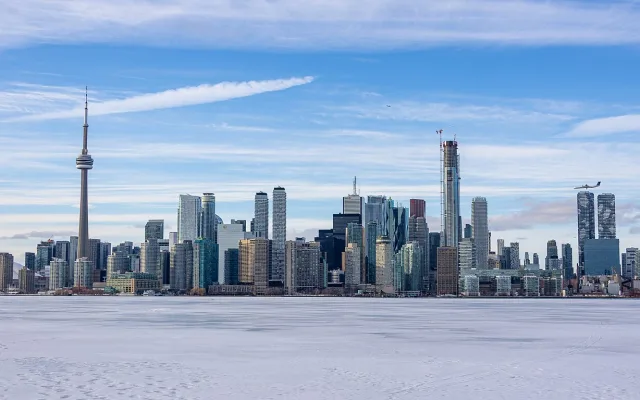
Toronto is known for its skyscrapers, above all the CN Tower, for historic buildings such as Casa Loma, and for shopping quarters such as Kensington Market. Niagara Falls is close by.
Wiki
Toronto is the largest city in Canada, the administrative centre of the province of Ontario and the country's business heart. Finance, culture and extraordinary ethnic diversity converge here: about 2.8 million people live within the city itself and about 6.7 million across the Greater Toronto Area. It is one of the most multicultural metropolises on the planet, where almost half the residents were born abroad and more than two hundred languages are spoken on the streets.
History and general character
The city grew on the northern shore of Lake Ontario out of the small British settlement of York, founded in 1793. In 1834 it took its present name, which goes back to a word from the Iroquoian languages. From a provincial port Toronto turned into an industrial and then a financial centre of North America: the shares of the largest Canadian companies trade on its TSX exchange, and the Financial District is built up solidly with the towers of bank headquarters. The skyline is formed by a dense cluster of skyscrapers by the water, dominated by the silhouette of the television tower.
Main sights
- The CN Tower — the city's calling card, 553 metres high, which from 1975 to 2007 held the title of the tallest free-standing structure in the world. At the top are observation decks, the Glass Floor, a revolving restaurant and the extreme EdgeWalk attraction — a harnessed walk around the outer ledge.
- Casa Loma — a romantic mansion-castle in neo-Gothic spirit, built by the financier Henry Pellatt at the beginning of the 20th century, with towers, a conservatory, stables and an underground tunnel.
- The Royal Ontario Museum (ROM) — the largest museum in the country, famous for its collections from Ancient Egypt and China and for palaeontology; the sharp crystalline extension was designed by Daniel Libeskind.
- The Art Gallery of Ontario (AGO) — a leading painting collection, with an extension designed by Frank Gehry and an outstanding holding of Inuit art and the Group of Seven.
- The Distillery District — a pedestrian quarter in the former Gooderham & Worts distillery, with Victorian industrial architecture in red brick, galleries and workshops.
- St. Lawrence Market — a historic covered market working since the beginning of the 19th century; the signature dish here is a sandwich with local peameal bacon.
- The Toronto Islands — a chain of islets in the lake, ten minutes by ferry from the centre, with beaches, cycle paths and the best view of the city skyline.
- The Hockey Hall of Fame — the principal hockey museum, home of the Stanley Cup.
Districts and atmosphere
Toronto is best seen quarter by quarter, each of which keeps its own character. Kensington Market is a bohemian, slightly chaotic district with vintage shops, graffiti and places serving food from all over the world; the busy Chinatown adjoins it directly. Refined Yorkville is known for boutiques, galleries and coffee houses. The Harbourfront promenade runs along the water with its piers and parks, and to the north stretches the broad High Park with ponds and cherry blossom in spring. The ethnic enclaves are worth a look too — Little Italy, Greektown, Little India — which show just how varied the city is.
Food
Toronto's food reflects its multiculturalism: in a single day you can try dim sum, Tibetan momos, Caribbean jerk, Portuguese tarts and Italian pasta. From the Canadian repertoire, people here love poutine — chips with cheese curds under meat gravy — along with maple syrup and the peameal bacon already mentioned. The food halls of St. Lawrence Market and Kensington Market are the clearest way to get to know the local table.
Trips out of the city
The main excursion is Niagara Falls, about 130 km to the south: a majestic cascade on the border with the United States, approached by sightseeing boats. Nearby is the picturesque historic village of Niagara-on-the-Lake amid the vineyards, the centre of the local wine industry. To the north lies the lakeside resort country of Muskoka, with coniferous forests and cottages by the water, and a few hours by train brings you to francophone Montreal.
Practicalities
Allow about four days for Toronto and its surroundings: two or three are enough for the city and the museums, and one more for the trip to Niagara. The centre is easy to cover on the TTC metro, trams and buses. The UP Express train runs from Pearson airport into downtown. The best time to visit is late spring and summer, when the island ferries are running and the terraces are open; winter is freezing and snowy, but the city keeps going thanks to the PATH network of underground pedestrian galleries.
Photos