
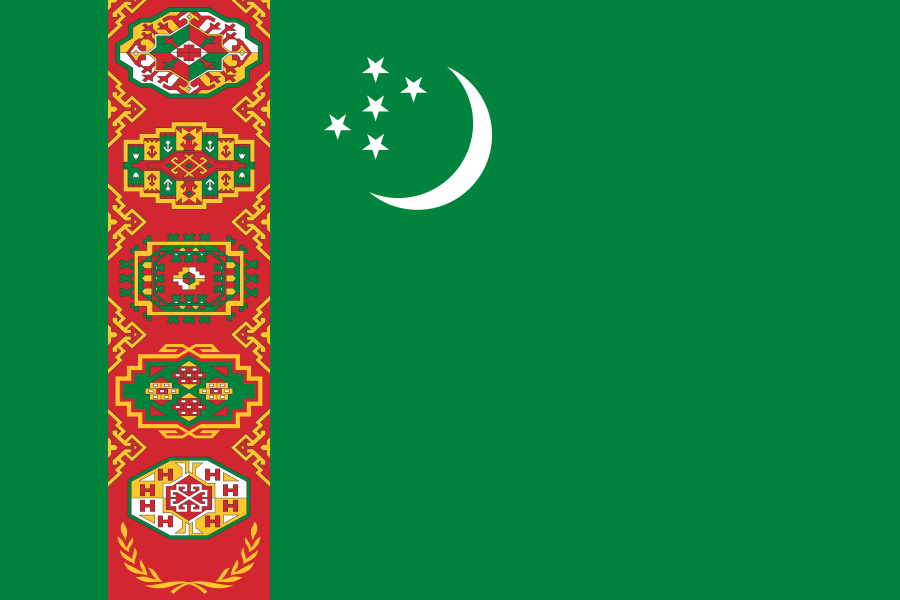
Turkmenistan
One of the most closed and least visited countries in the world — marble Ashgabat and its collection of Guinness records, the burning gas crater known as the Gates of Hell, ancient Merv on the Silk Road and the endless Karakum desert. Turkmenistan is an authoritarian state with a personality cult and eccentric architecture, where tourism is possible only on an organised tour with a guide and a letter of invitation. Visas are refused without explanation, but nobody who gets in ever forgets the place.
Where to go
#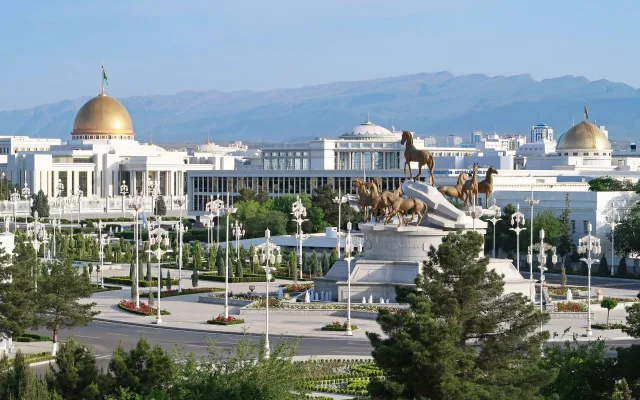
Ashgabat
The capital of Turkmenistan: a city of white marble, monumental avenues, the Gypjak mosque and the Darvaza gas crater out in the Karakum.
Mary
The gateway to the ruins of Merv — the Gyaur Kala and Sultan Kala walled cities on the UNESCO World Heritage list.
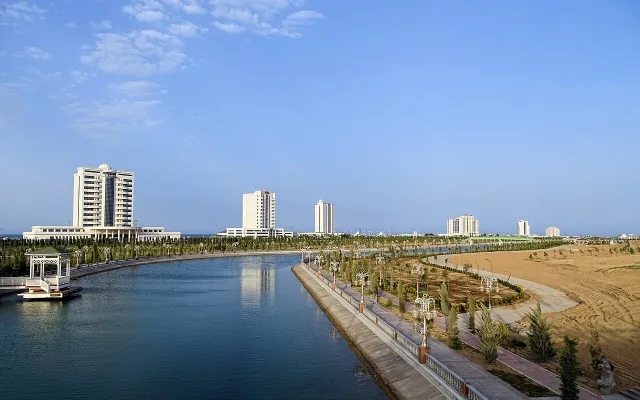
Turkmenbashi
The country's main Caspian port and the national Avaza leisure zone, with beaches and hotels.
What to see
#The Gates of Hell: The Darvaza gas crater is what to see above all else, however awkward the journey. The burning pit has been alight in the Karakum desert since 1971, and dusk is unquestionably the right time to stand at its edge.
Ancient Merv: An enormous archaeological park near Mary, where fortress walls and mausoleums have stood for a thousand years and more. You can wander for hours through the remains of what was once the greatest city in the Islamic world.
Yangykala canyons: Worth a trip for what people call the Turkmen Grand Canyon, layered in pink and white rock. The light at sunset looks frankly extraterrestrial, though the drive out there in a 4x4 eats most of a day.
Nisa: The former capital of the Parthian empire lies just 18 km from Ashgabat. It is the place to go if you want the roots of an ancient civilisation, spread out at the foot of the Kopetdag mountains.
Kow Ata lake: An underground thermal pool in a deep cave, warm all year round. Swimming while bats circle overhead is a specific sort of experience, and one you will not forget in a hurry.
Konye-Urgench: The ancient monuments of Khorezm in the north are architecturally extraordinary. The huge minaret and the mausoleums with their turquoise tilework make an excellent target for a full day out.
The dinosaur plateau: Out east you can literally put your foot inside the print of a prehistoric animal. It is difficult to reach, which is exactly why it stays an exclusive for people who like the obscure.
Prices
#Currency: The local money is the manat, and it is the only thing shops and taxis accept. Exchange counters operate at the airport and in the larger banks, and the official rate has barely moved in years.
Cash: Everything here runs on paper money, so put the digital world out of your mind before you land. Bring crisp, unfolded US dollars issued after 2009, because worn or older notes are frequently refused outright.
Cards: Foreign Visa and Mastercard occasionally work in a couple of Ashgabat hotels, but treat that as a lottery rather than a plan. Amex is not accepted anywhere, and there is no realistic ATM network for foreign cards, so arrive with every dollar you intend to spend.
Rates: The gap between the official rate and the real street rate is enormous, which makes the country expensive for anyone changing money through official channels. Guides usually help with the practicalities of exchange.
| Item | Price (USD) |
|---|---|
| Street samsa | 0.40 |
| Lunch in a café | 4.00 |
| Plov at the market | 2.50 |
| Bottle of water | 0.50 |
| Taxi across town | 3.00 |
| Fridge magnet | 2.00 |
| Cup of tea | 0.60 |
| Local beer | 1.50 |
| Museum entry | 10.00 |
| Bus fare | 0.20 |
| Kilo of melon | 0.80 |
| Portion of manti | 1.80 |
| Night in a hotel | 50.00 |
| Coffee in a lobby | 3.50 |
| Souvenir skullcap | 15.00 |
Getting around
#Getting in: Ashgabat's airport handles a modest number of international routes, and most visitors arrive via Istanbul or Dubai, which are the two connections that actually run reliably. Whatever your itinerary, the flight has to match the dates on your paperwork, so book the ticket only once your permission to enter is confirmed.
Domestic flights: Internal services are the quick way from Ashgabat to Mary or Turkmenbashi. Tickets cost around $40 and are best bought at the official counters rather than through intermediaries.
Trains: Services are slow but they save you a night's accommodation. There are compartment and deluxe classes, tickets sell out fast, and the timetable is worth planning around well in advance.
Buses: Intercity routes connect every regional centre. Fares are tiny, but the rigid schedules and the document checks at roadside posts make them a test of patience.
Taxis: Yellow cabs work the cities on call, and private drivers pick up passengers too. A ride across Ashgabat rarely exceeds five dollars; agree the price at the start rather than at the end.
Marshrutkas: The people's way of moving between settlements. Cramped and hot, but it is the best chance you will get to talk to locals and see the country at ground level.
Car hire: Renting a car without a driver is close to impossible for a foreigner. Hiring a local for the whole day costs about $60 and removes navigation, checkpoints and arguments from your life.
Where to stay
#The rules: Camping or staying with friends is not permitted. Visitors are required to sleep in the hotels listed on their official programme, and the list is checked.
Choice: Ashgabat has plenty of grand white marble buildings where the service is stuck somewhere in the last century. There are cheaper options attached to sports complexes, where the rooms are plainer and the price reflects it.
The regions: Outside the capital the choice narrows sharply. In Mary or Dashoguz expect simple hotels with the basics and, crucially, air conditioning that works.
Booking: The big international booking platforms cannot see the local inventory at all. Everything goes through your receiving agency, which also guarantees your name appears on the right lists.
Darvaza: There are no permanent buildings at the crater, only yurt camps. This is the one legal way to spend a night in the desert with the fire and the stars in view at the same time.
Tourist tax: On check-in expect to pay a tourist levy of $2 per night. It is usually not included in the room rate and is collected in cash.
Standards: Rooms are clean and the plumbing works, but hot water can be scheduled and wifi is decorative. Pack a book, because there is not going to be much else to do at night.
What to eat
#Plov: The king of the table, cooked slightly differently in every region. The Turkmen version tends to be rich, heavy on mutton and sweet carrot, and served in portions designed for a working man.
Shashlik: Fresh meat over coals is a national passion. Do not buy homemade alcohol from strangers to go with it, since that carries a serious fine and a stomach you will regret.
Bread and pastry: Try tandoor samsa and hot chorek flatbread. This is the cheapest and best street food in the country and every city bazaar has it coming out of the oven all morning.
Soups: A thick chorba with chunks of meat and vegetables sorts you out after a long drive. In the desert regions you will be offered slightly sour soups made with camel's milk.
Melons: Turkmenistan grows what many consider the sweetest melons on earth. In August the markets carry hundreds of varieties, and they beat any dessert you could order in a restaurant.
Drinks: Green tea is drunk by the litre from small bowls, and it genuinely helps with the heat. Café coffee is usually instant, so if you want a real espresso, head to one of the expensive hotels.
Safety
#Police: There are a lot of patrols and they take order seriously. Carry your original passport and your registration slip at all times, because either can be asked for at any moment.
Photography: Photographing government buildings, military installations and even some markets is strictly forbidden. Officers will approach and require you to delete the pictures in front of them.
Smoking: Smoking outdoors and in public places is banned and fined. The permitted areas are inside hotels, and you may only bring two packets into the country.
Crime: Street crime is close to non-existent and walking through lit city centres in the evening is genuinely fine. People are hospitable, but politics is not a conversation to start.
Desert: Watch for snakes and scorpions, particularly when camping at the crater. Shake out your boots before putting them on, and do not wander from the camp in the dark.
Roads: Drivers rarely stop for pedestrians even at marked crossings, so cross with full attention and only where you are supposed to. Jaywalking attracts a fine as well as a bumper.
Before you go: Check your own government's travel advisory, and register your itinerary with someone at home, since communications inside the country are unreliable.
Etiquette and culture
#Neutrality: Permanent neutrality is the foundation of state ideology and a real source of pride. Slogans and monuments celebrating the country's peaceful status and its achievements are everywhere you look.
Horses: The Akhal-Teke is a living national symbol and treated with enormous reverence. Catching a race meeting in Ashgabat is a stroke of luck and puts you in front of some of the most beautiful horses in the world.
Carpets: For Turkmen, a carpet is not furnishing but something closer to identity. Each tribe has its own gul motif, and one of them sits on the national flag.
Etiquette: This is a conservative country, so dress modestly. Men should keep shorts for the beach, and women are better off avoiding anything revealing in public.
The president: The personality cult is visible in everything, from portraits in offices to gilded statues on the squares. Treat it as a local feature and keep any commentary to yourself.
Festivals: Muslim traditions sit alongside state occasions such as Melon Day. On those days the cities transform, with concerts and public celebrations filling the squares.
Hospitality: If you are invited to tea, accept, and take the bowl with your right hand. Refusing outright is read as a slight, even when it is meant as politeness.
Connectivity
#Internet: Getting online is the traveller's biggest frustration here, and connectivity is among the worst in the world. Hotel wifi struggles with plain text, and images can take minutes to appear.
Censorship: Almost every familiar social network and messenger is blocked solidly. To reach home you will be relying on webmail such as Gmail, or a VPN installed before you fly, since you will not be able to download one once you arrive.
SIM cards: Foreigners are not sold SIMs at kiosks. It requires a trip to the central office of the operator Altyn Asyr with your passport, and even then the process can drag out. International eSIM services do not reliably work here either.
Language: English is not widely spoken outside hotel reception desks and the guiding profession. Russian remains the common second language, particularly among people over thirty, so a phrasebook or an offline translator is worth having.
Offline first: Download your maps, guides, tickets and reading material before you land. Assume that nothing you need will load once you are in the country, and pack accordingly.
Post: Old-fashioned postcards are a genuinely reliable way to send word home. Post offices work consistently, and stamps featuring Akhal-Teke horses make a fine souvenir in their own right.
Phrasebook
#| English | Turkmen | Pronunciation |
|---|---|---|
| Hello | Salam | sah-LAHM |
| How are things? | Ýagdaýlar nähili? | yag-dye-LAR neh-hee-LEE |
| Thank you | Sag boluň | sahg boh-LOON |
| Good | Gowy | goh-WUH |
| Yes | Hawa | hah-WAH |
| No | Ýok | yok |
| How much? | Näçe? | neh-CHEH |
| Expensive | Gymmat | ghim-MAHT |
| Give me a discount | Arzanlat | ar-zan-LAHT |
| Where is the bazaar? | Bazar nirede? | bah-ZAR nee-reh-DEH |
| Water | Suw | soov |
| Bread | Çörek | choh-REK |
| Very tasty | Öte lezzetli | UH-teh lez-zet-LEE |
| Mate (slang) | Dos | dohs |
| I have no money | Pul ýok | pool yok |
| Fine, deal (slang) | Bolýar | bol-YAR |
| Nice one! (slang) | Berekella | beh-reh-kel-LAH |
| Help me | Kömek ediň | kuh-MEK eh-DEEN |
| Goodbye | Hoş sag boluň | hosh sahg boh-LOON |
| Brother | Gardaş | gar-DASH |
| Teahouse | Çaýhana | chai-hah-NAH |
Good to know
#Documents: Keep a copy of your invitation and your passport on you at all times. On entry you are issued a movement card which has to be shown at every traffic police post between cities.
Sockets: Hotels use standard European two-pin sockets, so no adapter is needed if you are coming from the continent. British and North American plugs do need one. Voltage is stable in cities but surges happen in rural areas.
Medicines: Bringing in anything containing codeine or tramadol is strictly prohibited. Carry only what you genuinely need, in the original factory packaging, ideally with a prescription from your doctor.
Carpets: If you decide to buy a carpet, buy it in a state shop that issues an export certificate. Without that piece of paper customs will simply confiscate it when you fly out.
When to go: April, May and September are the good months. Summer heat in the Karakum reaches fifty degrees, which turns any excursion into a genuine health risk.
Souvenirs: Beyond carpets, look at tahya skullcaps and silver jewellery. Antiques over fifty years old cannot legally leave the country and are treated as smuggling of cultural property.
Frequently asked questions
#Almost every nationality does, and the visa is issued only against a letter of invitation arranged inside the country. The consular fee for a single entry of up to 30 days is around $55, and you should allow a month before departure for the paperwork.
You cannot do it independently, because the invitation must be filed by a company accredited in the country. In practice you contact a licensed tour operator, send scans of your documents and pay their fee.
Not in any practical sense. Cash is the only reliable method, so bring clean US dollars issued after 2009 and change them into manat, and do not count on foreign Visa or Mastercard working anywhere.
The internet is heavily censored and most major social networks and messengers are blocked. Travellers are left with slow hotel wifi, so install a VPN and download everything you need before you arrive.
Foreigners are not allowed to travel outside the cities without a certified guide. The route through the sand also demands a properly equipped 4x4 and someone who knows the terrain in the dark.
Mandatory fees and the cost of guided arrangements make this an expensive destination, so allow at least $150-200 per person per day. Remember that everything, including hotels and transport, is paid in cash.
Yes, though the trip may need to be named specifically in your invitation. The hotels there are modern and frequently half empty, which gives the whole resort a surreal quality.
Most monuments are fine, but always check whether guards or police are standing nearby before you raise the camera. Photographing government buildings, palaces and anyone in uniform is prohibited throughout the country.
Effectively no — flying is banned or out of reach for tourists. There are no flight rules. Tour operators report that drones are a prohibited import and are confiscated at Ashgabat airport customs. Rules for other countries are in the drone ranking by country.
Updated
The data on this page goes out of date. Visa rules and permitted stays, border requirements, prices and budgets, transport and local conditions all change fast, and we do not re-check every page every day. We show the date of our last check where we have one, but before you travel, verify with official sources: the country’s consulate, its immigration service, its e-visa portal and your carrier.