Description
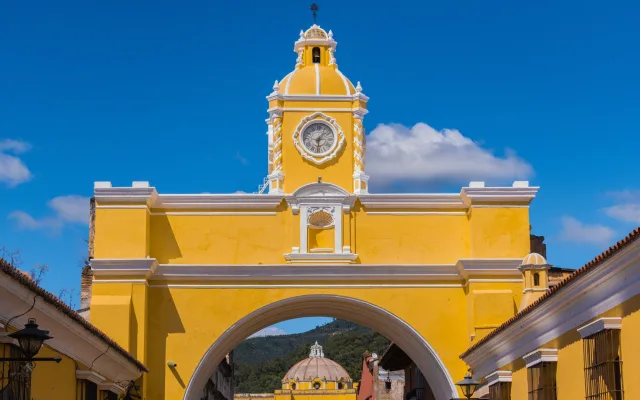
Antigua — a baroque colonial capital surrounded by three volcanoes, famous for its spectacular Holy Week processions.
Wiki
Antigua Guatemala is a small but historically significant city in the highlands of Guatemala, and the former colonial capital of Spanish Central America. Set in the scenic Panchoy Valley at around 1,500 metres and ringed by three volcanoes, it has preserved an unusually coherent ensemble of 16th–18th-century baroque architecture and has been a UNESCO World Heritage Site since 1979.
History and character
The city was founded in 1543 under the name Santiago de los Caballeros de Guatemala, and for two centuries served as the administrative, religious and cultural centre of the Captaincy General of Guatemala, which stretched from Chiapas to Costa Rica. Grand monasteries, churches and palaces were built here, and one of the oldest universities in the New World — San Carlos — operated within its walls. The devastating Santa Marta earthquake of 1773 prompted the authorities to relocate the capital, and the modern Guatemala City grew up on the new site. The old capital became known as Antigua ("the old one"), and it was precisely this decline that spared it from large-scale redevelopment: the streets kept their cobblestones, and the collapsed vaults of the monasteries became atmospheric ruins.
The layout follows the classic Spanish grid, centred on the Plaza Mayor (Parque Central), around which stand the Mermaid Fountain, the Cathedral and the former Palace of the Captains General with its long arcade.
What to see
- Santa Catalina Arch — a yellow 17th-century arch that once connected a convent to its garden; today it is the city's main visual landmark, framing the cone of Agua volcano in photographs.
- La Merced Church and Convent — a showcase of the exuberant Guatemalan "ultra-baroque" style, with saffron-coloured stucco and white ornament; the cloister preserves one of the largest colonial fountains in the country.
- San José Cathedral — of the original vast church only the façade survives; behind it stretch open-sky ruins of the nave and a crypt.
- Ruins of Santa Clara, La Recolección and the Capuchins — former convents that convey the sheer scale of colonial religious construction.
- Cerro de la Cruz — a hilltop cross with a viewpoint overlooking the entire city against the backdrop of Agua; the walk up takes about fifteen minutes.
The volcanoes deserve special mention. Pacaya and Acatenango are popular trekking destinations; a two-day ascent of Acatenango with a night at the high camp gives front-row views of eruptions on the neighbouring active volcano Fuego.
Culture and Semana Santa
The highlight of the year is Holy Week (Semana Santa), one of the most spectacular religious celebrations in Latin America. Streets are carpeted with alfombras — intricate rugs made from dyed sawdust, flowers and fruit — over which processions pass for hours, carrying heavy wooden floats. Preparations run throughout Lent, and the city fills with pilgrims for the event itself.
Antigua is also well known as a centre for Spanish-language study: dozens of language schools offer one-on-one tuition with homestay accommodation, drawing students from around the world.
Food and coffee
Local cuisine blends indigenous and Spanish traditions: thick pepián (meat slow-cooked in a sauce of roasted seeds and spices), corn tamales, black beans, plantains and charcoal-grilled street food. Café de olla — coffee brewed with cinnamon and raw cane sugar — is widely enjoyed. The surrounding slopes form a celebrated coffee-growing region, and tours of the fincas with tastings of arabica beans have become one of the city's signatures.
Practical information
The nearest international airport (GUA) is around 40 km away in the capital; the most convenient options are tourist shuttles or taxis. Within Antigua, the best way to get around is on foot — the historic centre is compact and everything fits within a kilometre's radius, though the cobblestones call for sturdy footwear. Regular shuttles connect the city with Lake Atitlán, Semuc Champey and other popular destinations.
The best time to visit is the dry season from November to April, when days are warm and highland nights are cool. In the rainy season (roughly May to October) downpours typically arrive in the afternoon and need not disrupt morning sightseeing. Three days is enough to explore the churches and ruins at a relaxed pace, climb to the cross, visit a coffee plantation and make a day trip to the volcanoes.