 Города и дороги
Description
The first Ottoman capital on the slope of Mount Uludağ: the Great Mosque with its twenty domes, the tiled Green Tomb, the silk caravanserai of Koza Han, thermal baths and a ski mountain above the city.
Wiki
Bursa is Turkey's fourth-largest city, with around two million people, spread across the northern slope of Mount Uludağ a hundred kilometres south of Istanbul across the Sea of Marmara. The Ottomans took it in 1326 and made it their first capital; the dynasty ruled from here for almost forty years before moving the centre to Edirne. This is where the early Ottoman architectural style took shape, and where the first sultans are buried. The city's second foundation was silk: goods from Persia passed through Bursa on their way to Europe, and the cocoon trade continued into the twentieth century. For its gardens and green slopes the city has long been called Yeşil Bursa, Green Bursa; UNESCO listed its historic quarters together with the village of Cumalıkızık in 2014.
Why come and what to actually see
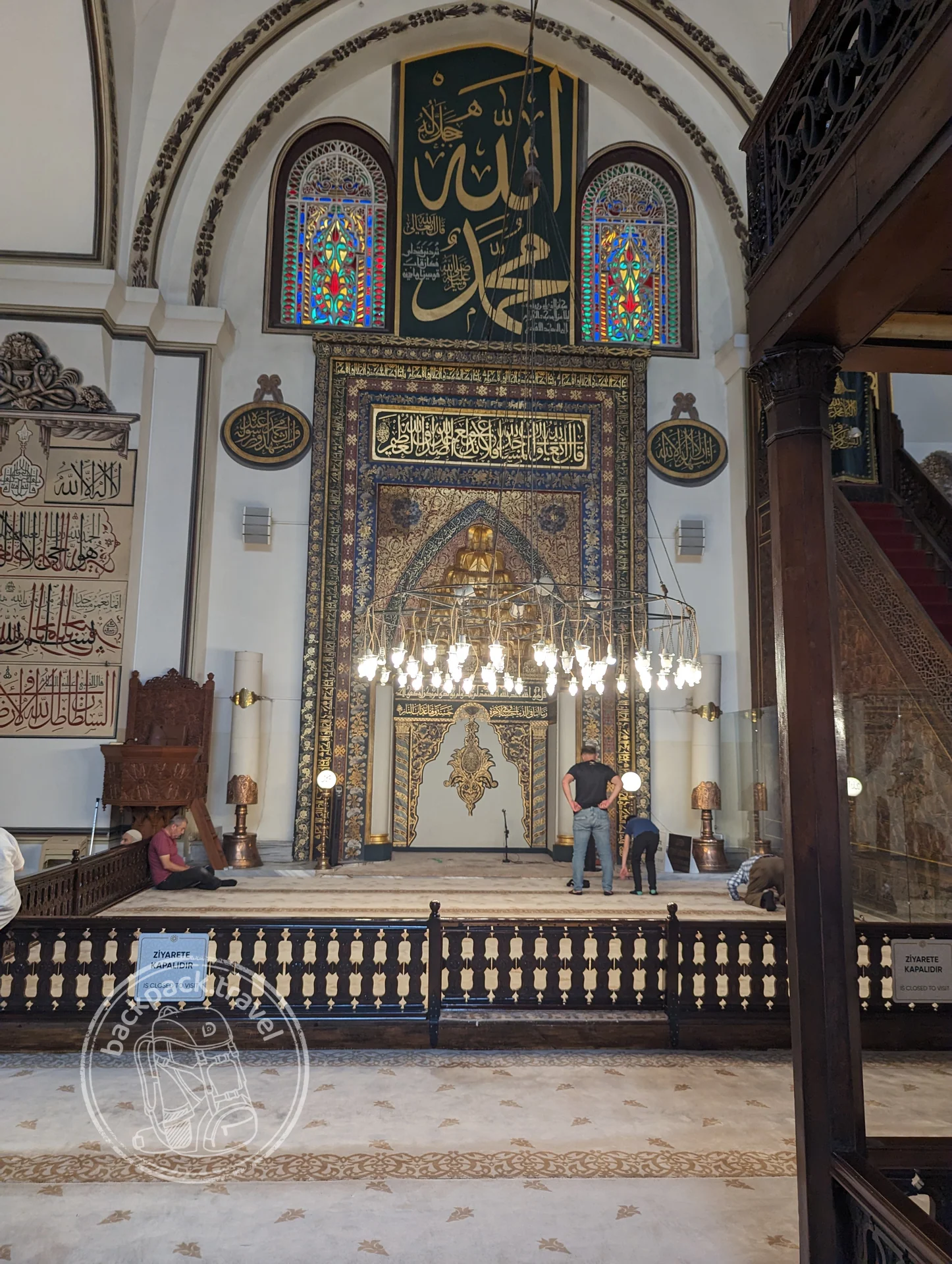
The Ulu Camii, the Great Mosque of 1399, was built under Bayezid I and rests on twenty domes carried by twelve piers. An ablution fountain stands in the middle of the hall under a light well, and the walls and columns are covered in calligraphy — nearly two hundred panels made by nineteenth-century masters. It is the strongest interior in the city.
The Green Mosque and the Green Tomb stand on a hill east of the centre. They were built between 1419 and 1424 for Sultan Mehmed I, and the name comes from the tiles: turquoise and blue cover the mihrab, the sultan's loge and, in the tomb, the walls entirely. The technique is called coloured glaze, and a workshop of craftsmen from Tabriz carried it out.
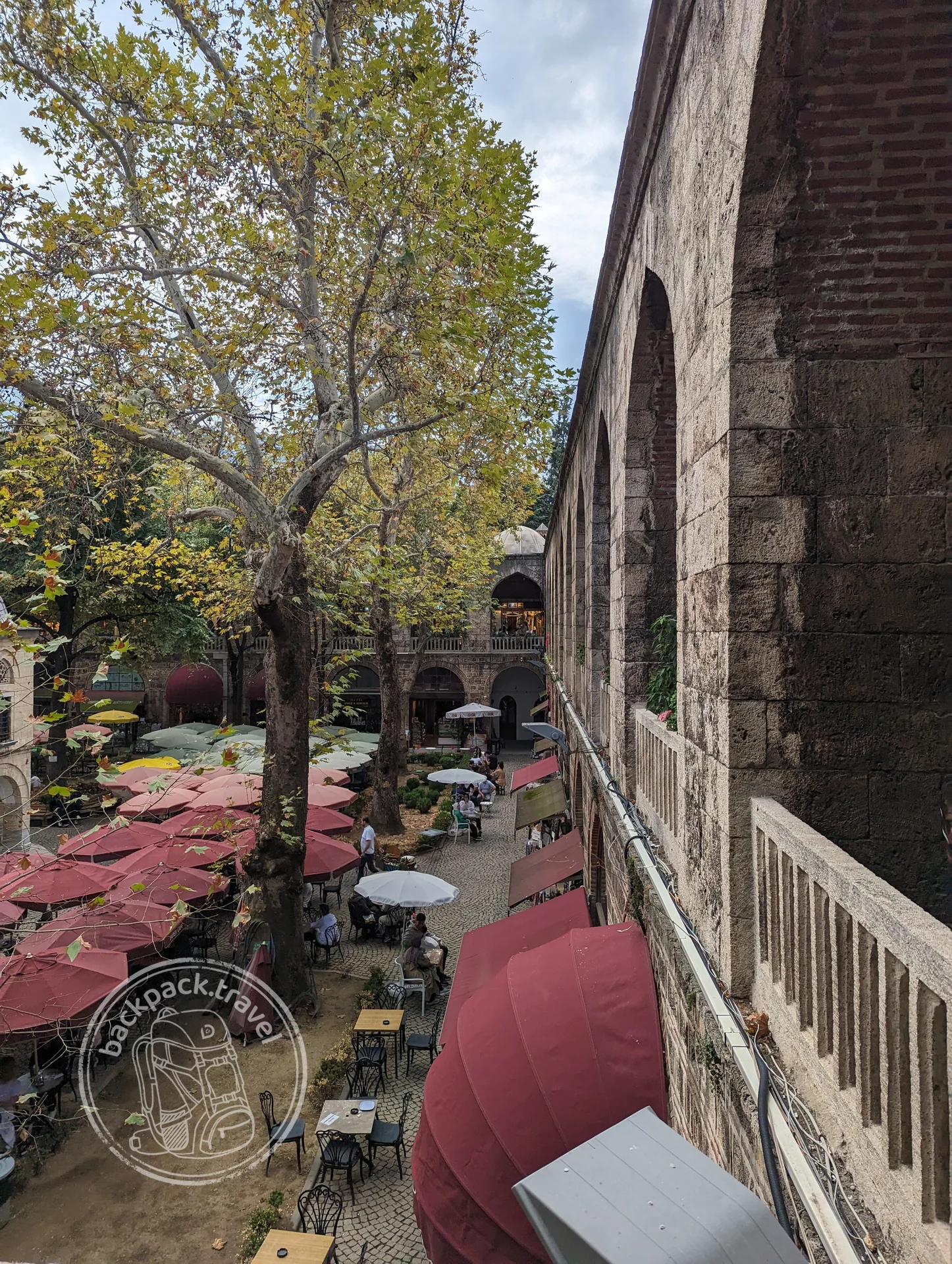
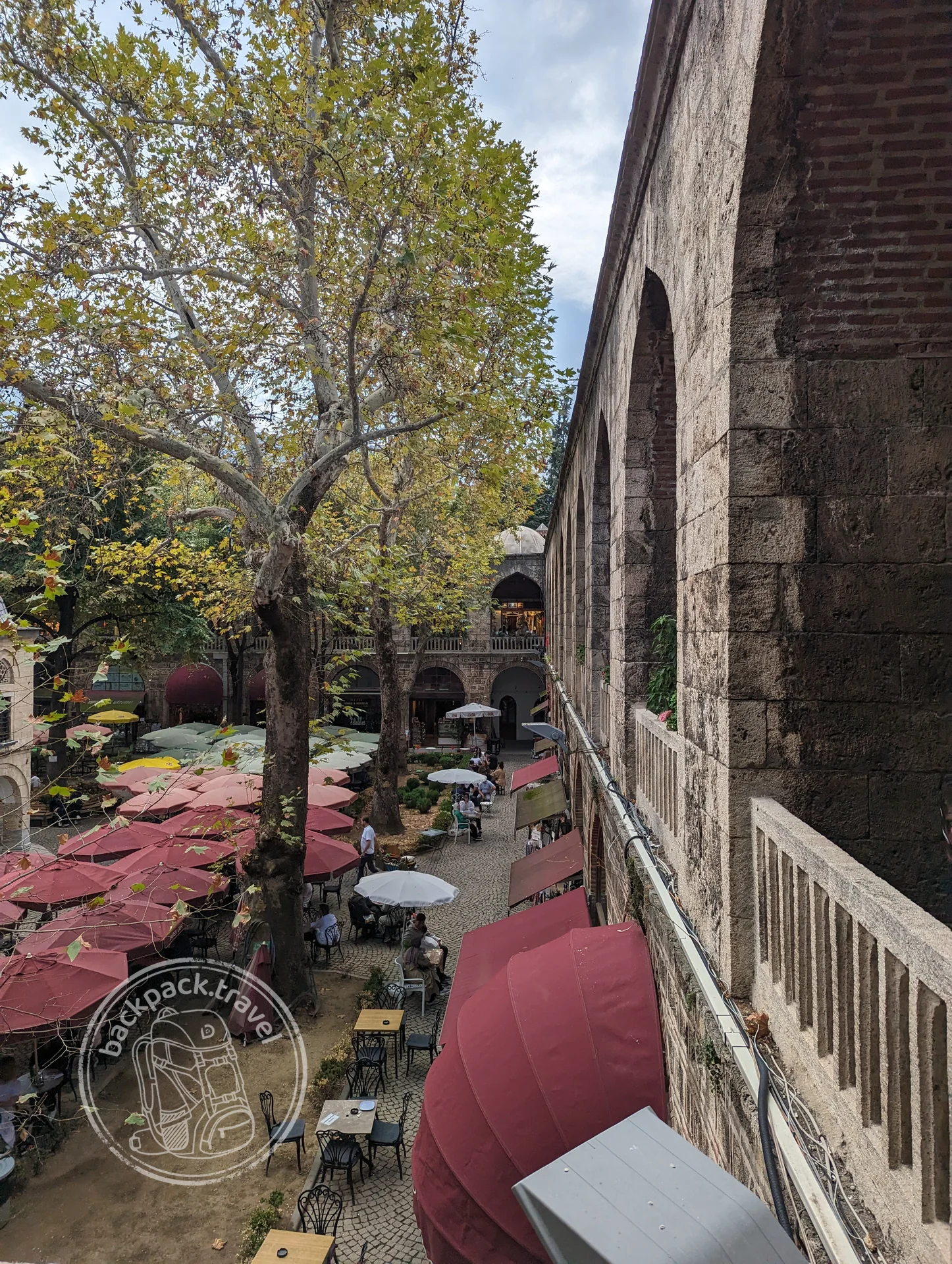
Koza Han, from 1491, is a two-storey caravanserai built to fund a mosque in Istanbul. A small mosque stands in the courtyard on supports above a fountain, silk and gold are sold around it, and in June silkworm cocoons are still brought here. Next to it is the covered market, a chain of hans linked by passages.
The Muradiye complex holds twelve mausoleums in a garden, the burial place of Sultan Murad II and some fifteen princes, including those executed under the law of fratricide. The place is quiet, the tiles inside come from different periods, and it gives the clearest picture of what early Ottoman funerary architecture looked like.
Çekirge is a district apart, with thermal springs known to the Romans. The oldest bathhouse, Eski Kaplıca, sits on Byzantine foundations.
Getting there and getting around
From Istanbul the easiest route is by sea: a fast ferry reaches Mudanya or Yalova in a little over an hour, and a bus covers the rest to the centre. By road, over the Osmangazi bridge, the journey takes around two and a half hours, with buses running constantly.
The city's own airport at Yenişehir handles few flights, and most people arrive via Istanbul. Inside the city there is a metro, known here as Bursaray, plus a tram through the historic centre and ordinary buses.
A cable car more than eight kilometres long runs up Uludağ — one of the longest in the world — climbing from the city to the Sarıalan plateau. The alternative is the mountain road by car, about forty kilometres.
Where to stay
The centre around the Ulu Camii and the covered market is convenient for sightseeing: everything is within walking distance and the choice of hotels is wide. Çekirge is two or three kilometres west and suits anyone coming for the thermal water, with hotels that have their own springs.
In winter a separate cluster operates up on Uludağ, next to the lifts. These hotels get cheaper in summer, but they are hard to use without a car.
Day trips
Cumalıkızık, twelve kilometres east, is a fourteenth-century Ottoman village of half-timbered houses and cobbled lanes, still lived in. Most people go for breakfast.
İznik, eighty kilometres away, the former Nicaea, gave its name to the famous tiles. Five kilometres of city walls survive, along with the ruins of the church of Hagia Sophia where the Seventh Ecumenical Council met, and workshops where the ceramics are still made.
Mudanya on the coast remembers the armistice of 1922, and the neighbouring village of Trilye has kept its Byzantine churches and olive groves. People go up to Uludağ for snow in winter and cool air in summer.
When to come
April, May, September and October are the best months: the city is warm without being close, the slopes are green, and the quarters can be walked all day. In spring the orchards bloom, which is what earned Bursa its green name.
Summer is hot, around thirty degrees, and humid because of the sea, but Uludağ stays cool fifteen hundred metres higher up and locals head there. Winter is the ski season, with snow on the mountain from December to March, while the city itself is damp and hovers around seven degrees. The thermal baths run all year and make particular sense in winter.
Food and money
İskender kebab was invented here, in 1867: thin slices of meat off the spit are laid on pieces of flatbread, doused in tomato sauce and clarified butter, and served with yoghurt. The portion is heavy, and lunch usually ends there.
The second local speciality is candied chestnuts, kestane şekeri, simmered in syrup over several days. Bursa peaches and figs are sold across the country, and street food means pide and kumpir. Cards are accepted everywhere; cash is needed only at the market.
What to know
Bursa is a major industrial centre with car factories, and the traffic is real — allow more time to cross the city than the map suggests. The historic quarters, on the other hand, are compact and walkable, though the ground slopes.
The earthquake of 1855 destroyed a considerable part of the old city, and much of what is on view is restoration from the late nineteenth and twentieth centuries. The region is seismically active; the North Anatolian Fault runs to the north, under the Sea of Marmara.
The mosques are in use, and tourists are kept out for twenty minutes during prayers. Women need a headscarf, usually available at the entrance.
Updated