Description
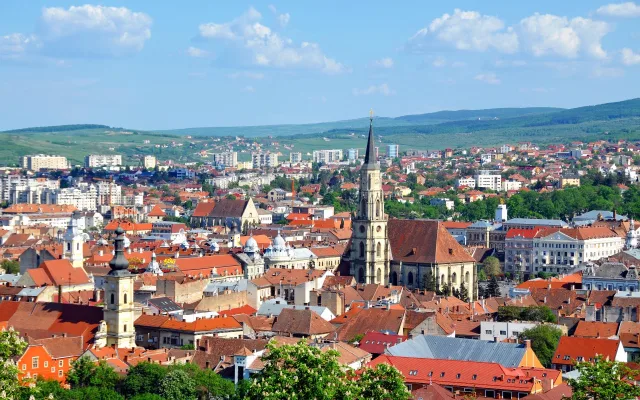
The cultural capital of Transylvania and Romania's largest student city, with independent cafés, galleries, and the UNTOLD festival.
Wiki
Cluj-Napoca is Transylvania without the Dracula-bait castle and without the crowds: a genuinely alive city where students, tech workers, and newcomers sustain a scene of independent cafés, galleries, and bars. People come not for a single postcard moment but for the atmosphere of a compact European centre that makes an excellent base for exploring the region.
Why go and how long to allow
Two days is comfortably enough: the centre is small and every highlight is within a couple of hours on foot. Day one — the city itself (squares, church, palace-museum, climb up to Cetățuia). Day two — either a leisurely round of cafés and parks, or a day trip to the Salina Turda salt mine (about 30 km away). If you arrive during the UNTOLD festival (August) or Electric Castle (July), that changes everything: tens of thousands of people flood the city, accommodation prices multiply and sell out months in advance — book early.
Getting there and getting around
Avram Iancu Airport (CLJ) sits a few kilometres east of the centre and is one of the most convenient entry points to Transylvania. A city bus runs into the centre cheaply; taxis and Bolt are fast and reasonably priced (a ride across town typically costs 15–35 RON, about $3–8). Bolt works well here and has effectively replaced conventional taxis.
A car is unnecessary within the city. The main sights — Unirii Square, St Michael's Church, the theatre, Bánffy Palace — are all within easy walking distance of one another. Trams and buses exist (tickets from kiosks or an app), but walking is usually simpler. Renting a car makes sense only if you plan excursions into the region — Turda, Sighișoara, the Apuseni Mountains.
What to see
- Unirii Square — the heart of the city, with the statue of Matthias Corvinus and the Gothic St Michael's Church alongside. The church is worth going inside, not just photographing from the square.
- Bánffy Palace — the largest Baroque-Rococo palace in Transylvania, now the Museum of Art. A sensible stop on a rainy or very hot day.
- Cetățuia — a hill topped by a former Austrian fort with the best panorama over the city. The climb is short; go in the late afternoon for the best light. Free.
- Alexandru Borza Botanical Garden — one of the largest in the region, with a Japanese garden and glasshouses; a good place to spend a quiet couple of hours.
- Salina Turda — the salt mine famous for its underground Ferris wheel, rowing lake, and vast subterranean halls. A remarkable attraction, but unmistakably a theme-park experience: worth the half-day trip only if that kind of thing appeals to you. It stays cool underground year-round — bring a layer.
- Romulus Vuia Ethnographic Park — an open-air museum on the edge of the city, with traditional Transylvanian wooden houses and churches.
Casino Centrale in Parcul Central is a restored lakeside pavilion — a pleasant spot for a stroll, not really a stand-alone sight.
Where to stay
The best base is within the centre, around Unirii Square and Museum Square (Piața Muzeului): everything is on hand and the evening scene is right there. Museum Square is the most relaxed pedestrian area, lined with café terraces. The university district and the streets along Eroilor are also convenient and lively. For festival visits, book as early as possible and expect prices to be several times higher than usual; staying slightly further from the centre but close to public transport is a reasonable fallback.
Food, coffee, and prices
Cluj is noticeably cheaper than Western Europe, but no longer rock-bottom. Lunch at a local place runs roughly 40–80 RON ($9–17), dinner at a restaurant around 95–185 RON ($21–40). Prices are as of 2026. Transylvanian dishes worth trying: sarmale (cabbage or vine-leaf rolls), mămăligă cu brânză (polenta with cheese), a hearty gulaș, and cozonac for dessert.
A particular strength of the city is its coffee and craft scene. There is a genuine specialty-coffee culture here, driven largely by students and the tech community. Quality matches European capitals; prices are lower. Local craft beer is another reason to linger on Museum Square in the evening.
Ways to save: eat where students eat rather than on the main square; use Bolt instead of flagging down a taxi; drink coffee and eat in independent spots rather than the tourist restaurants by the church.
Practicalities
- When to go. May–June and September are the most comfortable months: warm, green, and before the festival crowds arrive. July–August is hot and busy because of Electric Castle and UNTOLD.
- Safety. Cluj is a calm, student-oriented city; walking around the centre in the evening is perfectly fine. Normal awareness in crowds and around the train station is all that is needed.
- Money. The currency is the Romanian leu (RON), not the euro. Cards are accepted almost everywhere, but a small amount of cash is useful for markets and smaller cafés.
- Common mistake. Coming for "Dracula" and leaving disappointed — Cluj is not about that. It is about a living city, good coffee, easy walking, and a convenient base for Transylvania. Build your plans around that, and two days will feel well spent.