Description
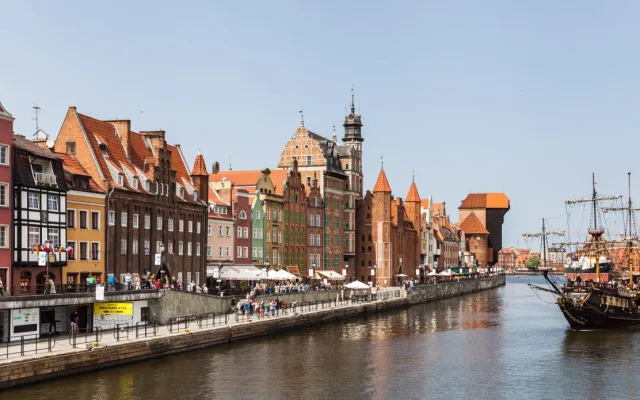
A Hanseatic port of amber and Solidarity: gingerbread facades along the Motława, the wooden Żuraw crane, powerful museums, and Sopot's beaches next door.
Wiki
Gdańsk is easy to underestimate: in travel guides it is often overshadowed by Kraków and Warsaw, but in practice it is one of the most coherent and atmospheric cities in Poland. Two days are enough to take in the gingerbread facades along the Motława and to get to grips with history that literally started here — with the first shots of the Second World War.
How many days and how to plan your itinerary
Two days covers Gdańsk itself plus a quick trip into the Tricity. The logic is straightforward:
- Day 1 — Main City. Długi Targ, the Crane, the Motława waterfront, museums of your choice. Everything is compact; most sights are 5–10 minutes apart on foot.
- Day 2 — history and/or the sea. Morning at the Museum of the Second World War or the European Solidarity Centre, then an afternoon train to Sopot for the beach and pier.
If you are travelling with children or mainly want the Baltic coast, shift the emphasis to Sopot and Gdynia. If history is the draw, both Gdańsk museums deserve half a day each — do not try to squeeze them into a single visit; you will burn out.
Getting there and getting around
Lech Wałęsa Airport (GDN) is 10–12 km from the city centre. The suburban SKM commuter train and city buses connect it to the main station, Gdańsk Główny, in about 30 minutes. A taxi or Uber from the airport to the Old Town is inexpensive by European standards.
The backbone of the Tricity is the SKM commuter train, which strings Gdańsk, Sopot and Gdynia along one coastal line. It runs frequently, tickets are cheap, and Sopot is about 20 minutes away. This is your main tool: the three cities effectively function as a single urban area.
Within Gdańsk itself you barely need public transport — the historic centre is entirely walkable. Trams and buses are useful mainly for reaching the Solidarity Centre or the outer neighbourhoods. Tickets are time-based; validate them on boarding.
Where to stay
- Główne Miasto / Stare Miasto (Old Town) — maximum atmosphere, everything within walking distance, but evenings near the Motława are noisy and prices are higher. The best base for a two-day stay.
- Wrzeszcz — a cheaper district, closer to the main station and convenient for SKM connections, yet lively with restaurants that cater to locals rather than tourists.
- Sopot — the right choice if you want to be beside the sea; but note that in summer this is the priciest address in the area.
For a short trip, staying in the Old Town is the better call — time saved on commuting outweighs the extra cost.
What is genuinely worth seeing
The city centre was rebuilt after the war (Gdańsk was almost entirely destroyed in 1945), but the restoration was done with care — a reconstruction that does not feel like a stage set. The non-negotiable highlights:
- Mariacka Street — the most photogenic street in the city, lined with stepped porticos and amber shops. This is also where you bargain for amber.
- St Mary's Church (Bazylika Mariacka) — one of the largest brick churches in the world; climb the tower for a view over the terracotta rooftops.
- The Crane (Żuraw) — the iconic wooden crane that is the symbol of the port, and also a branch of the Maritime Museum.
For museums, choose according to your interests: the Museum of the Second World War is a powerful, emotionally demanding exhibition of world-class quality; the European Solidarity Centre tells the story of how the collapse of the Eastern Bloc began here. Both outclass many of Europe's more heavily promoted museums.
Westerplatte is a deeply symbolic site, but the memorial itself is modest and a long way from the centre; it is worth the trip only if the subject genuinely matters to you. A pleasant way to get there is by leisure boat along the Motława.
Food and money
The cuisine is hearty and unfussy: pierogi, żurek served in a bread bowl, Kashubian herring, gołąbki, and pączki for dessert. Look for a bar mleczny (milk bar) — subsidised canteens serving home-style food at rock-bottom prices, and an honest way to eat cheaply right in the city centre. Restaurants on the Motława waterfront are pricier and aimed squarely at tourists; walk a couple of blocks inland and the prices drop noticeably.
A rough sense of costs: Poland is noticeably cheaper than Western Europe, but Gdańsk in summer is not the most budget-friendly city in the country. A meal at a milk bar costs very little; a proper dinner with a local beer (Amber, or a wheat beer) is moderate. Cash is rarely needed — cards are accepted almost everywhere, though you may want some at the amber market.
As a rough guide, lunch at a milk bar is 20-30 złoty ($5-8), dinner with a beer at a Motława restaurant 90-140 złoty ($25-38), and an SKM ticket to Sopot around 5 złoty ($1.30). Prices are as of 2026.
When to go
The best time is late May through September, when the beach season is in full swing and terrace seating is open. The peak is July–August: warm, but busy and more expensive, especially in Sopot. The Baltic is cool even in summer — swimming is not for everyone. Late November and December are worth considering for the Christmas market (Jarmark Bożonarodzeniowy), though drizzle and sea wind are the norm. Winter days are short and raw.
Practical notes and common mistakes
- Amber. Real amber feels warm to the touch, is lightweight, and builds up a static charge. Bargaining is perfectly normal on Mariacka Street; in underpasses and from street sellers it is easy to end up with pressed chips or plastic — buy from established shops with a reputation.
- Do not limit yourself to Gdańsk alone. The SKM train opens up Sopot and Gdynia for next to nothing — it would be a shame not to use it.
- Do not load your day with two large museums — each requires several hours and real mental energy.
- The weather is changeable even in summer: a windproof layer and an umbrella are worth packing.
- Westerplatte — do not spend half a day there if the war history is not a priority for you; use the time instead for a walk along the canals.