Description
Odense is a city in Denmark, best known as the birthplace of Hans Christian Andersen. It is home to the storyteller's museum, the house where he grew up, and an annual festival dedicated to his fairy tales.
Wiki
Odense is one of those cities where the whole place functions as a single large museum dedicated to one person. Hans Christian Andersen was born here, and Denmark has made the most of it, turning the city into a fully-fledged literary capital: the storyteller appears on signposts, in shop windows, and in the layout of the streets. It is also a convenient base on the island of Funen — compact, cycle-friendly, and easy to cover in one full day.
Why visit and how long to stay
One day is genuinely enough. The historic centre is small and everything worth seeing is within walking distance. If you want to add Egeskov Castle or the zoo, build in a second day or drop something in town.
Odense fits naturally into a route between Copenhagen and Jutland: the city sits right on Denmark's main rail line, and the train from Copenhagen takes roughly an hour to an hour and a half. That makes it a convenient stop rather than a dead-end detour.
Getting there and getting around
- Train — the main option. The central station (Odense Banegård) is a 5–10 minute walk from the historic core.
- On foot — the easiest way around. From the station to the Andersen museum, the cathedral, and the pedestrian street takes only a few minutes.
- Bicycle — something close to a local religion. A large share of all journeys in the city are made by bike; the infrastructure is excellent, with wide cycle lanes and rental options. If you want to experience the city the Danish way, hire a bike — though for a single day in the centre it is not essential.
- Tram (Odense Letbane) — a recent addition linking outer districts, but visitors spending a day in the centre will not need it.
What to see
A sensible day's route takes in the old town, where everything is clustered together.
- H.C. Andersens Hus — a new museum opened in 2021, designed by Kengo Kuma. This is far more than a house museum: the building is largely underground, surrounded by gardens and circular glass pavilions, and the exhibition is conceived as an immersion into the world of fairy tales rather than a dry biography. This is the city's main draw — book tickets in advance during the high season.
- H.C. Andersens Barndomshjem (Andersen's Childhood Home) — a tiny yellow house where Andersen lived from age 2 to 14. It makes vivid how much poverty he came from. Nearby is an atmospheric quarter of old half-timbered streets, worth strolling through in its own right.
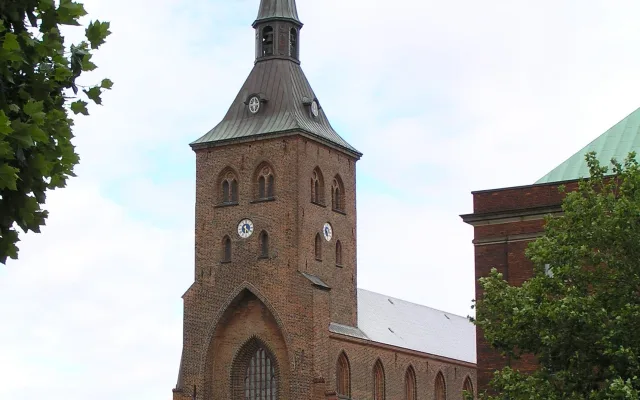
- Sankt Knuds Kirke (St Canute's Cathedral) — 14th-century Gothic; beneath the altar lie the remains of King Canute, martyred in 1086. Admission is usually free, and the carved altarpiece is worth a look.
- Brandts — a former textile mill converted into an arts quarter: photography, media, contemporary art, and cafés. A good place to pause and have lunch.
- Munke Mose — a green park with a pond by the river, a pleasant break between museums.
Outside the city (if you have a second day or a car): Egeskov Castle, about 30 km away, is a Renaissance fortress built on piles in the middle of a lake and one of the finest in northern Europe; Den Fynske Landsby is an open-air ethnographic village; Odense Zoo has a strong African collection. Further afield lie the Jelling Runestones (UNESCO, about 80 km), though that is already a trip in itself.
Where to stay
Stay in the centre or near the station — that covers both logistics and all the sights. The area around the pedestrian street and old town is the most convenient: you step out of the hotel and you are already on the route. For a single night there is no point hunting for something on the outskirts to save money — the centre here is not as expensive as the capital.
Food and money
Denmark is expensive, and Odense is no exception, though it is noticeably cheaper than Copenhagen. Rough guides:
- Budget eating — supermarkets (Netto, Rema 1000, Fakta) and street bakeries. Danish pastry (wienerbrød) is tasty and relatively affordable.
- Smørrebrød (open-faced sandwiches) — the classic lunch option; filling and good value.
- Cafés at Brandts and along the pedestrian street sit at a mid-range price point, but the quality is consistent.
- Tap water is excellent; there is no need to buy bottled.
- Payment by card is accepted everywhere; cash is rarely needed.
Practicalities and common mistakes
- Don't arrive expecting a fairy-tale theme park: Odense's appeal lies in its coherence as a calm, pleasant city, not in spectacle. Come ready for a walk, not a show.
- Summer is the main season — warm weather and outdoor programming. In August the city hosts the Andersen Festival, with theatre and parades. Off-season is quieter and cheaper, but short winter daylight limits time outdoors.
- Prioritise the Kengo Kuma museum — if you spread yourself too thin across every sight, this is the one you will run out of time for, and it is the standout experience.
- Egeskov Castle and the zoo do not fit into a day that also covers the centre — do not try to combine everything; you will end up rushing.
- The weather is changeable year-round: a rain jacket and layers matter more than an umbrella, given the wind.