Description
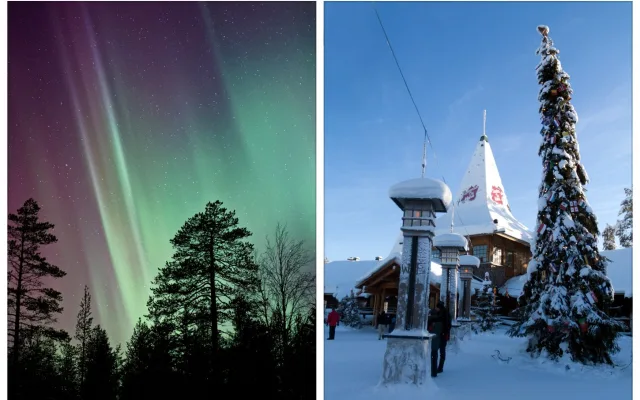
The official Santa Claus Village on the Arctic Circle — Santa's Village, the northern lights, and husky safaris.
Wiki
Rovaniemi is the administrative centre of the Lapland region and the largest city in Finnish Lapland, spread along the Arctic Circle at the confluence of the Kemijoki and Ounasjoki rivers. It is the gateway for most journeys into the far north, and is known around the world as the official home of Joulupukki — the Finnish Father Christmas, better known internationally as Santa Claus.
History and cityscape
A settlement at the mouth of the Ounasjoki existed as far back as the Middle Ages, serving as a trading and ecclesiastical centre, but Rovaniemi only gained city status in the twentieth century. The turning point came with the Lapland War: in the autumn of 1944, retreating German forces applied a scorched-earth strategy, and the city was almost entirely destroyed — only a handful of buildings survived.
Reconstruction took place in the late 1940s and 1950s according to a master plan drawn up by the celebrated architect Alvar Aalto. His design gave the street network the outline of a reindeer's head with antlers: the central square represents the eye, and the radiating boulevards form the branching antlers. Aalto also designed the city's landmark civic ensemble — the Lappia House, containing a concert hall and theatre, the city library, and the administrative building — all forming a single cultural centre.
Santa Claus Village and the Arctic Circle
Rovaniemi's defining attraction is Santa Claus Village, 8 km north of the centre, sitting directly on the Arctic Circle (66°33′). The complex is open year-round: visitors can meet Joulupukki for free (photography is charged), formally cross the Arctic Circle and receive a personalised certificate, and send a letter or postcard from Santa's Main Post Office with its unique Arctic Circle postmark. The village also has cafés, shops selling traditional handicrafts, and reindeer enclosures.
Nearby is SantaPark — an underground theme park carved into the bedrock, with an ice gallery, an elves' workshop, an "academy," and live shows aimed primarily at families with children.
Museums and culture
An essential stop for understanding the region is Arktikum, a museum and science centre housed beneath a striking glass gallery facing the river. Its exhibitions cover the history of Lapland, the nature and climate of the Arctic, and the culture of the indigenous Sámi people. Next door stands the Pilke Science Centre, dedicated to northern forests and sustainable forestry. The picture is rounded out by an art museum and the Lappia House mentioned above, which hosts concerts and theatrical performances.
Northern lights and winter activities
Thanks to its position on the 66th parallel, Rovaniemi is one of the most accessible places to see the aurora borealis. The season runs roughly from late August through April; the best chances come on a clear, frosty night away from city light pollution, so many visitors head outside town or join dedicated aurora-hunting tours.
Winter Rovaniemi offers a full programme of outdoor activities:
- Husky safaris — dog-sledding excursions ranging from half an hour to multi-day expeditions with overnight stays; kennel visits and mushing lessons are also widely available.
- Reindeer sleigh rides — sled rides, reindeer feeding, and visits to Sámi farms where guides explain traditional herding practices.
- Snowmobile safaris — routes through taiga forest and across frozen lakes, often combined with ice fishing or visits to ice structures.
- Ice hotels and snow villages — seasonal constructions of ice and snow in the Lapland region (including around Kittilä), complete with ice bars and bedrooms.
In summer the focus shifts to river rafting and fishing, hiking, and berry and mushroom picking. The sun stays above the horizon from roughly 6 June to 7 July, and it never gets properly dark for much of the summer.
Lapland cuisine
Local food is built on the produce of the north. Reindeer meat forms the backbone of many dishes — most typically served pan-fried with mashed potato and lingonberry sauce (poronkäristys). Arctic char and whitefish are popular, as is leipäjuusto (baked Lapland cheese) served with cloudberry jam, and dishes featuring northern berries — lingonberries, bilberries, and cloudberries. In any café it is worth trying pulla — a soft cardamom bun — and the warming hot drinks that are essential on a cold day.
Practical information
Rovaniemi is connected to Helsinki by direct flights and convenient overnight trains with car-carrier carriages; the airport is close to both the city centre and Santa Claus Village. The compact centre is easy to explore on foot, while buses and taxis serve the out-of-town attractions.
Allow around three days: the first for the city centre, Arktikum, and the riverfront; the second for Santa Claus Village and the Arctic Circle; the third for an active day with huskies, reindeer, or snowmobiles followed by an evening aurora hunt. In winter, warm layered clothing, thermal underwear, boots rated for extreme cold, and face protection against the wind are essential — temperatures frequently drop well below freezing. In summer, insect repellent is a must. Peak season is December, with its pre-Christmas atmosphere, so accommodation and tours for that period should be booked well in advance.