 Города и дороги
Description
A town of a hundred thousand in Iran's Khuzestan, built around a Sasanian system of dams, canals and rock-cut watermills that ran for seventeen centuries and is now a UNESCO World Heritage site.
Wiki
Shushtar is a town in Iran's Khuzestan province, about a hundred thousand people, standing on the Karun river in the foothills of the Zagros. It is known for one thing: a hydraulic system built in Sasanian times that stayed in service for seventeen centuries, until the middle of the twentieth. The complex has been on the UNESCO World Heritage list since 2009, and UNESCO calls it a "masterpiece of creative genius". Everything else in town is an appendix to it.
Why come and what to actually see
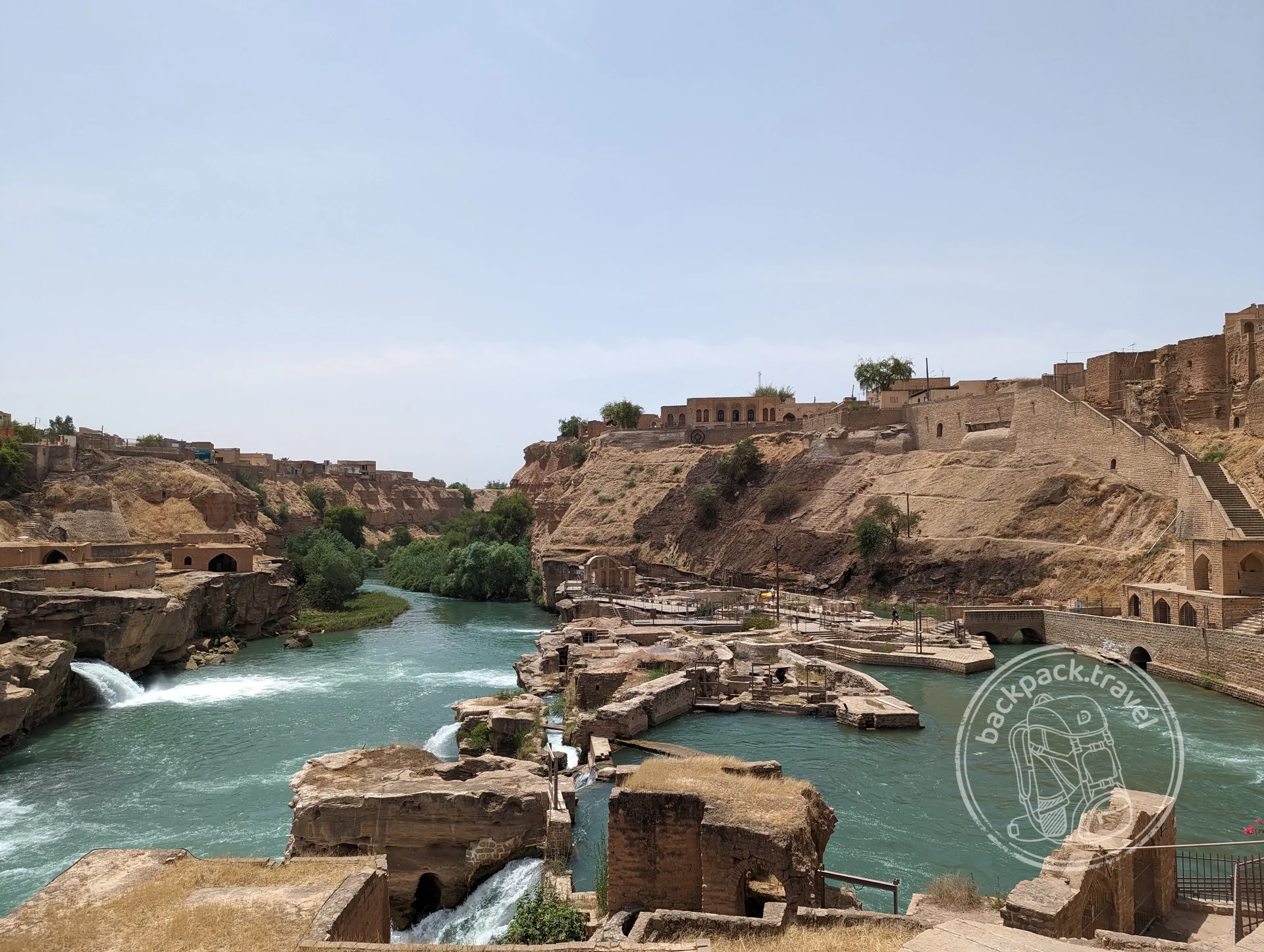
The Shushtar Historical Hydraulic System is not one monument but a linked set of dams, canals, tunnels, bridges and watermills. The core was laid down under Shapur I in the third century; tradition holds that the work was done by captured Roman engineers taken after the defeat of the emperor Valerian, and in places the masonry technique really is Roman.
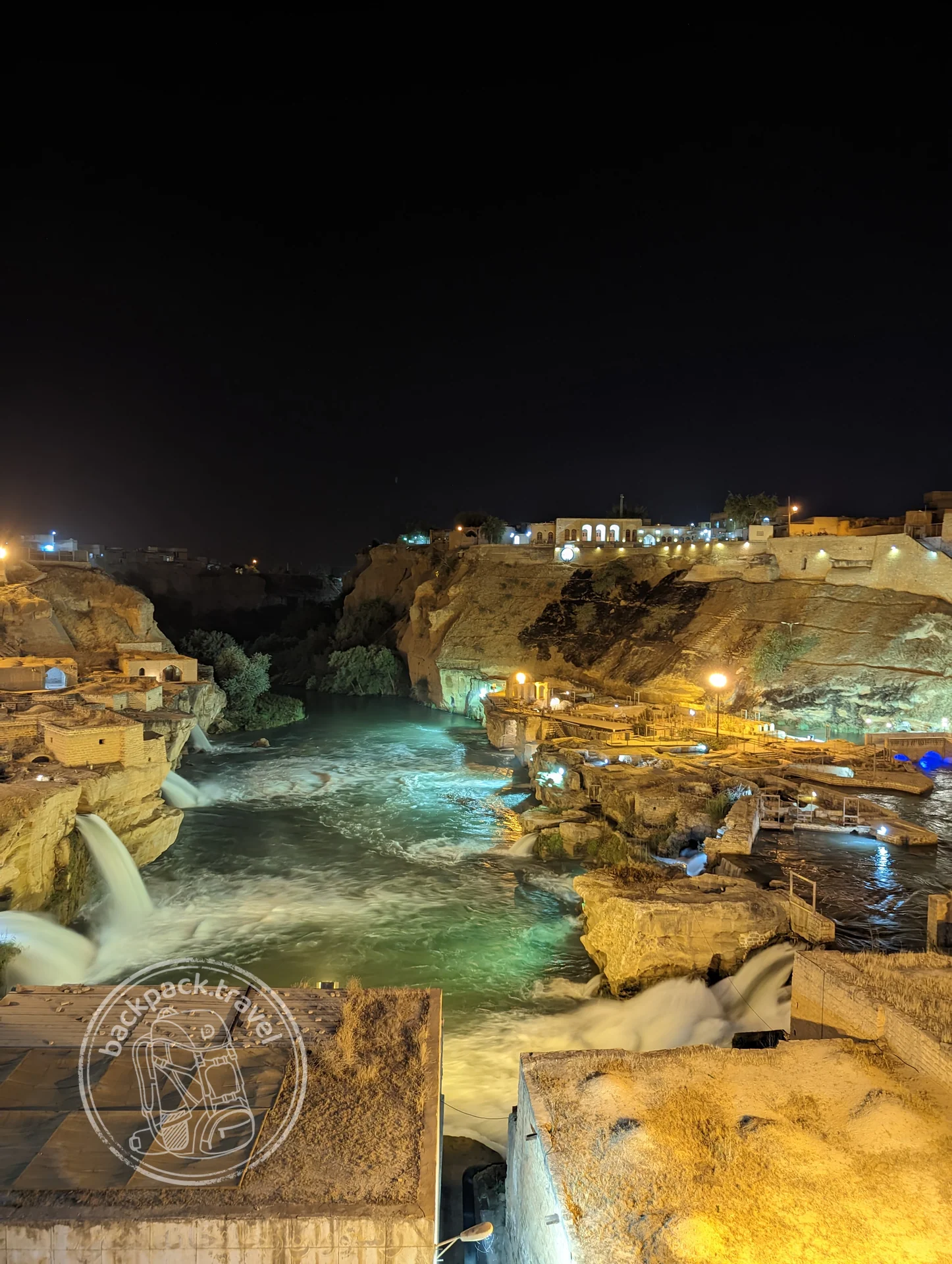
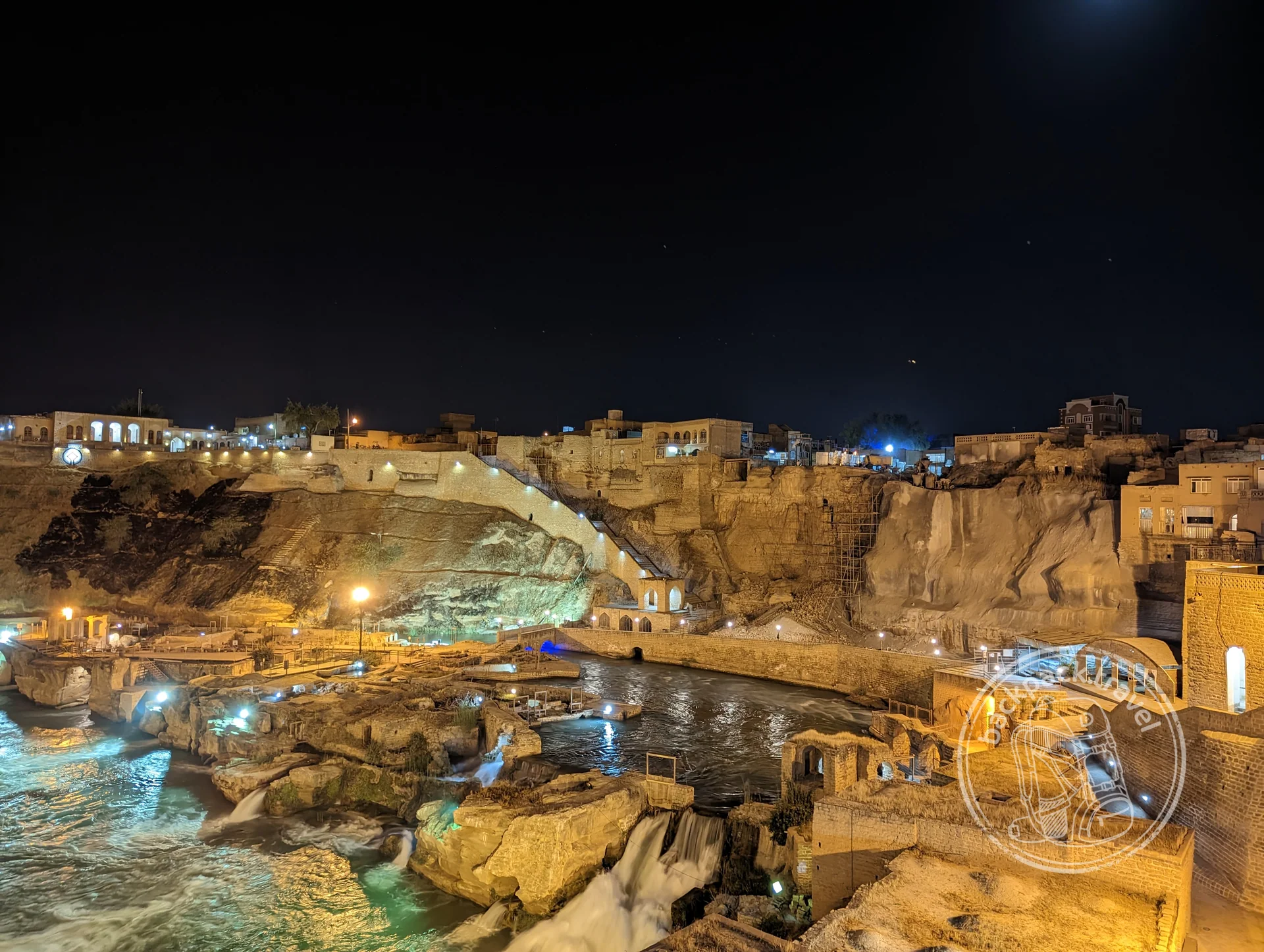
It works like this: the river is blocked by the Shadorvan bridge-dam, part of the flow is diverted into the Gargar canal cut through rock, and at the outlet the water falls from ledges onto mill wheels carved straight into the stone. Below are catchment basins and tunnels to discharge the surplus. The system did more than grind grain — it watered the town and its fields, and the drop in level was used to cool the air in underground rooms. Viewing platforms run along the edge of the canyon and stairs lead down. The cascades are lit in the evening, and the water on the ledges reads better then than under daytime sun.
Beyond that, the ninth-century Friday Mosque, one of the oldest in Iran, built on the site of a Zoroastrian temple, and Salasel Castle at the head of the canal. The old quarters have kept houses with underground shabestan rooms, where people retreated from the heat.
Getting there and getting around
The nearest airport is Ahvaz, 90 km away, an hour and a half by car; flights come in from Tehran and Mashhad. There is a railway too: Shushtar station sits on the Tehran–Ahvaz line, and the train from the capital takes about twelve hours.
Buses connect the town with Ahvaz, Dezful and Shush. Within Shushtar people walk or take taxis: about ten minutes on foot from the centre to the cascades. A taxi hired for the day is useful if the plan includes Shush and Chogha Zanbil.
Where to stay
The choice is modest: a few plain town hotels and a couple of guesthouses in traditional buildings with a courtyard. Standards are low, but so are the prices.
Many people make Shushtar a day stop on the road between Ahvaz and Isfahan, or come out from Ahvaz, where there is more choice. If the point is to see the cascades in daylight and under the lights both, it is still better to sleep here.
Day trips
Chogha Zanbil, an Elamite ziggurat of the thirteenth century BC, the largest outside Mesopotamia and the first Iranian site on the UNESCO list, is 80 km away.
Shush, the biblical Susa, with the ruins of Darius's palace, the mausoleum of the prophet Daniel and the French archaeologists' castle, is 60 km away. These two are usually taken together with Shushtar in one long day. Dezful, with its Sasanian bridge over the Dez, is 40 km to the north.
When to come
November through March. Khuzestan is the hottest part of Iran: summer regularly passes 50°C, and from June to September sightseeing in the open air is physically impossible. Winter days run 15–25°C, which is ideal.
November and February–March are also good for water: after the rains the river is fuller and the cascades look the way they were meant to. In the dry months part of the ledges stays bare. By April the heat is moving in, but still bearable. Nowruz at the end of March is the peak of domestic tourism, and the town fills with Iranians.
Food and money
The cooking is Khuzestani, with Arab influence: a lot of rice, fish from the Karun, ghormeh sabzi, kebabs. The local trait is more heat than in central Iran. Places to eat are simple, and restaurants in the European sense barely exist.
Foreign cards do not work in Iran at all: cash has to be brought in and changed in Ahvaz or Tehran — Shushtar has almost no exchange offices. For payments inside the country a tourist card issued in a large city is convenient.
What to know
The cascade complex charges admission and opens by day and in the evening, but the lighting schedule shifts with the season, so check on the spot. The descents to the mills are partly closed, and some paths run above the water without railings.
Khuzestan is more conservative than Tehran: women need a headscarf and covering clothes, men long trousers. Nobody comes here in summer, and that is not an exaggeration: 50°C with high humidity off the river is harder to take than the dry heat of the desert. Mobile internet works, but slowly, and some services in Iran are unreachable without a VPN.
Updated