Description
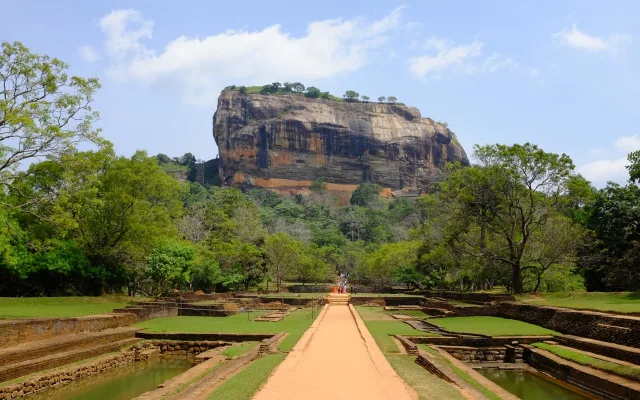
The 5th-century rock palace on the UNESCO list — frescoes, the lion's paws and a panorama of jungle from the summit.
Wiki
Sigiriya is Sri Lanka's foremost historical icon and one of the most powerful archaeological sites in Asia: a rock outcrop rising almost 180 metres above flat jungle, with the ruins of a royal residence on its flat summit. It is a UNESCO World Heritage Site. At its foot is a village of a few thousand people, living off the hotels and the tour.
The fortress capital was built by King Kashyapa I, who reigned from 477 to 495. According to the chronicle he seized the throne by killing his father and took refuge on the unassailable rock from his brother, the rightful heir: a palace with a throne hall and bathing pools was laid out on top, and the slopes were painted with frescoes. After Kashyapa's death the court returned to Anuradhapura, and for several centuries Sigiriya served as a Buddhist monastery.
What to see
- The rock of Sigiriya — a plug of hardened magma from an ancient volcano. The climb is around 1,200 steps and about an hour and a half with stops; the spiral metal stairways on the upper sections are narrow and feel exposed.
- The Lion's Paws — the gateway halfway to the summit. Of the giant lion figure, through whose mouth the stairway once led, only the two front paws carved from the rock remain.
- The frescoes of the celestial maidens — around two dozen 5th-century paintings in a sheltered niche partway up; there were originally many times more. Photography is forbidden.
- The Mirror Wall — the gallery wall polished to a shine and covered with pilgrims' graffiti of the 8th to 10th centuries; it is one of the oldest bodies of Sinhala writing.
- The Water Gardens — symmetrical pools, channels and fountains at the western foot. In the rainy season the fountains still work, fifteen centuries on.
- The Boulder Gardens — a chaos of enormous rocks on the slope, with the cave cells of monks.
- The palace on the summit — the foundations of the buildings, a throne cut into the stone and the royal bath; what matters here is not the ruins but the view over jungle to the horizon.
- The Sigiriya Museum at the foot — models, finds and reconstructions. It makes more sense to visit before the climb than after.
What is nearby
- Pidurangala — the neighbouring rock a kilometre to the north. The climb is shorter and rougher, with the last stretch a scramble over boulders, and the ticket costs a fraction as much; above all, this is where the photographs of Sigiriya itself are taken. The classic plan is sunrise from Pidurangala, then Sigiriya.
- Dambulla, 17 km away — the UNESCO-listed cave temples: five caves, 153 images of the Buddha, and paintings whose layers span almost two thousand years.
- Polonnaruwa, an hour away — the island's capital in the 11th to 13th centuries, a wide field of ruins best covered by bicycle.
- Minneriya National Park, half an hour away — the main place to see elephants on the island. From July to October the herds converge on the shrinking reservoir, in the event known as the Gathering.
Sigiriya belongs to the Cultural Triangle along with Dambulla, Polonnaruwa and Anuradhapura, and usually falls in the middle of a standard Sri Lanka itinerary.
Food and prices
The cooking is Sri Lankan: rice and curry, a large plate of rice with six to eight bowls of vegetable, fish and meat curries; kottu, chopped roti tossed with vegetables on a large griddle; hoppers, thin bowl-shaped rice pancakes, often with an egg; and kiribath, rice cooked in coconut milk. Lunch at a local canteen runs to 1,700-3,000 rupees ($5-9) and dinner at a hotel to 5,000-10,000 rupees ($15-30). The Sigiriya ticket for foreigners is set in dollars at about $30, and Pidurangala is around 1,700 rupees ($5). A tuk-tuk around the area costs 670-1,700 rupees ($2-5), and scooter hire 2,700-4,000 rupees ($8-12) a day.
Transport
There is no local airport; the nearest is Bandaranaike (CMB) near Colombo, 170 km away. By car from Colombo it is about four hours; by train to Habarana about the same, plus half an hour by taxi. Around the area people travel by tuk-tuk and scooter.
When to go, and how to time it
The dry season is December to April, 25-32°C. Rain comes in October to December and in a short peak in May, but it rarely wrecks a visit.
It is best to climb at opening, around seven in the morning: later the heat sets in and a queue builds on the narrow stairways, which is unpleasant to stand in. Bring water, as there is almost no shade on the rock. The monkeys at the entrance snatch food from people's hands, so keep bags inside your pack.