Description
Royal residence and seat of the UN's International Court of Justice — the Mauritshuis with Vermeer, and Scheveningen beach.
Wiki
The Hague (Dutch: Den Haag, officially 's-Gravenhage) is the third-largest city in the Netherlands and the country's administrative capital, home to the royal residence, the government, parliament, and numerous foreign embassies. It is also the world capital of international law: the International Court of Justice and the International Criminal Court both sit here, and the city is often called the "city of peace and justice."
Introduction to The Hague's Attractions
Despite its status as the de facto capital, The Hague feels noticeably different from tourist-saturated Amsterdam: calmer, more spacious, and more graceful, with wide boulevards, palaces, embassy mansions, and green parks. Formally, The Hague is not the constitutional capital of the Netherlands — that title belongs to Amsterdam — but it is where the kingdom's governmental and diplomatic life is concentrated. The city sits on the North Sea, with dunes and beach districts adjoining its urban fabric, so The Hague combines the qualities of an administrative centre, a museum city, and a seaside resort.
Historically, The Hague grew from the hunting grounds and residence of the Counts of Holland in the 13th century — hence the name, which derives from the phrase meaning "the count's hedge" (des Graven hage). For a long time the settlement had no city rights, but as governing institutions took root here it became one of the most important centres in the country. For visitors, the layout is convenient: almost all the main sights are compactly clustered around the historic core near the Binnenhof and the Hofvijver lake, while the sea is reachable by tram in 15–20 minutes. Two days are enough to explore the centre, visit one or two key museums, and still make time for Scheveningen beach.
Main Attractions
Peace Palace
The Peace Palace (Vredespaleis) is the symbol of The Hague as a city of international law. The building, in a neo-Gothic and neo-Renaissance spirit, was constructed in the early 20th century with funds donated by the American industrialist and philanthropist Andrew Carnegie. Today the Peace Palace houses the International Court of Justice — the principal judicial organ of the United Nations — along with the Permanent Court of Arbitration and an extensive library of international law. A visitor centre next to the palace tells the story of the building and its institutions; the court itself is not open to the public, but the exterior, the ceremonial gates, and the park can be seen freely.
Binnenhof and the Hall of Knights
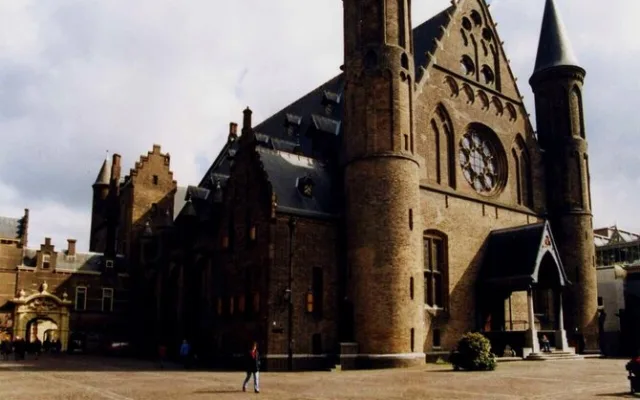
The Binnenhof ("inner court") is a historic complex of buildings at the very heart of the city and one of the oldest continuously used governmental buildings in the world, having housed the Dutch parliament for centuries. At the centre of the ensemble stands the Hall of Knights (Ridderzaal) — a 13th-century Gothic building with a tall gabled roof, where the annual ceremonial opening of the parliamentary year (Prinsjesdag) takes place in the presence of the monarch. The inner courtyard, viewed from the Hofvijver lake side, forms one of The Hague's most recognisable vistas.
Scheveningen Pier
Scheveningen is the seaside district in the north-west of The Hague and the country's main beach resort, with a wide stretch of sand along the North Sea. Its landmark is the pier (De Pier), extending far out to sea: it features observation decks, cafés, a Ferris wheel, and a bungee-jumping point. Along the seafront runs a string of hotels, seafood restaurants, and a promenade, while in summer the area hosts festivals including the famous international kite-flying event. Scheveningen pairs well with a walk through the dunes and a swim during the warmer months.
Mauritshuis Museum
The Mauritshuis is a small but world-famous art museum housed in an elegant 17th-century classical mansion beside the Binnenhof. Its collection focuses on Dutch Golden Age painting. The star works are Vermeer's Girl with a Pearl Earring and Rembrandt's The Anatomy Lesson of Dr. Nicolaes Tulp; paintings by Frans Hals, Jan Steen, and other masters are also on display. The compactness of the collection is a virtue: the masterpieces can be seen in a couple of hours without fatigue.
Madurodam Miniature Park
Madurodam is a popular park where the main landmarks of the Netherlands are recreated at a scale of 1:25 — Amsterdam's canals, the port of Rotterdam, windmills, palaces, and an airport with moving models. It is simultaneously an attraction for families with children and a visual "map" of the country in the open air. The park is named after George Maduro, a wartime resistance fighter, in whose memory it was founded.
Panorama Mesdag
Panorama Mesdag is a unique monument of 19th-century painting: a vast cylindrical panorama roughly 120 metres in diameter, depicting the fishing village of Scheveningen, the sea, and the dunes as they appeared in the 1880s. Visitors climb to a central platform and find themselves seemingly inside the landscape — the illusion is heightened by artificial dunes in the foreground. The work was painted by marine artist Hendrik Willem Mesdag, working alongside a team of assistants.
Escher Museum
The Escher Museum (Escher in Het Paleis) occupies the former winter palace of Queen Mother Emma. The exhibition is dedicated to the graphic artist M. C. Escher, famous for his "impossible" staircases, metamorphoses, and optical illusions. Alongside original engravings and lithographs, the museum has interactive rooms where visitors can experience visual tricks first-hand, and the palace interiors themselves — with their striking chandeliers — add atmosphere to the visit.
St. James's Church
The Grote Kerk, or St. James's Church (Grote of Sint-Jacobskerk), is one of The Hague's oldest buildings: a late-Gothic church with a distinctive hexagonal tower prominent in the city-centre skyline. Members of the royal family have been baptised here, and the interior preserves tombs, stained-glass windows, and a carved wooden pulpit. The church also serves as a venue for exhibitions and concerts.
Noordeinde Palace
Noordeinde is the working palace of the King of the Netherlands, located in the city centre. The building itself is closed to visitors, but it can be admired from outside; an equestrian statue of William of Orange stands in front of the palace. Behind it lies a well-kept palace garden open to the public, while the surrounding streets are known for antique shops and galleries.
Louwman Museum
The Louwman Museum is one of the world's largest private collections of vintage and rare automobiles. The collection spans horse-drawn carriages, early self-propelled vehicles, and sporting and state cars from various eras, including vehicles that belonged to notable historical figures. The museum appeals beyond motoring enthusiasts: the display traces the history of design and engineering thought.
Natural Attractions
Meijendel Dunes and Nature Reserve
To the north of the city, a belt of dunes stretches along the coast — the natural area of Meijendel, the largest dune landscape in the vicinity of The Hague. It is a network of walking and cycling routes among sandy hills, shrubland, small lakes, and woodland patches inhabited by roe deer, foxes, and many species of birds. The dunes also serve a practical purpose, protecting the low-lying Netherlands from the sea.
Clingendael Park
Clingendael is a large landscape park in the east of the city, best known for its Japanese garden. This garden is open to visitors for only a few weeks each year in order to protect its fragile mosses and plants; at other times one can walk through the English lawns, ponds, and tree-lined paths of the wider park.
Hofvijver Lake
The Hofvijver is a rectangular lake in the very centre of the city, beside the walls of the Binnenhof. Its surface reflects the historic façades of the governmental complex, creating the postcard image that serves as the city's visual emblem. The lake is pleasant to walk around, and a small island in the middle provides nesting habitat for birds.
Cultural and Historic Sites
Beyond the main museums, The Hague is home to the Kunstmuseum Den Haag, which holds the world's largest collection of works by Piet Mondrian alongside a rich decorative-arts collection. Nearby is the popular-science centre Museon and a panoramic cinema, both well suited to family visits. Also worth seeking out is the historic centre with the Passage arcade — the country's oldest covered shopping gallery — as well as the area around the Plein square and Lange Voorhout, lined with embassy mansions and pavement cafés.
Practical Information
The Hague is well connected to other Dutch cities: trains to Amsterdam, Rotterdam, and Schiphol Airport run frequently and quickly, making the city a convenient base for day trips. Within the city, tram and bus services are well developed, and the historic centre is compact and pedestrian-friendly. For a two-day visit, the logical approach is to spend the first day in the centre — the Binnenhof, Hofvijver, Mauritshuis, and Peace Palace — and the second at the seaside in Scheveningen, adding Madurodam, the Escher Museum, or Panorama Mesdag according to interest. The best time to visit is from late spring to early autumn, when the beaches are open and the gardens are at their finest, though the museum programme makes the city rewarding year-round.