
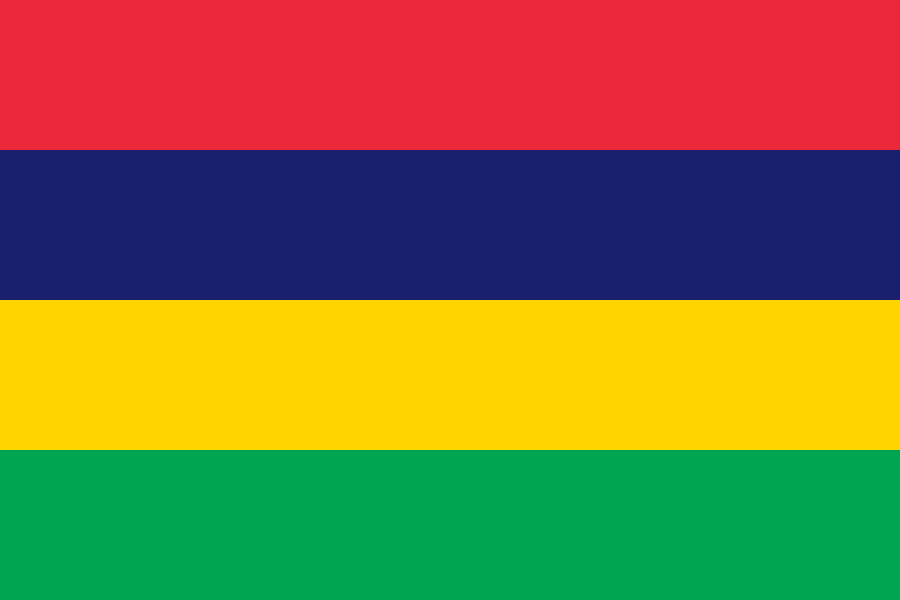
Mauritius is a tropical island in the Indian Ocean where turquoise lagoons are ringed by coral reef and the mountains are wrapped in forest. Indian, Creole, Chinese and French cultures live side by side, producing a distinctive cuisine and atmosphere. The island is unexpectedly affordable: street food for $1, a hire car from $23 a day, and every beach free and open to all.
Where to go
#Port Louis
The capital and main port is where you go for the noisy central market and a walk along the Caudan waterfront. It is a working city rather than a resort, so treat it as a day trip. Most bus routes on the island funnel through here, which makes it useful even if you never stay the night.
Grand Baie
The northern tourist hub, packed with restaurants and the easiest place to arrange boat trips. There is a wide choice of budget accommodation, which is rare on this island. Evenings here are the liveliest you will find outside the capital.
Flic-en-Flac
A west-coast village fronted by an enormous beach and calm, shallow water. The infrastructure is good without being showy, which is why it suits travellers looking for balance between price and comfort. Sunsets from this side of the island are the best on Mauritius.
Mahebourg
The town next to the airport has kept its historic charm and an unhurried pace with no crowds. Come for the feel of old Mauritius, the Monday market and the small waterfront. It also makes a practical first or last night given the airport is minutes away.
Le Morne
A small village at the foot of the famous basalt monolith in the southwest. This is the island's kitesurfing capital, and the beaches here are widely considered the most beautiful on Mauritius. Sunsets under the mountain are the reason half the visitors come.
Curepipe
The island's cool, elevated heart, several degrees fresher than the coast. People come up for the Trou aux Cerfs volcanic crater and for shopping. It is a useful stop if the coastal humidity is wearing you down.
What to see
#Coloured earth: The Chamarel dunes are worth a trip for their seven shifting shades of ochre and violet. To catch the colours at their strongest, come before noon or after four in the afternoon. Midday flattens everything into beige.
Le Morne Brabant: The hike to the top of the rock is the island's signature climb. From the summit you look down on the famous underwater waterfall, an optical illusion created by sand streaming off the shelf. The upper section requires a guide.
Pamplemousses garden: The oldest botanical garden in the southern hemisphere holds giant water lilies and an entire collection of spice trees. It is easy to do in a day and the shaded avenues are a genuine escape from midday heat. Take a guide at the gate if you want the plants explained.
Casela park: A large activity park combining safari drives, zip lines and walk-through enclosures. You can happily fill a whole day here, particularly with children. Book the more popular activities in advance during peak season.
Chamarel waterfall: A thin ribbon of water drops a hundred metres into an emerald gorge. The viewing platform sits right beside the coloured earth, so the two combine into one easy stop. Flow is strongest after rain.
Grand Bassin: A sacred crater lake watched over by an enormous Shiva statue. People come for the living culture as much as the setting, and Hindu ceremonies here are a genuine spectacle. Dress modestly and remove your shoes at the temples.
Prices
#Currency: Everything is priced in Mauritian rupees (MUR). As of 2026 the rate is around fifty rupees to the euro, so mental arithmetic is straightforward.
Exchange: The airport bureaux offer fair rates, which is unusual enough to be worth using. It is often better to change the bulk of your cash the moment you land than to hunt for a bank in a village later. Euros and US dollars both change easily.
Cards: Visa and Mastercard work in supermarkets, petrol stations and larger restaurants; American Express is much less widely accepted. For buses, markets and small shops you need cash. ATMs are common in towns and Wise or Revolut cards work fine in them.
Tipping: Around ten per cent is normal in restaurants when service is not included. In guesthouses and taxis it is entirely at your discretion, and nobody will be offended either way.
Budget: Street food and buses keep daily costs remarkably low for an Indian Ocean island. The big line items are flights and car hire, not the day-to-day, and every beach on the island is free.
| Item | Price (USD) |
|---|---|
| Dhal puri street snack | 0.5 |
| Cafe lunch | 6 |
| Bottle of Phoenix beer | 2 |
| Bottle of rum 0.7l | 12 |
| Bus ride | 0.8 |
| Chamarel entry ticket | 8 |
| Car hire per day | 35 |
| Litre of petrol | 1.4 |
| SIM card with data | 5 |
| Kilo of mangoes | 3 |
| Dodo fridge magnet | 2 |
| Restaurant dinner | 25 |
| Casela park entry | 15 |
| Snorkelling boat trip | 30 |
Getting around
#Buses: The bus network is cheap and covers the whole island, which makes it the backbone of independent travel here. Buy your ticket from the conductor on board, in rupees, and keep small notes handy. Services stop early in the evening, so plan the last leg of any day trip carefully.
Route logistics: Almost everything is routed through Port Louis. Going from the north to the south usually means changing in the capital, and the two main terminals there are a short walk apart. Factor that transfer into any cross-island journey.
Car hire: A car is the ideal way to reach the beaches and viewpoints on your own schedule. Remember that Mauritius drives on the left and that mountain roads are narrow and winding. An automatic gearbox makes the adjustment much easier.
Local rental agencies: Booking through a platform that aggregates small Mauritian rental firms is often cheaper than the international chains and much gentler on the deposit. Read the fuel and insurance terms before you commit.
Taxis: Meters are rare, so agree the fare before you get in. A cross-island run can cost fifty to seventy dollars, which makes taxis a poor choice for long distances but fine for airport transfers.
Boats: Speedboats and catamarans run to Ile aux Cerfs and other offshore islets. You can also negotiate directly with fishermen on the beach, which is cheaper and considerably more atmospheric.
Where to stay
#Guesthouses: Guesthouses are the best way to keep costs down and live at the local pace. Most have a kitchen, which matters if you want to cook rather than eat out twice a day.
Private rentals: Many Mauritians rent out apartments attached to their own villas. Book through an established platform rather than an informal arrangement, so you have some recourse on cleanliness and service.
Location: Move ten minutes' walk back from the beachfront and the price roughly halves. The inland districts are cheaper still, though you will then need a car or the bus to reach the water.
What to expect: Budget accommodation can feel old-fashioned, with oilcloth on the tables or a curtain where you expected a door. Read recent reviews carefully before booking; the photos are frequently optimistic.
Air conditioning: In cheaper rooms the air conditioning remote is sometimes an extra charge. Always clarify this with the owner in advance rather than discovering it at midnight.
Booking: For the December peak, reserve three months out. During the southern winter, roughly June to September, good discounts are easy to find and availability is rarely an issue.
What to eat
#Street food: Start with dhal puri, a soft flatbread rolled around split-pea filling and curry. It costs almost nothing and it is the best thing you will eat on the island. Vendors set up near markets and bus stations.
National dishes: Order rougaille, a spiced tomato stew served with rice and fish, and you have the essence of the local kitchen. Mauritian cooking is a genuine fusion of Indian, Creole, Chinese and French traditions, and dishes can be far spicier than they look. Ask for mild if you are unsure.
Chinese influence: In Port Louis look for boulettes, steamed dumplings served in a rich broth. Chinatown also sells unusual dried and preserved fruits worth trying.
Markets: Buy pineapple, mango and papaya at the central markets, where they are a fraction of hotel prices. The same stalls sell smoked marlin fillet, a local delicacy that travels well as a gift.
Drinks: Phoenix beer and Mauritian rum are inexpensive in supermarkets. The Chamarel distillery runs tastings of its better bottlings and is easy to combine with the coloured earth and waterfall.
Breakfast: Guesthouse owners often serve homemade Creole pastries and preserves. It is the cheapest possible way to eat authentically, and usually the friendliest hour of the day.
Safety
#Overall: Mauritius is an unusually calm place to travel. The main risk is petty theft, so never leave a wallet or phone unattended on the beach while you swim.
Sun: Tropical sun here is fierce and will burn you through cloud cover. Use factor fifty and reapply after every swim, particularly on boat trips where there is no shade.
The ocean: Inside the reef the water is safe and calm; beyond it currents are strong. Watch the flags on managed beaches and avoid swimming far out at wild ones where nobody is watching.
Marine life: Sea urchins and sharp coral are common on the seabed. Reef shoes are not a luxury item here, they are basic equipment.
Driving: Get used to looking right first, because traffic drives on the left. The mountain roads are narrow with blind bends, so keep speeds down and expect buses to take their half out of the middle.
Cyclones: Between January and March storms and heavy rain are possible, occasionally severe. Local forecasts are accurate and warnings are taken seriously; follow them and check your own government's travel advisory before you fly.
Etiquette and culture
#Diversity: Hinduism, Islam and Christianity coexist peacefully on the island. You will regularly see a mosque, a cathedral and a brightly painted Tamil temple within a few streets of each other.
Temples: Enter any place of worship with shoulders and knees covered. Take your shoes off before going into Hindu shrines, and follow whatever the people ahead of you are doing.
Festivals: Maha Shivaratri brings an enormous pilgrimage to Grand Bassin, with roads across the island filled by people walking in white. If your visit coincides, expect traffic and go and watch anyway.
Sega music: This rhythmic dance with African roots turns up on beaches and at hotel evenings. It is a symbol of freedom and joy in Mauritian culture and the live version is far better than the staged one.
The dodo: The extinct bird has become the national symbol and brand. Souvenirs bearing it fill every shop in Port Louis, and the skeleton in the Natural History Museum is the real thing worth seeing.
Towards visitors: Mauritians are welcoming and genuinely helpful, and independent travellers are treated with interest rather than suspicion. English works everywhere, so asking for directions is easy.
Connectivity
#Local SIM: Buy a My.t or Emtel SIM in the arrivals hall as soon as you land. Data packages cost very little and the service is reliable across the island.
eSIM: If you would rather arrive already connected, eSIM providers such as Airalo cover Mauritius and activate on landing. A local SIM is cheaper for stays over a week, but the eSIM saves you the counter queue.
Languages: English is the official language, though you will hear Creole and French far more often. Anyone in tourism will understand all three, and English is what road signs and menus use.
Coverage: 4G reaches almost everywhere, including remote beaches and mountain trails. Guesthouse Wi-Fi is usually free but the speed can be mediocre, so a data bundle is worth having.
Navigation: Google Maps handles both driving and bus routes well here, showing route numbers and arrival times accurately. Download the island offline anyway before you leave the airport.
Messaging: WhatsApp is how everything gets arranged with hosts, drivers and rental agencies. Nothing is blocked or filtered, so staying in touch with home is straightforward.
Phrasebook
#| English | Mauritian Creole | Pronunciation |
|---|---|---|
| Hello | Bonzour | bon-ZOOR |
| Thank you | Mersi | mer-SEE |
| How are you? | Ki maniere? | kee man-YAIR |
| All good | Korek | ko-REK |
| How much is it? | Komien sa koute? | kom-YEN sa koo-TAY |
| That's expensive | Sa ser | sa SER |
| Give me a discount | Donn enn ti rabe | don en tee ra-BAY |
| Where is the beach? | Kot laplaz? | kot la-PLAZ |
| I'm thirsty | Mo swaf | mo SWAHF |
| Beer | Labier | la-BYAIR |
| It's tasty | Bon sa | bon SA |
| Help me | Ed mwa | ed MWA |
| Friend | Kamarad | ka-ma-RAD |
| Yes | Wi | wee |
| No | Non | nong |
| Food | Manze | man-ZAY |
| Small / a little | Tipti | teep-TEE |
| Goodbye | Salam | sa-LAM |
| OK / got it (slang) | Ayo | AH-yo |
| No problem | Pa ena problem | pa e-NA prob-LEM |
| Beautiful | Zoli | zo-LEE |
| Let's go | Ale | a-LAY |
Good to know
#Drinking water: Skip the tap and buy five-litre bottles instead. They cost very little in supermarkets and refilling from them saves a pile of small plastic.
Sockets: The island uses both British type G and European type C outlets, sometimes in the same room. A universal adapter is the easiest solution and is worth packing before you leave.
Opening hours: Most markets and town shops shut by three or four in the afternoon. Do your shopping in the first half of the day and plan evening meals around restaurants instead.
Kit: Bring reef shoes for the sea urchins. On a lot of beaches getting into the water without them is genuinely painful, and they cost more locally than at home.
Consular help: Several countries maintain embassies or high commissions around Port Louis and Floreal, and others cover Mauritius from Pretoria or New Delhi. Look up who represents your passport and save the number before you travel.
Insect repellent: Mosquitoes are numerous in forested areas and near waterfalls. Local repellents work better than most imported ones, so buy a bottle at a pharmacy when you arrive.
Frequently asked questions
#Many Western passports receive a free visa on arrival for stays of up to sixty days, but you should check your own passport's rules before booking. Everyone needs to complete the online All-in-One arrival form before landing. You will also be asked for a return ticket and proof of accommodation.
May to December is the most comfortable stretch, dry and warm without being oppressive. From January to March it is hotter and much more humid, with tropical downpours and the possibility of cyclones. The water stays swimmable all year.
The cheapest option is bus 198, which runs towards Port Louis via Mahebourg. Note that drivers may refuse large suitcases, in which case a taxi is the fallback. Airport transfers arranged by guesthouses are usually cheaper than a taxi taken on the spot.
It can be very affordable if you eat street food and use the buses. The heavy costs are flights and car hire, while beaches are free everywhere on the island and markets are cheap. Sticking to guesthouses rather than resorts changes the budget completely.
Most people adapt within a day; the trick is to slow down and pay attention at junctions. Renting an automatic removes one thing to think about. The narrow mountain roads demand more concentration than the left-hand driving does.
English is official and understood by anyone working in tourism, so you will never be stuck. Between themselves Mauritians speak Creole and French, and a couple of phrases in Creole go a long way socially. Signs and menus are generally in English or French.
Local rum is excellent value and makes a good souvenir straight from an ordinary supermarket. Chamarel and New Grove are the names to look for, both distilled on the island from local cane. The Chamarel distillery runs tastings if you want to compare before buying.
Connectivity is excellent, with 4G reaching even the mountains. Buy a My.t SIM at the airport or in town and you will have fast, cheap data for the whole trip. Guesthouse Wi-Fi exists everywhere but is slower than mobile data.
Yes, but with restrictions. Registration is mandatory for a drone of any weight. You need to register the drone with the DCA and hold a foreign pilot licence. Rules for other countries are in the drone ranking by country.
No — your national licence is accepted for a car. Traffic drives on the left. Car rental starts at 23. National licences are accepted and traffic drives on the left. Rules for other countries are in the driving and rental table.
You can rent a bike and your national licence is enough. Crucially, your licence must include category A. Category B is not enough — this is what catches most riders out. A helmet is compulsory. Bike rental usually starts at 18. Rules for other countries are in the driving and rental table.
Middling: tourist areas are calm, but some districts are best avoided. Intentional homicides: 2.675 per 100,000 a year (UNODC, 2024 data). The general emergency number is 999. Ratings for other countries are in the safety table.
Updated
The data on this page goes out of date. Visa rules and permitted stays, border requirements, prices and budgets, transport and local conditions all change fast, and we do not re-check every page every day. We show the date of our last check where we have one, but before you travel, verify with official sources: the country’s consulate, its immigration service, its e-visa portal and your carrier.