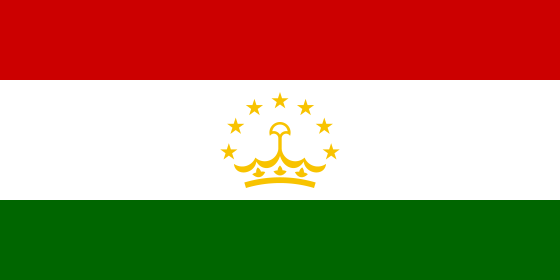
Tajikistan
TJA mountain country where 93% of the land is upland — the Pamir, the Fann mountains and the western spurs of the Tian Shan. The Pamir Highway is one of the great roads of the world, crossing passes above 4,000 m within sight of seven-thousanders. The Fann mountains offer turquoise lakes among the rock and trekking without crowds or queues. Tajikistan is the cheapest country in Central Asia, and Russian is understood almost everywhere.
Where to go #
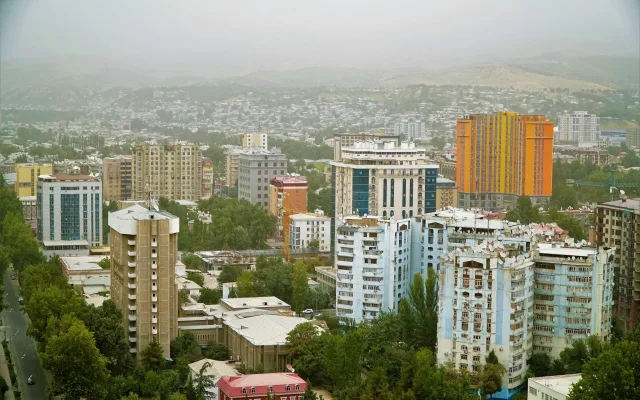
Dushanbe
The capital of Tajikistan: Rudaki Avenue, the Museum of Antiquities with its sleeping Buddha, and the gateway to the Pamirs.
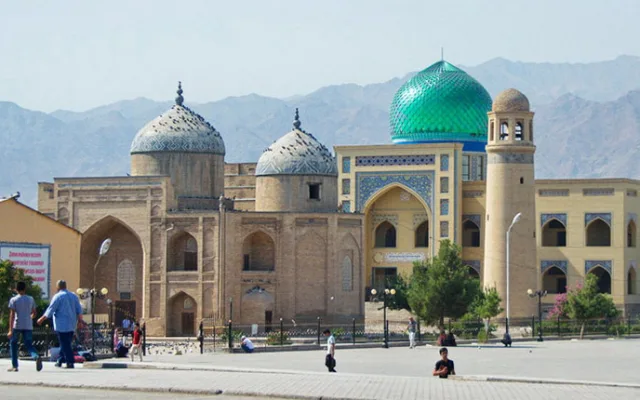
Khujand
Tajikistan's second city, on the Syr Darya — the fortress on the site of Alexandria Eschate and the Panjshanbe bazaar.
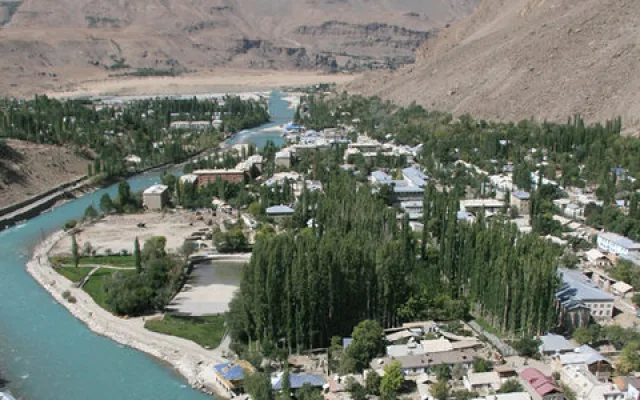
Khorog
Khorog is the capital of Tajikistan's Pamirs, on the Panj at the Afghan border, and the main base on the Pamir Highway.
What to see #
The Pamir Highway: The legendary M41 is what most people actually come for. The road crosses passes above 4000 metres with views to the seven-thousanders of the Hindu Kush and Afghan villages across the Panj river.
Iskanderkul: The jewel of the Fann Mountains, and close enough to do as a day trip from the capital. Turquoise water ringed by cliffs and the five-metre "Fann Niagara" waterfall impress even seasoned hikers.
The Wakhan Valley: Where to go for history, with the ruins of the Yamchun and Kaakha fortresses still standing above the valley. The Bibi Fatima hot springs, famous for their supposed healing properties, are right there too.
Hisor Fortress: What to see near Dushanbe without a long drive. The restored gate and old madrasa give a sense of medieval regional architecture, though the reconstruction is heavy-handed in places.
The Fann Mountains: A trekking paradise with the Alaudin and Kulikalon lakes at its heart. Give it a week and you can walk trails among glaciers with none of the crowds you would meet in Nepal.
The Seven Lakes: A chain of differently coloured lakes in the Shing valley near Panjakent. You can see all seven in a day, climbing from the turquoise first one up to the highest and coldest.
Prices #
Currency: The somoni (TJS) is the only currency used inside the country. Change money at banks or licensed exchange offices rather than anywhere else.
What to bring: Crisp US dollars or euros are the easiest to exchange. Rates in Dushanbe and Khujand are perfectly fair, but beyond Khorog finding a bank to change anything becomes close to impossible.
Cards: Card acceptance is thin. Visa and Mastercard work at some hotels and larger supermarkets in Dushanbe and Khujand, and essentially nowhere else. A Wise or Revolut card is useful for the occasional ATM in the capital, no more.
Cash: Always carry a reserve of somoni notes. On the Pamirs and in the Fann Mountains a bank card is a piece of plastic and there is no cash machine for hundreds of kilometres.
Tipping: Not a strong local custom, though rounding up in a city cafe is welcome. Drivers and guides on a multi-day Pamir trip do expect something at the end.
| Item | Price (USD) |
|---|---|
| Plov in a simple chaikhana | 2.50 |
| Dinner for two in a cafe | 12.00 |
| Street samsa | 0.40 |
| Tandoor flatbread | 0.25 |
| Litre of petrol | 0.95 |
| Dorm bed in Dushanbe | 10.00 |
| Pamir guesthouse with meals | 18.00 |
| Hotel room in Dushanbe | 45.00 |
| Minimum city taxi fare | 1.20 |
| Shared taxi to Khujand | 9.00 |
| Coffee in the capital | 2.00 |
| Water 1.5 l | 0.35 |
| Local beer 0.5 l | 1.10 |
| SIM card with data | 8.00 |
| Trolleybus ride | 0.15 |
Getting around #
Getting there: Dushanbe is served through Istanbul on Turkish Airlines and through Dubai on flydubai, with useful regional links from Almaty and Tashkent. From Europe or North America you will connect at least once, and Istanbul is generally the smoothest option.
Shared taxis: These are the fastest way between towns. Cars leave from designated stands once all four to seven seats are sold, and you simply turn up and wait.
Domestic flights: Somon Air links Dushanbe with Khujand and Konibodom. Flights to Khorog exist but are frequently cancelled because of mountain weather and poor visibility.
City taxis: Yandex Go works well in the capital and rides cost very little. The cars are modern and often electric, which makes the ride quiet as well as cheap.
Pamir transport: Old 4x4s work the Highway. If you are travelling alone, be ready to wait hours or even days for a vehicle to fill on remote stretches.
Car hire: Renting without a driver for the mountains is effectively impossible. Most agencies permit sealed roads only and insist on a local driver for anything Pamir-bound.
Buses: The larger cities run trolleybuses and modern buses. You pay with a transport card bought from a terminal at the stop or from the driver.
Where to stay #
City hotels: Dushanbe and Khujand offer everything from ostentatious five-stars to modest guesthouses. Service rarely matches the star rating, but staff genuinely try to help with anything you ask.
Pamir guesthouses: In villages along the Highway this is the only option, and a good one. You stay in an ordinary home, sleep on traditional kurpacha mattresses on the floor and eat with the family.
Yurts: On the high plateau around Murghab and Karakul lake you can sleep in genuine Kyrgyz yurts. It is spartan and there is no electricity, but the atmosphere is unmatched.
Booking: Booking.com covers the capital adequately, but on the Pamirs it is replaced by messaging apps. Contact owners in advance, or simply find a bed on the spot on your driver's recommendation.
Facilities: In cheap guesthouses the toilet and shower are often outside. In winter rooms can be cold, since houses are heated by wood or dung stoves.
Prices: Mountain accommodation usually includes breakfast and dinner in the rate. Do not hesitate to negotiate if you are staying several nights or arriving as a group in low season.
What to eat #
Plov: The king of the local table, cooked differently in every region. Thursdays and Sundays are traditional plov days, and the best batches in popular chaikhanas are gone by one in the afternoon.
Qurutob: The most distinctive dish in the country: torn layers of flatbread soaked in a thick sauce of soured qurut cheese. It arrives in a big wooden bowl topped with fried onion and fresh herbs.
Shirchoi: A Pamiri drink built for high altitude, made of strong tea with milk, butter and salt. It sounds odd and it genuinely works, warming you up and keeping you going in the mountains.
Hygiene: Wash your hands before eating and carry sanitiser. Provincial cafes treat sanitary standards loosely, which is the usual cause of an upset stomach here.
Meat: Mutton and beef dominate the menu, often on the fatty side. Around Murghab you should try yak, which is denser and has a distinctive but very pleasant flavour.
Tea: Green tea accompanies every meal and comes in small bowls. It is good manners not to fill the bowl completely, since the host is signalling that he wants you to stay longer.
Safety #
Overall: The country has low crime and a genuine warmth towards visitors. You can walk around the cities in the evening without worrying about yourself or your belongings.
Altitude sickness: On the Pamirs you will be above 4000 metres. Gain height gradually, drink far more water than feels necessary and carry altitude medication so a bad headache does not wreck the trip.
Roads: Mountain switchbacks have no barriers and rockfall is routine after rain. Leave the driving to experienced local drivers who know every dangerous bend on the Highway.
Borders: Stay away from the Afghan border zones outside established tourist routes. Photographing border posts and soldiers is strictly forbidden and will get your images deleted or worse.
Water: Do not drink from the tap in the cities. Buy bottled water and wash market fruit and vegetables thoroughly to avoid stomach infections.
Signal: Mobile coverage disappears in the mountains for long stretches. Download offline maps and warn people at home that you may be unreachable for days on the Highway. Check your own government's travel advisory before you go.
Etiquette and culture #
Hospitality: Mehmonnavozi underpins everything here. You may be invited in for tea by someone you just met in the street, and refusing a first invitation reads as disrespect.
Religion: Tajikistan is moderately Muslim. Dushanbe and Khujand are largely secular, but cover shoulders and knees for mosques and in rural districts.
Pamiris: The people of Badakhshan stand apart in language, appearance and faith, being Ismaili. They are notably open, often invite travellers into their homes, and will happily talk about their traditions and the Aga Khan.
Navruz: The 21 March new year is celebrated on an enormous scale. Everyone comes out into the streets, sumanak is cooked from sprouted wheat and the horseback game of buzkashi is played.
Etiquette: Take your shoes off entering a home or a mosque. Pass objects and food with the right hand only, since the left is traditionally considered unclean.
Photography: Always ask before photographing people, especially women. Most agree readily, but asking first opens far more doors than it closes.
Connectivity #
Language: English is rare outside the capital's tourist businesses, and there are few signs or menus in it. Russian is the working lingua franca and is understood almost everywhere, particularly by older people, so a translation app with Russian and Tajik downloaded is genuinely useful.
SIM cards: The main operators are Tcell, Megafon Tajikistan and Babilon. You can buy at the airport or in a phone shop, and you will need your passport and your registration document.
Mobile internet: 4G is excellent in the larger cities, but in the mountains it drops to 2G or vanishes. Some sites are blocked, so a VPN installed before you arrive is worth having.
Tariffs: Data is cheap, with 10 to 15 dollars buying a generous monthly allowance. Tcell is generally reckoned to have the best coverage in hard-to-reach mountain districts.
IMEI registration: If you intend to use a local SIM for more than 30 days, your handset must be registered in the state IMEI system or the slot gets blocked.
Messaging: WhatsApp and Telegram are how you reach drivers and guesthouse owners. Almost every tourist contact in the country runs through one of the two.
Phrasebook #
| English | Tajik | Pronunciation |
|---|---|---|
| Hello | Assalomu alaykum | as-sa-LO-mu a-lay-KUM |
| Thank you | Rahmat | rah-MAT |
| How are you? | Chi kheled? | chee khe-LED |
| Good | Khub | khoob |
| How much is it? | Chand pul ast? | chand pool ast |
| That's expensive | Garon ast | ga-RON ast |
| Give me a discount | Arzon kuned | ar-ZON koo-NED |
| Brother, mate | Aka | a-KA |
| Guest | Mehmon | meh-MON |
| Please | Marhamat | mar-ha-MAT |
| Bread | Non | non |
| Water | Ob | ob |
| Very tasty | Bisyor bamaza | bis-YOR ba-ma-ZA |
| Where is...? | ...dar kujost? | dar koo-JOST |
| Straight ahead | Turri | toor-REE |
| Left | Chap | chap |
| Right | Rost | rost |
| Help me | Kumak kuned | koo-MAK koo-NED |
| Goodbye | Khayr | khayr |
| I don't understand | Man namefahmam | man na-me-fah-MAM |
| No problem (slang) | Soz | soz |
Good to know #
Consular help: Few countries keep a mission in Dushanbe, and many cover Tajikistan from Tashkent or Astana. Find out which applies to your passport and save the number offline, since mountain signal is unreliable.
Maps: Download Maps.me or OsmAnd before you go. Both know the mountain tracks and small Pamir villages, where Google Maps often shows nothing but blank space.
Medical kit: Alongside the basics, bring rehydration salts, digestive enzymes and something for altitude sickness. Specific medicines are simply unavailable in mountain pharmacies.
Power: In remote Pamir districts electricity runs on a generator schedule, a few hours a day. A large power bank keeps you from being caught with a dead phone.
Clothing: Even in summer, night temperatures in the mountains drop to freezing. Layers are the answer: a light shirt for the valleys and a fleece plus a windproof shell for the passes.
Small gifts: Bring sweets or small souvenirs from home. It is a good way to thank a host for their hospitality or to make friends with children in high mountain villages.