Города и дороги
Description
White travertine terraces built up by hot springs, with ancient Hierapolis on the plateau above them: a Roman theatre, the largest necropolis in Anatolia and a pool full of fallen marble columns.
Wiki
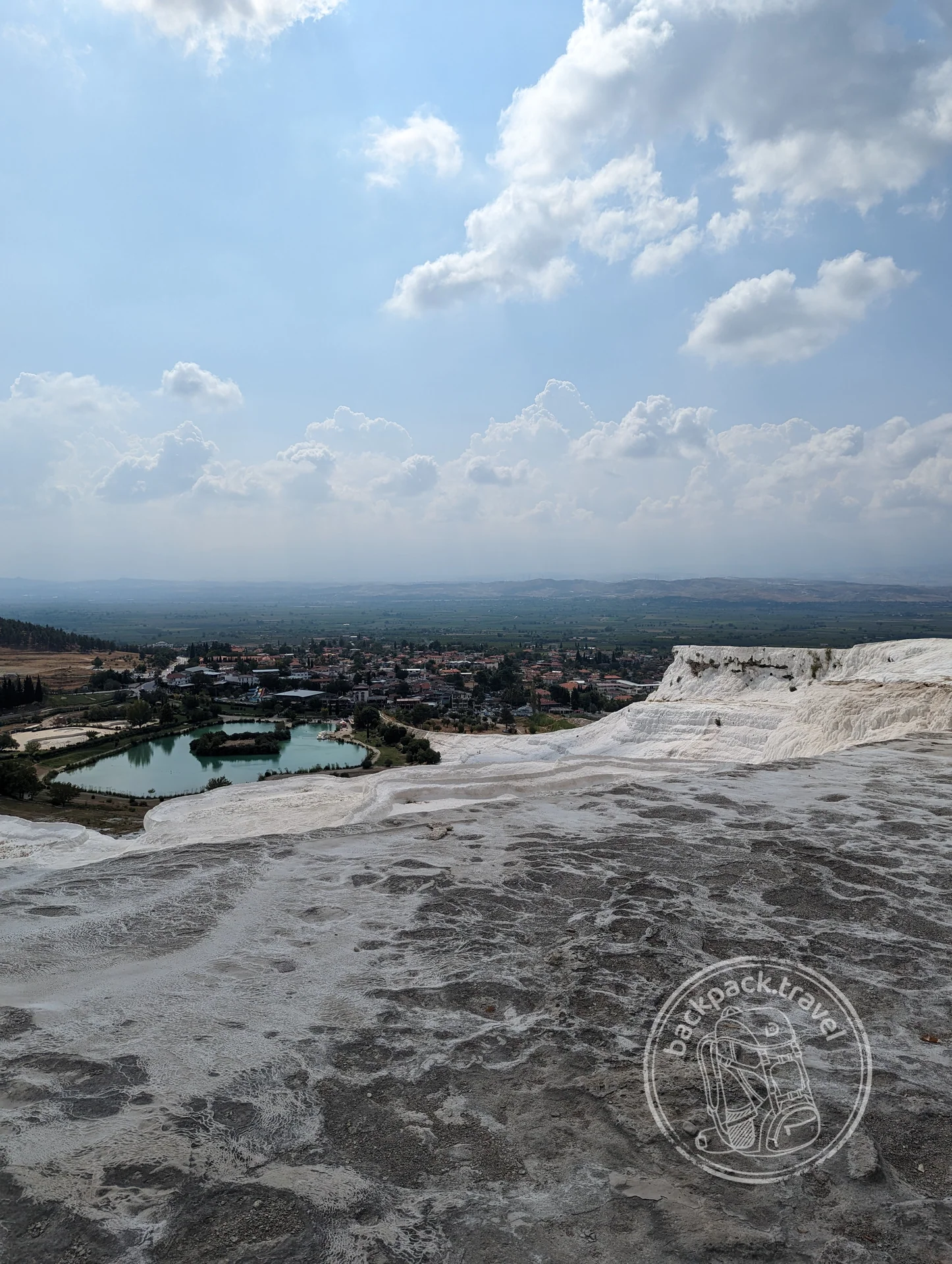
Pamukkale is a small village eighteen kilometres north of Denizli that lives entirely off the white slope it stands beneath. The name means "cotton castle": from the valley floor the terraces do look like drifts of snow. What forms them is travertine, deposited by hot springs rich in calcium: the water surfaces on the plateau at around thirty-five degrees, loses its carbon dioxide and leaves lime behind, layer by layer. On top, directly above the terraces, lies ancient Hierapolis, a spa city founded in the second century BC. The travertines and Hierapolis were inscribed by UNESCO as a single site in 1988. The village has only a couple of thousand permanent residents.
Why come and what to actually see
The terraces are crossed by one marked path, and only barefoot: shoes scratch the lime, so you carry them. The water in the basins is ankle-deep, warm in places, and the bottom is slippery. The climb from the lower gate takes about twenty minutes and is better done from the bottom up — that way the white opens gradually, whereas coming down you are walking towards the valley.
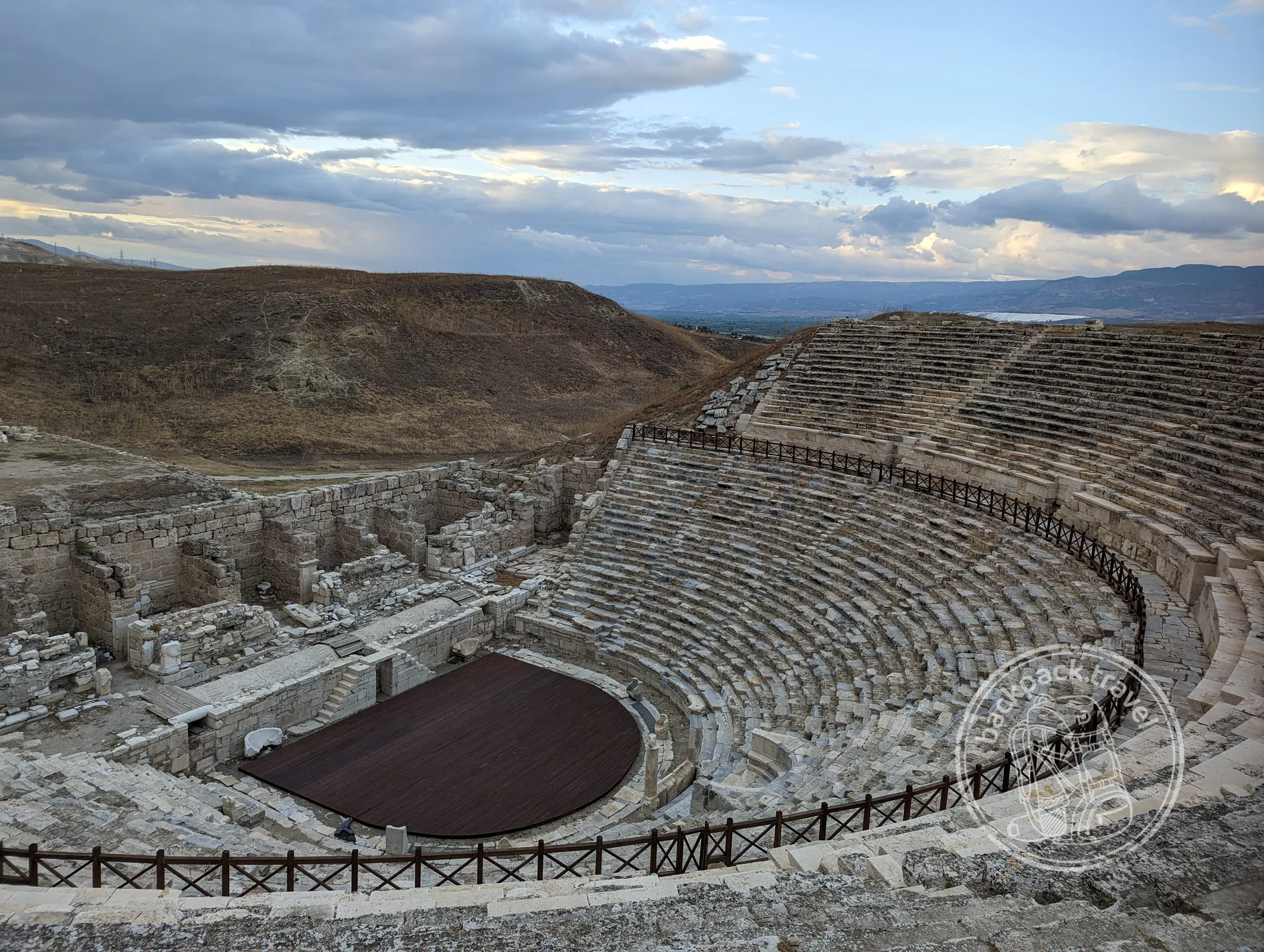
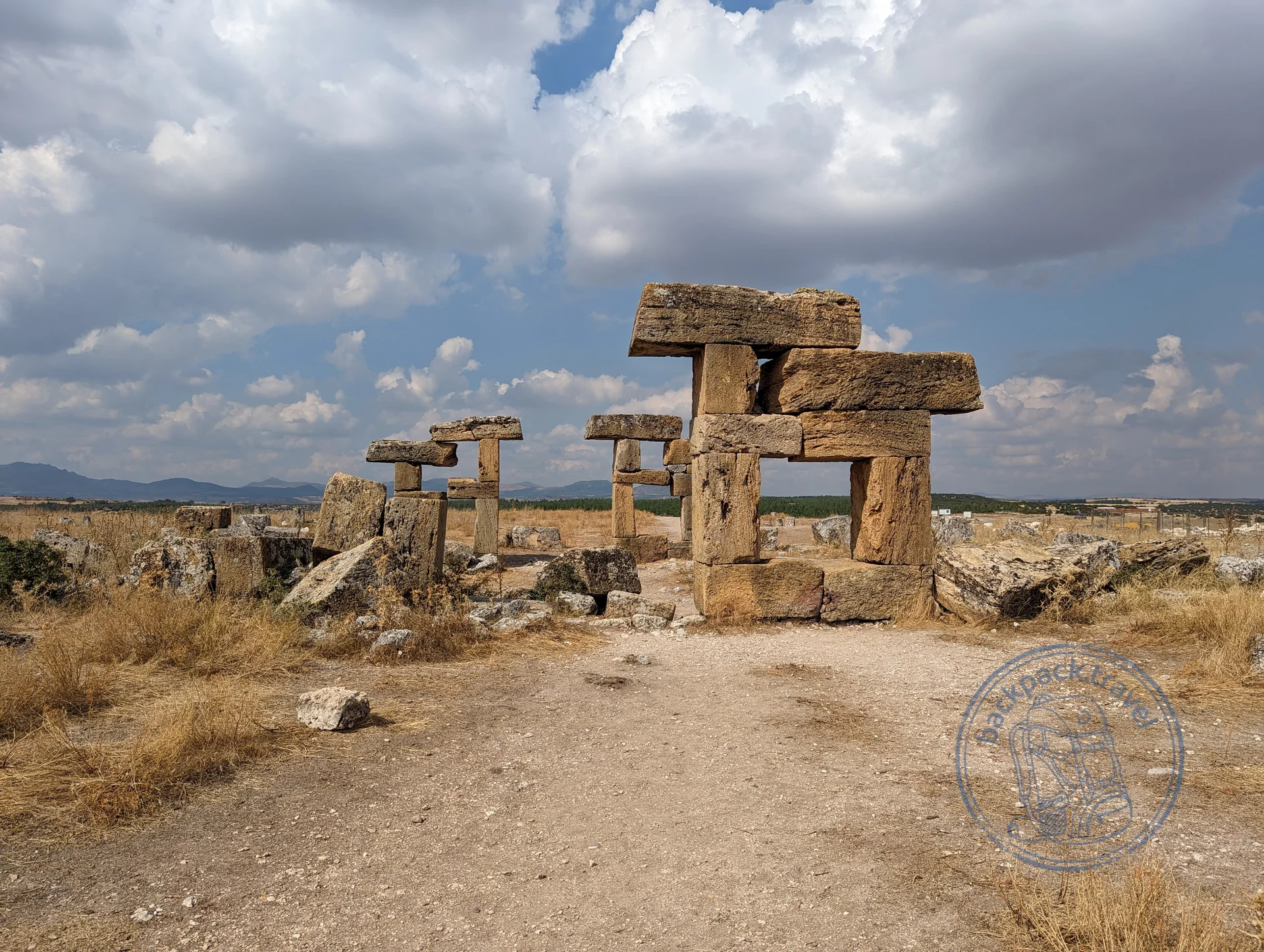
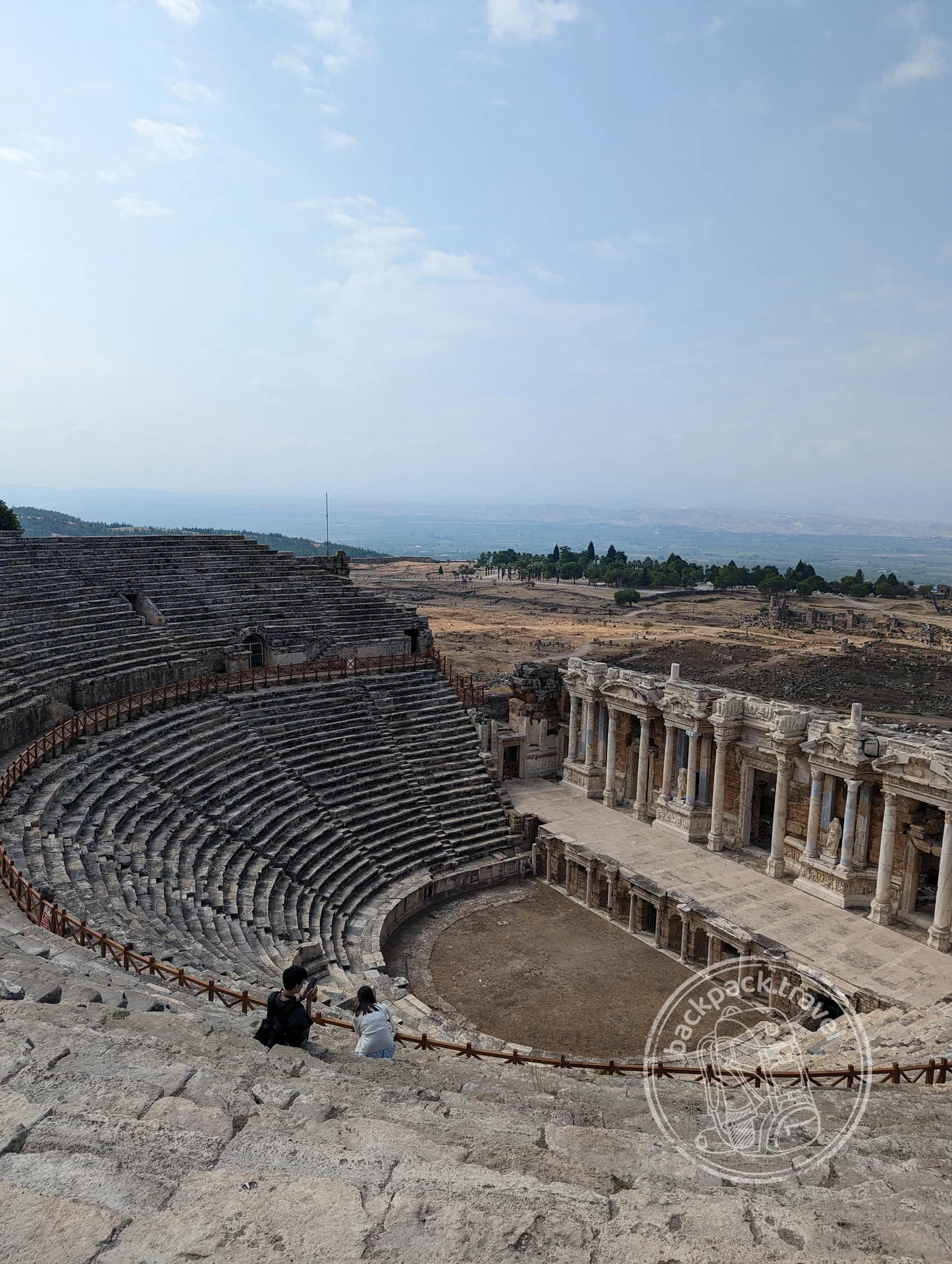
Hierapolis on the plateau turns out larger than people expect: the city runs for several kilometres. The second-century theatre, with its stage building and reliefs intact, was rebuilt under Septimius Severus and remains the finest structure on the site. The necropolis by the north entrance is the largest in Anatolia, with around twelve hundred tombs of various types, from plain sarcophagi to round tumuli; people came here to be cured, and some of them stayed.
The Plutonium, the gate of Hades, is a small grotto beside the temple of Apollo that seeps carbon dioxide. Ancient authors described priests leading animals into it and the animals dropping dead; modern measurements confirm that the gas concentration at ground level is lethal. The opening is now closed off by a grille.
On the hilltop stands the martyrium of the apostle Philip, an octagonal fifth-century building; his tomb was found next to it in 2011. Operating separately is the ancient pool with marble columns lying in it — they came down in a seventh-century earthquake, and swimming among them costs extra.
Getting there and getting around
The nearest city is Denizli, from where dolmuşes run every twenty minutes and reach the village square in half an hour. Çardak airport is eighty kilometres away, with buses timed to the flights.
Long-distance buses arrive in Denizli: about four hours from İzmir, the same from Antalya, an overnight run from Istanbul. From İzmir there is also a train.
The site has three entrances. The lower one, in the village itself, leads straight onto the terraces. The south and north gates are up on the plateau, with car parks, and make a convenient start for anyone driving. From the north gate to the lower one is about four kilometres on foot across the whole of Hierapolis, which is worth taking into account.
Where to stay
Staying in Pamukkale itself makes sense: guesthouses sit a couple of steps from the lower entrance, many with thermal-water pools and a view of the white slope. The standard is simple and family-run, and prices are low.
Karahayıt, five kilometres to the north, is the second option: its springs are not white but rust-red from iron, and large thermal hotels there run treatment programmes. That is a different kind of stay, over several days.
The main argument for spending the night is the time of day. The tour buses arrive around midday, while in the early morning and at sunset the terraces are nearly empty.
Day trips
Laodicea, twenty kilometres away, is a large excavated city with two theatres and a stadium, one of the seven churches of Revelation. Akhan, a Seljuk caravanserai of 1253, stands on the same road.
Kaklık cave, thirty kilometres out, repeats the travertine forms underground. Further on, towards Aydın, lie Aphrodisias, with an almost intact stadium seating thirty thousand, and Nysa; Aphrodisias is about an hour and a half away and makes a full trip in its own right.
When to come
April, May, September and October give the best combination: the terraces are warm, the air is not yet or no longer baking, and Hierapolis can be walked all day. In summer the plateau holds above thirty-five degrees, with no shade either on the terraces or among the ruins, and it is sensible to split the visit between early morning and evening.
In winter the village empties and the water in the basins feels cold, but the white against a grey sky looks striking, and fog often sits over the valley. Snow does fall on the terraces and does them no harm.
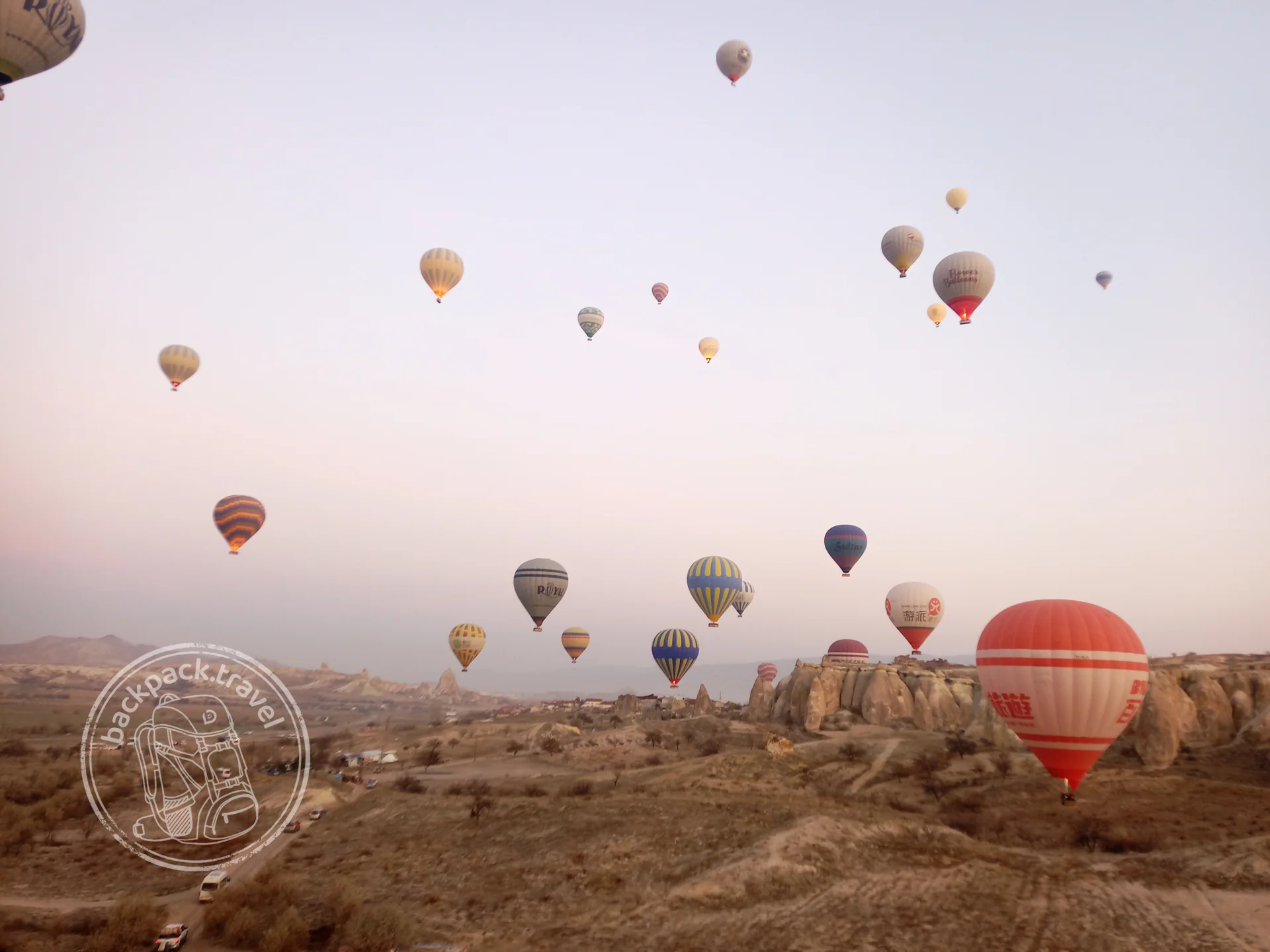
Balloons are a separate matter: they go up at dawn during the warm season and depend on the wind.
Food and money
The food here is simple and aimed at visitors: guesthouses serve breakfast with village cheese, olives and jam, and in the evening home-made güveç and mantı. Pamukkale has no speciality of its own; the cooking is the valley's — Denizli kebab, pide, vegetable meze.
It is worth carrying cash: some of the small guesthouses and shops do not take cards, and the dolmuş is paid for in coins and notes.
What to know
The terraces are walked barefoot and only along the marked path; stepping off it is not allowed, as the lime is fragile. The surface is slippery and falls are common, so go slowly.
There is less water in the basins than in older photographs: the flow is distributed between sections and parts of the terraces are periodically dried out to restore the white. In the 1990s the hotels that stood directly on the slope were demolished to save it, and that worked.
Sunlight reflected off the white hits harder than usual, so a hat and sunglasses are needed even on a cool day. One ticket covers the terraces and Hierapolis; the ancient pool is paid for separately.
Updated